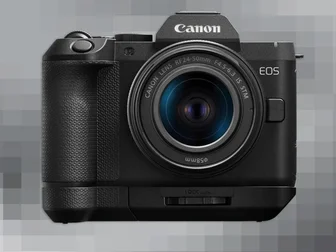
Canon finally puts IBIS in the small full-frame body
Canon just announced the EOS R8 Mark II, and the headline for me isn't 40fps or the retro styling — it's that this 1.2-pound, $1,899 body finally has in-body stabilization. The original R8 from 2023 shared its sensor with the R6 Mark II but skipped IBIS to stay small. Three years later, Canon figured out how to add a 5-axis IBIS unit without breaking the body weight, and the R8 II lands as what Canon calls the lightest EOS body with IBIS to date at approximately 546g with battery and card.
Honestly? That's the gap that mattered. Every time I picked up the original R8 I liked the size and hated the wobble at 1/15s. I shoot a lot of handheld street stuff with my GH7 and the 12-40mm, and the in-body stabilization is what lets me skip a gimbal. Canon's pitch on the R8 II — Coordinated Control IS combining in-body and lens stabilization, plus Peripheral Coordinated Control for edge sharpness on wide-angles — is the actual reason someone shopping for a compact full-frame body in 2026 should care.
What changed vs. the original R8
Same 24.2MP full-frame sensor and the same Digic X processor as the original, Canon confirmed. Burst jumps from 6 fps mechanical to 40 fps electronic, with a new pre-continuous shooting mode that buffers up to 20 frames before you finish pressing the shutter. Canon cites 58% longer JPEG bursts and 30% longer RAW bursts than the 2023 model.
Autofocus gets Dual Pixel CMOS AF II with subject detection for people, animals, and vehicles, plus a Register People Priority mode that locks onto specific faces. That's basically the AF system from the R6 Mark II and the R5 Mark II trickling down — which, frankly, is what should've been in the original R8 from day one.
The body adds a multi-controller joystick that the original R8 didn't have, which is a real ergonomic win for anyone who shoots AF point selection constantly. Card slot is still single SD (UHS-II), battery still LP-E17, so your existing R8 batteries and cards carry over.
Video gets a serious bump
Video is where the R8 II stops looking like a stills-first entry body. Uncropped 6K-oversampled 4K at 60p with 10-bit 4:2:2 internal recording across XF-HEVC S and XF-AVC S codecs. Uncropped Full HD up to 180fps for slow motion. Audio at all frame rates, plus Canon's new Filmtone color profiles for both stills and video.
I will say it: this is more compelling than the spec sheet suggests. A 1.2-pound full-frame body that shoots 4K60 oversampled and 1080p180, with full subject-detect AF, at $1,899 — that's a hybrid body, not a stills camera that happens to record video. If Canon had launched this in 2022 instead of the original R8, the R8 II would've eaten a lot of Sony A7C II sales.
The retro thing
Canon is leaning hard on the EOS 650 SLR styling — silver-top, black-body two-tone look. Engadget's Steve Dent noted that the R8 II borrows design cues from the 1989 EOS 650, and I'll be honest, I think it works. The R8 II isn't trying to be a Fuji X-T5 retro throwback — it's a working photographer's camera with a little bit of personality. The silver top is plastic, not metal, but it doesn't read cheap in the press shots.

Pricing and what you get
Body only: $1,899 USD. Kit with the RF 24-50mm f/4.5-6.3 IS STM: $2,099 USD. Both ship in late October 2026. Two accessories launched alongside: the EG-E2 Extension Grip ($99.99) for users with larger hands or heavier lenses, and the Speedlite EL-5 Ver.2 flash ($379) with extended wireless range over the original EL-5.
Canon also released a free Windows app called Dual Pixel 3D Converter that generates 3D photos, 3D models, and 3D video from Dual Pixel RAW files or depth-tagged JPEGs captured on the R8 II. Cool demo, unclear real-world use for most photographers.
My take
I haven't held an R8 II yet — Canon hasn't shipped review units this far ahead of the late-October launch — so I'm working off the press kit and Canon Rumors' coverage plus Erik Naso's full spec breakdown on Newsshooter. The spec sheet is solid for the price, but three things will decide whether this body is worth $1,899.
First, real-world IBIS performance at telephoto. Canon rates up to 7.5 stops with coordinated IS, but the 24-50mm STM is the kit lens and won't push that. Real testing matters.
Second, autofocus tracking of non-human subjects in video. Canon claims cinema-grade AF on the R8 II but the original R8 was mediocre for video AF. The Mark II processor is the same, so I want to see actual clips.
Third — and this is the personal one — whether the R8 II eats into Sony's compact full-frame market or just splits Canon users who want to step up from the original R8 without paying R6 Mark II money. My guess: it does the second thing well and the first thing modestly. Sony A7C II is still smaller and lighter, but the R8 II has IBIS, 4K60 oversampled, and a $400 lower price. That's a real fight.
Speculation, not fact: I bet we'll see an R8 II V or R8 II Mark II in 2027 with the stacked sensor trickling down. For now, the R8 II is the most interesting sub-$2,000 full-frame body Canon has shipped in years — and the only one I'd actually consider over my GH7 for a trip where I want full-frame look without the weight.