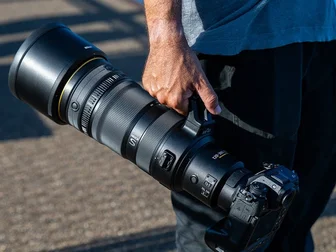
Nikon announced the NIKKOR Z 120-300mm f/2.8 TC VR S this morning, and the number that jumped out at me wasn't the price. It was the weight.
2,735 grams. About six pounds. That is a constant f/2.8 telephoto zoom with a 1.4x teleconverter built into the barrel, and Nikon shaved roughly 515 grams off the F-mount lens it replaces. The NIKKOR AF-S 120-300mm f/2.8E FL ED SR VR weighed 3,250g. The new Z-mount version is 515g lighter than that, while also being faster in the only sense that matters for a working pro: you don't have to unscrew an external 1.4x converter in the rain to get to 420mm.
Nikon is calling it the world's first zoom lens with a constant f/2.8 maximum aperture and a built-in 1.4x teleconverter — a claim the company scopes to interchangeable zoom lenses announced as of October 29, 2026, based on its own research. That's a mouthful, but the pitch underneath it is simple: one lens covering 120-300mm natively and 168-420mm with a switch, at f/2.8 and f/4.
Here is what Nikon actually published, what it left out, and what I'd want to know before this thing lands in November.
The spec sheet, straight from Nikon's own page
The full specifications are on Nikon's product page now, which is a change from the five months this lens spent in development limbo. Thirty elements in 24 groups. The special glass list is one each of ED, fluorite, short-wavelength refractive, Super ED, and aspherical element, plus Meso Amorphous Coat and ARNEO Coat. Minimum focus distance runs from 0.98m at the 120mm end to 2m at 300mm. Filter size is 112mm at the front, and the rear takes 46mm slip-in filters. Zoom ratio is 2.5x. Minimum aperture f/32.
Vibration compensation is rated at up to 6.5 stops, and that figure only lands if you pair it with a body that supports Synchro VR. It's internal focus with an internal zoom, so the barrel length doesn't change as you focus or zoom, which is the thing that makes a lens like this usable on a monopod without constantly re-centering it.
Autofocus is driven by Nikon's Silky Swift voice coil motor. Nikon says the system is designed for fast, precise and smooth focusing on moving subjects, and it claims minimum focus breathing. I haven't tested any of that, so I'll leave it where it is.
The physical dimensions are where it gets interesting. 353.5mm long, 2,735g. Nikon's comparison point is the F-mount lens it replaces, and Nikon's own footnote says the weight and size are what they are with the tripod collar. There's an Arca-Swiss compatible tripod foot with a rubber cushion and an integrated finger grip, and Nikon explicitly warns against lever-type clamps that may not secure the foot properly. That's a small line in a press release that tells you they've thought about people actually mounting this on a monopod head.
Two custom buttons plus a Memory Set button for recalling a stored focus position. The HB-120 hood that ships with it has no protruding parts, which is the kind of detail that only matters if you have ever tried to fit a lens with a hood into a bag.

The price, and the gap between the two prices
Nikon gives a suggested retail price of $13,999.95 and says the lens will be available in mid-November 2026. The B&H listing that went live with the announcement shows $13,996.95 and a November 12 ship date. Those are two different numbers for the same lens, and the difference is which number you are reading: Nikon's own suggested retail price versus what the retailer is actually charging.
That is a $3 gap, which is a rounding error, but it is the same kind of gap that has existed between Nikon SRP and B&H listings on other lenses for years, and it's worth knowing which one you are looking at before you quote a price to somebody else.
The more useful comparison is the one Nikon itself makes. The NIKKOR Z 400mm f/2.8 TC VR S launched in late February 2022 at a suggested retail price of $13,999.95 — the exact same number, to the cent. So on paper, Nikon is offering a zoom that covers the reach of the 400mm TC prime, with the 400mm's own teleconverter doing the 560mm job, for exactly what the prime cost on day one.
Nikon is also calling this a "flagship" and putting it in the S-Line, which is Nikon's designation for its highest tier of NIKKOR Z optics — the same line the 400mm f/2.8 TC VR S and the 600mm f/4 TC VR S sit in.
What Nikon left out, and what that means
This is the part that matters more than any of the numbers, because Nikon has now published the spec sheet but still hasn't published lab data.
There's no MTF chart in the release. There's no statement about how the 420mm end performs wide open at f/4, or at f/5.6 stopped down one or two thirds for light. There's no minimum focus distance at the teleconverter end. Nikon's specification table lists minimum focus distance against each focal length from 120mm to 300mm — 0.98m at the short end, 2m at 300mm — and there is no entry for the 168-420mm range. There's no flare test, no bokeh comparison, no demonstration of the autofocus actually tracking a subject. Nikon says the lens "delivers outstanding rendering performance comparable to that of a prime lens across the entire frame" and leaves it there.

That is a claim, and it's a claim that will get tested the moment the lens is in reviewers' hands. S-Line lenses are supposed to be the ones that justify the S-Line label, so the bar is set, but Nikon hasn't put anything on the table yet.
There's also no statement about a price for markets outside the US. The European figure that has been floating around since the rumor cycle isn't confirmed by Nikon in this release.
What a GH7 shooter would actually notice
I shoot a Lumix GH7 with the OM SYSTEM 12-40mm f/2.8 PRO II. That's Micro Four Thirds, it's about a third of the price of this lens, and it's a completely different world of glass. I have no business pretending I know how a 2,735g f/2.8 telephoto zoom feels in the hand, and I haven't handled one.
What I can say is what the numbers mean for someone who does have to decide whether this replaces something they already own.
The 515g saving is the headline, and it's real, but you need to put it in context. Nikon's claim is against a 2020 F-mount DSLR lens that no longer has a direct competitor in F-mount because the whole pro sports world moved to Z. The person most likely to buy this already owns a Z 400mm f/2.8 TC VR S at 2,950g, and the zoom is lighter than that prime. That's the comparison that matters, and Nikon doesn't make it, so I checked it: 2,735g against 2,950g.
The built-in teleconverter changes more than the weight. On the 400mm f/2.8 TC VR S, the converter assembly sits near the mount, which pushes the centre of gravity back. On a zoom with an internal zoom mechanism, the whole barrel has to accommodate the converter across the full 120-420mm range. The 353.5mm length tells you that worked. Whether it worked in a way that makes the lens pleasant to actually pan with is a question for someone who's carried one.
My own comparison point is smaller and duller. My GH7 with the 12-40mm f/2.8 PRO II comes to about 1.2kg total and it goes in a backpack for a whole day of street work without me thinking about it. There is no version of $13,999 that fits in a backpack. The honest framing is that this lens isn't for people like me. It's for a sports or wildlife photographer who bills by the day and needs 168-420mm without changing glass.
The bits I still can't answer
Whether the 168-420mm range is a genuinely usable working range or a paper range. f/4 at 420mm in an indoor arena on overcast stadium light is a different conversation from f/4 at 420mm in daylight, and indoor sports is precisely what Nikon is pitching this for.
How the autofocus behaves at 300mm f/2.8 in low light. Constant f/2.8 at the long end is the reason this is a zoom instead of another prime, and low-light autofocus is where big glass gets expensive.
Whether Nikon's f/4 at 420mm holds up against the 400mm f/2.8's f/5.6 stopped down. Those are not the same thing, and the one test that would settle it hasn't been run yet by anyone I can find.
And whether the VR rating of 6.5 stops means anything for a photographer who isn't pairing it with a Synchro VR body. It won't.
Nikon says mid-November. Reviewers will have it before then. I'm not going to say how it performs, because I haven't shot a frame with it.
The thing I'd genuinely like to see, and haven't found anywhere yet, is how it handles a 420mm f/4 shot into a low sun with the ARNEO Coat doing its job. That's the scenario the coating exists for, and every press image so far is a front-on product shot with the hood on.