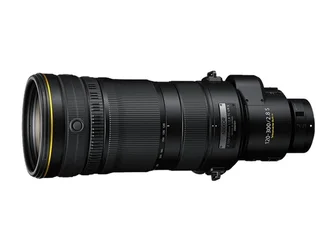
Nikon finally put a number on the NIKKOR Z 120-300mm f/2.8 TC VR S, and the number is $13,999. That figure came from NikonRumors on October 24, and it puts the lens roughly level with the NIKKOR Z 400mm f/2.8 TC VR S rather than above it. That revises what NikonRumors reported the previous day, which had the 120-300mm as the most expensive lens in the lineup. The lens is also now sitting on a B&H product page, which is the retailer telling you it is close enough to real that it needs a page.
None of this is an official announcement. Nikon has not published a price, a release date, or full specifications. The only thing Nikon has officially said about this lens is a development announcement from May 7, 2026, which confirmed the name, the mount, and one specific fact that still matters more than any price: the built-in 1.4x teleconverter.
What Nikon Has Actually Confirmed
Nikon announced the development of the NIKKOR Z 120-300mm f/2.8 TC VR S on May 7, 2026. The company's own wording was that it is "a telephoto zoom lens offering a focal length range of 120mm to 420mm, enabled by a built-in teleconverter that extends its focal length by 1.4×", and that it belongs to the S-Line series. Nikon's release also said the lens would "support professional photographers' imaging expression in genres such as sports photography and beyond", and warned at the bottom of the page that specifications, equipment and release dates are subject to change without notice.
That disclaimer has done a lot of work in the five months since. Nikon still has not published the weight, the dimensions, the minimum focus distance, the filter size, or the optical formula. Anyone quoting you a figure for any of those is quoting a rumor, and the rumors have moved around.
The 420mm endpoint is the part that is not in doubt. With the internal teleconverter engaged, the 120-300mm range becomes 168-420mm, and the aperture drops from f/2.8 to f/4. That is the design logic in one sentence: a fast zoom that also covers the reach of the 400mm primes, without the dust risk of bolting an external converter onto the back of a lens in bad weather.
The Price Picture
The $13,999 figure is a rumor, sourced to NikonRumors. What that number does is place the zoom in context. Nikon's NIKKOR Z 400mm f/2.8 TC VR S has an MSRP of $14,696.95 and is listed at B&H at $12,696.95 with an instant savings running through October 28. The NIKKOR Z 600mm f/4 TC VR S sits above both. On those numbers, a $13,999 zoom would land underneath the prime it is arguably meant to replace, which is a different pitch from the one NikonRumors described a day earlier.
That is the part I keep circling back to. If the 120-300mm really does land below $14,000, Nikon's argument writes itself: one lens, two focal ranges, and a price that is not obviously punitive next to the primes. But "not obviously punitive next to the primes" is still a four-figure number for glass that a lot of photographers will never need.
The same reporting puts European pricing near €16,000. That gap between a US figure and a European one is normal and not worth reading anything into.
The B&H Listing
The retail listing is the more interesting signal, because retailers rarely build pages for products that are months away. B&H has the NIKKOR Z 120-300mm f/2.8 TC VR S up with the price still blank and the status showing as a coming item, which is what a retailer does when a supplier gives them a product record but not a ship date.
There was also a wrinkle in the timeline: a version of that listing appears to have existed as early as May, when the lens was first announced in development, which suggests B&H created the product record early and is now filling in availability. The listing going live with a status change in the last couple of days is still a signal, just a noisier one than a fresh page would be.
What I'd Want to Know First
I shoot on a Lumix GH7 with the OM SYSTEM 12-40mm f/2.8 PRO II, which is Micro Four Thirds and not remotely the same world as a $14,000 super-telephoto. I have no business pretending I know how this lens handles. So the questions I would actually want answered before October 29, and which none of the reporting so far answers:
- Weight, and weight with the tripod collar off. Nikon has published nothing. NikonRumors estimates the length at roughly 352mm, about 28mm shorter than the Z 400mm f/2.8 TC VR S, and leaked images from the Singapore Grand Prix reportedly show it being carried handheld without a monopod. A photo is not a comfort test. The teleconverter bulge on Nikon's existing TC lenses sits near the mount, which shifts the centre of gravity backwards, and that helps. For reference, Nikon lists the Z 400mm f/2.8 TC VR S at 2,950g and 380mm long. I have not seen a weight figure for the zoom, and a 120-300mm f/2.8 with a converter is a big object regardless of where the mass sits.
- Whether the 168-420mm range is a usable working range or a paper range. f/4 at 420mm is fine for daylight sports. It is a different conversation for overcast stadium light.
- What the aperture does at the long end natively. Not the TC end — the 300mm f/2.8 end.
- How the AF behaves in low light with that aperture. A constant f/2.8 at 300mm is the reason this is a zoom rather than another prime, and low-light AF is where big glass usually gets expensive in both money and time.
I also want to know how it compares in size to the Z 400mm f/2.8 TC VR S, because Nikon's marketing for the existing TC primes leans hard on being lighter than the alternatives, and that comparison is the one buyers will make in the store.
What To Do Until Then
If you're shooting on Z and you need this range, the practical advice is to wait for October 29 rather than order blind. NikonRumors is reporting the announcement date as October 28 or 29, and when Nikon publishes a price it will be the first time anyone has a real number rather than a leak. That is also when the weight, dimensions and full spec sheet arrive, and those are the numbers that decide whether a lens is worth carrying.
If you're not sure you need it, the arithmetic is not on its side. At $13,999, this zoom costs about the same as the Z 400mm f/2.8 TC VR S on its own, and the Z 600mm f/4 TC VR S sits a little higher. Buying a zoom to pair with a long prime is not saving money. The value proposition is convenience — one body, one lens, one less thing to change — and convenience is worth paying for only if you actually shoot the whole range in a single session often enough to care.
There is one more reference point that puts the number in historical terms. The DSLR lens this one replaces, the NIKKOR AF-S 120-300mm f/2.8E FL ED SR VR, launched alongside the D6 in 2019 at $9,600. Four years of inflation, a built-in teleconverter, and a mirrorless mount later, $13,999 is the same order of magnitude.
Nikon's own development announcement is the only official word so far, and it is worth reading in full, because the language about "superior optical performance and mobility" tells you exactly what Nikon is selling: a fast zoom that does not feel like a brick. Whether it delivers that is a question I won't answer until I have handled one.
— Leo