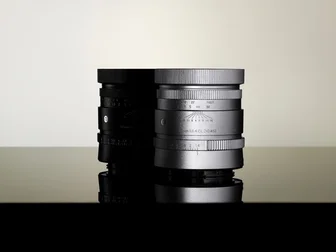
Sigma has always been good at making a specification sound exciting. This week it did something more difficult: it announced a 50mm f/1.4 that is only 375g and a little over 5cm long, then put distance and depth-of-field scales on an autofocus lens.
The Sigma 50mm F1.4 CL DG | Contemporary is the first lens in a new CL branch of Sigma's I Series. It arrives in L-Mount and Sony E-mount in early spring 2027. Pricing has not been announced. Sigma says the lens is intentionally softer in the focus plane than a conventional fast standard prime, with smooth background transitions and what the company calls "rich textural rendering."
That combination is unusual. Most 50mm f/1.4 lenses are built around correction, consistency and the smallest possible optical compromise. The CL starts from the opposite direction. Sigma says it used simulation tools to control aberrations deliberately, aiming for gentle softness rather than chasing clinical sharpness.
The part that changes the shape of a camera bag
The CL measures 64.7mm in diameter and 54.0mm long on L-Mount, or 56.0mm long on Sony E. It weighs 375g in either mount. The front filter thread is 52mm. The minimum focusing distance is 45cm, the maximum magnification ratio is 1:6.8, and the optical formula is 9 elements in 6 groups with 14 rounded diaphragm blades.

Compare that with Sigma's own 50mm F1.4 DG DN | Art: 78.2mm in diameter, 109.5mm long on L-Mount, 670g, and a 72mm filter thread. The CL is nearly half the length, 295g lighter, and uses filters smaller than the cap of a conventional 72mm lens.
For anyone who treats a full-frame body as the centerpiece of a small walking kit, those numbers matter more than another row of resolution figures. I haven't handled the CL, so I can't judge balance on a body or how convincing the metal feels in the hand. The dimensions, however, already answer a practical question: this is no longer a lens that dictates the size of the kit.
AF/MF without a switch
To keep the barrel short, Sigma uses whole-lens extension focusing instead of an inner-focus design. That makes the moving group heavier, so the company developed the RDD — Rotary Direct Drive — actuator. Its coils and magnets are arranged in a circle to match the shape of the lens barrel rather than sitting behind it.
Sigma says the RDD allows the lens to shift temporarily to manual focus when the focus ring is turned while autofocus is active. Focus returns to autofocus when the ring stops moving. There is no AF/MF switch to hunt for, and the aperture ring has an A position for autofocus operation.

This is the sort of detail that sounds neat on a spec page. I would want to try it in changing light before saying whether it saves time or merely adds another behavior to remember. The lens has a knurled focus ring, an aperture ring, a distance scale and a depth-of-field scale, all on an all-metal body. The scales are particularly interesting for street and documentary work because they provide a physical reference without turning the lens into a manual-focus product.
The price will decide whether the soft look is useful
Sigma has not announced a retail price. The 50mm F1.4 DG DN | Art currently costs about $920, but the CL is a different optical proposition rather than a smaller version of the Art lens. Its release date is also broad: early spring 2027, with no exact date attached yet.
That leaves one important question open. A controlled softness that costs a little resolution may be a deliberate creative tool. The same softness, paired with a price that approaches the Art lens, would be harder to defend. The first thing I'd want to see is a straight-out-of-camera comparison at f/1.4, then the same frame stopped down, before deciding whether the rendering is expressive or merely soft.
The CL is dust- and splash-resistant, and the front element carries a water- and oil-repellent coating. It will not be waterproof. Sigma's product page shows black and silver L-Mount versions and a black Sony E version, with a magnetic metal front cap among the supplied accessories.
For Sony E and L-Mount photographers who have been priced out of small fast primes, the CL is worth watching. The scale, size and AF/MF behavior are concrete. The character claim still needs files, and the price will decide whether it becomes a practical everyday f/1.4 or another beautiful object that stays on the shelf.