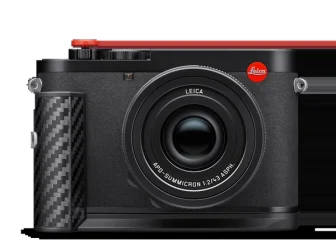
Three releases landed in the last four days, and two of them are about the same thing: what happens when a manufacturer decides a camera should cost what a car used to cost.
On October 20, in Los Angeles, Leica Camera and Formula 1 announced a licensing partnership and unveiled the Leica Q3 43 Formula 1 Edition. It is a Q3 43 with a motorsport livery, German-made carbon-fibre parts on the handgrip, thumb rest and soft-release button, black Microvelour body covering, an engraved top plate and matching lens cap, and a rope strap carrying both brands' logos. The technical foundation is unchanged: a 60.3MP effective CMOS full-frame sensor, the Maestro IV processor, video up to 8K, and the APO-Summicron 43mm f/2 ASPH. with its 60cm minimum focus and 26.5cm macro setting. The whole body is 130 × 80.3 × 97.6mm and weighs roughly 772g with the battery. Leica says the exclusive look is applied through the FOTOS app and is visible in the viewfinder as you shoot rather than only after processing.
It went on sale October 21 at Leica Stores, the Leica Online Store and specialist retailers for $9,950, with PetaPixel also listing £7,300 and €8,500.
There is also an exclusive photographic look available through the Leica FOTOS App. The collaboration was presented by Formula 1 presenter Ariana Bravo and 2009 world champion Jenson Button, with 26 motorsport photographs by Callo Albanese displayed at the event.
Sixty-five hundred dollars more than a base Q3 43 at $6,895, according to DPReview. That number is the actual story here, and it is not a criticism — Leica has never priced this camera competitively. What the F1 Edition does is take a product whose price already rested on the lens and turn it explicitly into a purchase about affinity rather than value.
The material choices are more interesting than the badge. Carbon fibre on the handgrip, thumb rest and release button is the part you touch, and Leica says it is manufactured in Germany specifically for this edition. Microvelour is described by the company as giving a grip similar to what is found on racing steering wheels. Those are the parts a photographer would actually notice after two years, and they are the parts the F1 Edition changes.
What has not changed is that the lens is fixed at 43mm, so there is still no way to get closer without cropping. The first thing I would want to test is how the Microvelour holds up in summer humidity — it is a fabric, and Leica bodies that use it on the shell have not had a long track record of being handled wet.
Tamron's 20-40mm finally ships for Nikon Z
The Tamron 20-40mm F2.8 Di III VXD (model A062) went on sale for Nikon Z on October 22. It was announced for that mount on October 8 and has been available in Sony E since October 27, 2022.
The price is $729 for Nikon Z against $699 for the Sony E version — a $30 premium for the newer mount, which is unusual. Most third-party lens makers charge more for a mount that has been available longer, because early adopters get the cheaper original. Tamron reversed that, which suggests they priced the Z version from the current market rather than from the 2022 E-mount price list.
The specification is unchanged between mounts: constant f/2.8 across the range, 380g, 88.7mm long, 9 aperture blades, 0.17m close focus at the 20mm end, 67mm filter thread. Newsshooter reported the $729 figure at announcement; Photography Talk and Precision Camera both list the same number at launch.

A 20-40mm f/2.8 is an unusual focal range. It starts wide enough for interiors and street work and stops long enough to frame a subject without stepping back. That 1:2 ratio is also why it is 88.7mm long where a conventional 24-70mm can be shorter.
For a Nikon Z shooter this fills a gap native glass leaves open — a Z 20-40mm f/2.8 S does not exist, and the nearest native option is much slower or much longer. Whether it is worth $729 over a used 20mm prime plus a mid-range zoom depends on how you actually shoot.
Insta360's Mic lands at the price where the decision actually happens
Insta360 launched the Insta360 Mic on October 22, globally, through its Official Store, Amazon and authorized retailers. Pricing is $79.99 for a standalone transmitter, $139.99 for one transmitter plus one receiver, and $249.99 for two transmitters plus a receiver and charging case.
The Mic is the middle of Insta360's wireless microphone line, sitting between the Mic Air and the Mic Pro. The headline features are a customizable E-Ink display, a microSD slot on the transmitter, and 32-bit float internal recording.
The microSD detail is the one that matters, and it is narrower than it sounds. Fstoppers is explicit that 32-bit float applies to the transmitter's internal recordings to the card, not to the audio sent to your camera. So the float path protects the backup recording on the transmitter, not the track your camera receives. Insta360's own press release frames it the same way — recording 32-bit float on the transmitter itself means audio that comes in too loud or too quiet stays free of distortion.
That still solves a real problem. The transmitter keeps its own copy on card, so if the gain stage clips before the signal ever reaches the camera, you have the card recording to fall back on. It does not solve the problem of a clipped camera input.
Noise reduction runs on a dedicated chip with an NPU-based algorithm. Insta360 lists two automatic gain modes — Auto for peaking, Dynamic for level variation — plus three vocal tone presets in Regular, Rich and Bright. Battery life is rated at up to 34 hours.
At $139.99 for a two-piece kit, this is the first price in Insta360's line where onboard recording and 32-bit float are not reserved for the $329.99 Mic Pro. If you have been waiting to find out whether the Pro's headline feature was worth the step up, this is the cheaper answer, with the caveat that float is backup-only.
What these three have in common
Two of them — the Leica and the Tamron — are about the same question from opposite ends. Leica is asking $9,950 for a fixed 43mm full-frame camera with a badge on it. Tamron is asking $729 for a 20-40mm f/2.8 that fills a hole in a system that otherwise costs more. The third, Insta360, lands a feature set that was previously reserved for a model costing 2.4 times as much.
The Leica price is not going to move. Tamron's $30 Z premium probably will not either. The Insta360 Mic is the one with an actual price argument attached, because the gap between the $139.99 kit and the $329.99 Pro is now a gap you choose rather than one you pay.
One thing to watch next week: Sigma has sent invitations to a launch event on October 24, and SonyAlphaRumors has reported a 50mm F1.4 in the i-series, which would be the fastest aperture Sigma has put in that line. That is tomorrow's story.