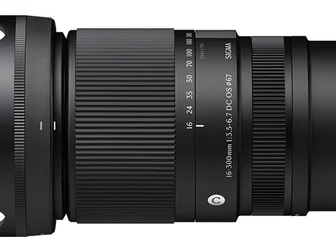
Sigma finally lands its biggest APS-C superzoom on Nikon Z
Sigma added Nikon Z to the mount list for the 16-300mm f/3.5-6.7 DC OS Contemporary on October 8, 2026, with the lens shipping November 5 at $769 USD. The Z version becomes the fifth mount for the same optics — joining the existing L-Mount, Sony E, Fujifilm X, and Canon RF versions — and Sigma confirmed the agreement is via the same Nikon license that brought the 16mm, 30mm, and 56mm f/1.4 DC DN primes to Z earlier in 2026. PetaPixel, DPReview, Fstoppers, and Photography Talk covered the news on the same day.
The Z version also uses Sigma's existing Nikon license (the same agreement that brought the 16mm, 30mm, and 56mm f/1.4 DC DN primes to Z earlier in 2026).
What the spec sheet says, and where it actually matters

The headline number is the 18.8x zoom ratio. Sigma says it's "the world's first among autofocus interchangeable lenses for mirrorless cameras as of September 2026" — that's a footnote in their own wording, scoped to AF mirrorless and dated to September 2026, not a blanket claim. The phrase "world's first" carries a definition; readers should not extend it to DSLR-era zooms like Tamron's 18-400mm f/3.5-6.3 Di II VC HLD or Sigma's own older 18-300mm.
For the actual optics, the 16-300mm uses one FLD glass element, three SLD elements, and four aspherical elements in a body that measures 73.8mm in diameter, 121.4mm long, and weighs 615g on L-Mount. Sigma does not list a separate Nikon Z-mount weight in the global spec sheet; Fstoppers' coverage notes the body should be identical, but I have not seen Sigma publish a distinct Z-mount weight, so I'll cite the L-Mount figure rather than overstate. The lens uses a stepping motor for autofocus and ships with optical stabilization rated at 6 stops (CIPA, measured at the wide end).
The 1:2 maximum magnification at 70mm is the standout. That's half life-size — close enough for product, flower, and tabletop work at the long end of the zoom. By the wide end it's 1:3, and 1:4 at the long end. Combined with a minimum focusing distance that gets close at the wide end, the 16-300mm is, in practice, a 0.5x macro that happens to also reach 300mm. That's an unusual selling point for a superzoom, and the only real competition is either Sigma's own 18-300mm DC DN Macro (which has more reach at 300mm but doesn't reach 16mm wide) or Sony's older 18-200mm SEL, neither of which has the same constant half-macro claim.
Image-quality behavior I can't speak to
I haven't tested this on any mount yet. The earlier Sony E version has been reviewed by several outlets including DPReview's archive and PetaPixel, with consistent notes of "good center at all focal lengths" and "edge softness wide open at 16mm that improves at f/8" — not Sigma's strongest optical showing wide open. The Nikon Z version is the same optics, just with a different mount protocol for autofocus and stabilization, so I'd expect similar rendering. But I haven't verified that on a Z body, so that's an inference and not an observation.
What I will say: at 615g and the APS-C image circle, this is closer in size to a high-end 70-200mm f/2.8 than to a "vacation plastic-fantastic" superzoom. For Z DX shooters — Nikon Z50II, Z fc, Z30, Z 9, Z 8 — this replaces the awkward "zoom + macro + telephoto" three-lens kit with a single option that covers from landscape wide angle (16mm on DX = 24mm equivalent) to sports-reachable telephoto (300mm on DX = 450mm equivalent). That's the actual market positioning, and it's the strongest argument for buying the lens rather than waiting for a faster midrange zoom.
The price positioning vs the existing trinity
The contemporary lineup on Z now covers:
- 16-300mm f/3.5-6.7 DC OS at $769 (this lens, all-in-one)
- 18-50mm f/2.8 DC DN Contemporary at ~$549 (small standard zoom)
- 30mm f/1.4 DC DN Contemporary at ~$429 (portrait prime)
- 56mm f/1.4 DC DN Contemporary at ~$479 (telephoto portrait)
Compared to Nikon's own DX zooms (Nikkor Z DX 18-140mm f/3.5-6.3 VR at $749 and the Nikkor Z DX 50-250mm f/4.5-6.3 VR at $399), Sigma's 16-300mm trades outright optical reach for an extra 100mm at the wide end and a half-macro close-up mode. That's a reasonable trade for travel and wildlife, not such a strong one if your subject is at 200mm only.
Final take
I'll hold judgment on rendering until I see real-world samples from a Z DX body. The lens is exactly what Sigma said it would be: a competent, well-priced, licensed superzoom that closes a real gap for Z DX shooters who'd otherwise be stuck choosing between wide and long. If a Z DX user wants one lens and not three, this is the most sensible answer in Sigma's Z-mount Contemporary lineup right now.
*Reference: Sigma 16-300mm product page | Fstoppers coverage | Photography Talk*