The week in focus: optical firsts and supply reality
The first full week of November 2026 brought a split screen across the camera industry. On one side, optics engineers delivered genuine technical milestones that rewrite category expectations, headlined by Venus Optics building the world's first f/2 tilt-shift lens with an image circle massive enough to clear medium-format sensors. Canon celebrated fifteen years of its Cinema EOS system not with nostalgic marketing, but by releasing firmware that moves multi-camera color management directly into camera processors. On the other side, reality set in at retail: Japan's largest camera dealer published hard inventory data showing that nearly half of 2026's most prominent cameras remain locked behind multi-month backorders, confirming the component cost pressures Canon executive leadership warned about late last month. Between those bookends came high-speed memory cards priced like flagship camera bodies, video firmware upgrades from Nikon, and ultra-compact prime lenses pushing affordability to the floor. Here is what actually shaped the week of November 2 through November 6, and what it means for your kit bag.
Laowa 24mm f/2 Zero-D Tilt-Shift: breaking the optical speed limit
Venus Optics announced the Laowa 24mm f/2 Zero-D Tilt-Shift lens on November 5 at an MSRP of $1,499. To understand why an f/2 tilt-shift matters, you have to look at how optical physics normally constrains this category. Traditional tilt-shift lenses from Canon, Nikon, and Schneider have historically topped out at f/2.8 or f/3.5 to f/4. To provide perspective control without severe vignetting, a lens must project an image circle far larger than standard 35mm full frame (which requires roughly 43.2mm of diagonal coverage). The Laowa 24mm f/2 projects a massive 67mm image circle. That provides plus-or-minus 12mm of shift and plus-or-minus 10 degrees of tilt on full-frame mirrorless mounts (Sony E, Canon RF, Nikon Z, and Leica L). More surprisingly, that 67mm circle is wide enough to cover medium format sensors on Fujifilm GFX and Hasselblad XCD natively, allowing plus-or-minus 8mm of shift without severe corner degradation.
For architectural and interior photographers working in low-light environments, the step from f/4 or f/2.8 to f/2 means capturing twice to four times as much light natively before relying on long exposures or high-ISO noise reduction. For astrophotographers shooting Milky Way foregrounds with tilted focal planes, f/2 at 24mm without optical distortion (Zero-D optical formula) opens up single-frame possibilities that previously required composite focus stacking. The trade-off is mechanical bulk: at 1,180 grams with an 86mm front filter thread, this is a substantial piece of metal and glass designed for tripod operation rather than casual walkaround shooting. At $1,499, Venus Optics has priced a specialized optical tool at roughly half the historical retail price of legacy first-party tilt-shift designs, creating a compelling value proposition for architectural and commercial specialists.
Canon Cinema EOS at 15: color matching moves inside the body
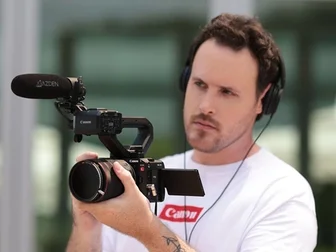
Canon marked the fifteenth anniversary of its Cinema EOS platform this week by announcing major firmware updates for the EOS C400, EOS C80, and EOS C50 cinema cameras, alongside dedicated production accessories and multi-camera bundles. Fifteen years ago, Cinema EOS began with the legendary EOS C300, which helped bridge the gap between large-sensor DSLR video production and dedicated cinema workflows. The central feature of the anniversary update is the in-camera Multi-Camera Colour Matching (Multi-Matrix) system. Instead of relying on external hardware LUT boxes or correcting color drift in post-production, camera operators can align matrix parameters and sensor profiles directly across C400, C80, and C50 units in real time through Canon's updated Camera Control Center application.
The firmware also expands Slow and Fast (S&F) frame rates with full autofocus support and introduces a button-assigned sensor crop mode, allowing operators running prime lenses to execute instantaneous 1.5x framing crops without lens swaps. Complementing the camera firmware, Canon announced the TC-N3 and TC-E3 wired timer remotes—designed for long-exposure astrophotography and overnight intervalometer shooting—as well as the DM-E10D digital shoe-mounted monaural microphone. Meanwhile, in Tokyo, Canon partnered with Nextorage and Fujiya Camera to subject an EOS C50 to a continuous 168-hour (seven-day) uninterrupted recording stress test to demonstrate thermal stability under heavy production loads.
What makes this development significant is workflow democratization. For years, running three or four cameras on live concert captures or commercial interview sets required dedicated color engineers or hours of conforming log profiles in grading suites. Moving precise multi-matrix alignment into firmware saves measurable post-production labor for independent video crews and rental operations.
The backorder reality: five of eleven marquee cameras are unavailable
In retail data published this week by Tokyo photographic retailer Map Camera, five of the eleven most significant mirrorless cameras released in 2026 are currently listed as backordered with estimated wait times stretching between two and five months. The models caught in delivery bottlenecks span enthusiast full-frame bodies, dedicated video platforms, and premium compacts. This retail reality follows Canon's third-quarter 2026 financial disclosure, where executives explicitly noted that rising semiconductor component costs and memory shortages would result in consumer price increases beginning in 2027.
The most notable takeaway from the supply numbers is that the constraints are not confined to complex, stacked-sensor flagship bodies. Fixed-lens compact cameras remain severely constrained worldwide despite CIPA data showing compacts as the only segment demonstrating year-over-year unit volume growth (up 15.3% year-to-date). The practical takeaway for photographers is straightforward: the traditional assumption that new camera releases will see predictable holiday discounting or surplus inventory on retail shelves does not hold true in late 2026. If you require specific hardware for contracted commercial assignments in the coming quarter, waiting for speculative discounts poses an operational risk.
The rest of the week, quickly
- Nikon ZR Firmware 2.00: Nikon announced firmware version 2.00 for the video-first Nikon ZR, introducing Log3G10 gamma in H.265 recording and adding focus peaking while monitoring RED R3D NE raw video streams. The announcement coincided with TIME Magazine selecting the Nikon ZR as one of the Best Inventions of 2026.
- Meike 58mm f/1.2 Mix: Meike expanded its Mix lineup with a manual-focus portrait prime for APS-C sensors priced at $449. The lens features an 11-blade aperture diaphragm, 14 elements in 10 groups, and is available for Sony E, Fujifilm X, and Nikon Z mounts.
- Nextorage NX-F2AE 1TB SDXC V90: Nextorage introduced a 1TB UHS-II V90 SDXC card priced at $999.99. While delivering sustained 280MB/s write speeds, the nearly one-thousand-dollar price tag highlights the steep premium of UHS-II density compared to CFexpress Type B options.
- Shimoda Action X v3 & Insider Sling: Shimoda refreshed its outdoor adventure pack system, adding a carry-on compliant 35-liter backpack and a modular $129.95 sling designed to pack inside larger gear bags.
- OM System PEN Availability: The OM System PEN began shipping to UK retail channels at 999.99 pounds with IPX1 weather sealing and an electronic viewfinder, while pre-order fulfillment in Japan remains delayed until spring 2027 due to component constraints.
- Sirui Swift Compact AF Primes: Sirui opened sales for its Swift series autofocus primes—a 20mm f/2.4 and a 40mm f/2.2—priced at an aggressive $149 each across Sony E, Nikon Z, Leica L, and Fujifilm X mounts.
- HOA A1 by Lutra: South Korean design studio Lutra unveiled the HOA A1, an experimental screenless camera utilizing an open rectangular cutout as a direct optical framing guide alongside a 26mm-equivalent f/1.75 fixed lens.
Three numbers worth keeping
- f/2.0: The maximum aperture of Laowa's new 24mm tilt-shift, setting an industry record for optical speed in a perspective-control lens.
- 168 hours: The length of the continuous video recording endurance test completed on Canon's EOS C50 cinema camera without thermal shutdown.
- $999.99: The MSRP of Nextorage's 1TB V90 SD card, illustrating the economic ceiling of legacy SD card architectures as video bitrates climb.
What I'd actually do with this
I shoot street and cityscape work around Hong Kong with a GH7 and the OM 12-40mm f/2.8 PRO II, so an ultra-fast f/2 full-frame tilt-shift isn't something I can mount natively on Micro Four Thirds, nor is a thousand-dollar V90 SD card something my dual-slot workflow demands. But watching this week unfold from the sidelines provides a clear read on where gear investment makes sense right now. On one end of the spectrum, manufacturers are delivering targeted optical problem solvers—like Laowa building a medium-format-capable tilt-shift or Canon automating multi-camera color grading—that directly eliminate specific operational bottlenecks for working professionals. On the other end, third-party manufacturers like Sirui and Meike are proving that everyday prime lenses do not need to command four-figure price tags to deliver dependable performance.
The middle ground—where buyers wait on backordered standard zoom bodies hoping for mid-cycle discounts—is where the friction lies. If you are sitting on working bodies and reliable glass that currently handles your client deliverables or personal projects, this is a week to keep shooting with what is already in your bag. The optical tools that launched this week are worth admiring for their engineering, but patience remains the smartest strategy while the broader supply chain sorts itself out.