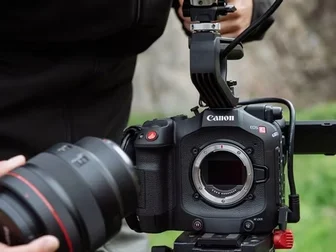
Fifteen years ago this month, Canon's Cinema EOS system didn't exist. What existed was the EOS 5D Mark II, released in November 2008, and the reason people were buying it in droves was the Full HD video nobody else was taking seriously. Canon asked filmmakers what they needed, then went and built a separate line of cameras for them. The first one, the EOS C300, arrived in January 2012.
Canon marked that anniversary on November 4, and buried inside the celebratory release is a firmware update for the EOS C400, C80 and C50 that tells you a lot more about where the company is heading than any anniversary post does.
What actually changed
The headline feature is called Multi-Matrix Support, and it lands on all three bodies. Canon describes it as giving you control over the phase and gain of specific colour axes, either from the camera menu or remotely. Canon Canada's explanation of the use case is the clearest one I've read: a live broadcast crew running a multi-camera setup can make in-camera colour adjustments to match the C400, C80 and C50 feeds against existing studio cameras while they're on air.
Multi-camera matching has historically meant either paying a colourist to fix it in post, or carrying a hardware grading box. In-camera control doesn't remove either of those for good, but it moves the adjustment to the point where the mistake is actually being made.

The rest of the update is a long list of smaller things that only matter if you own one of these bodies, but a few are worth pulling out. The EOS C400 and C80 get autofocus support in Slow & Fast mode at 72, 75, 90 and 96fps, which extends the existing 60-to-120p range to four more frame rates. Audio output is now available in Slow & Fast mode too. There's improved CV metadata for focus and zoom encoder data, black level adjustment when you're shooting Canon Log 2 or Canon Log 3, and image stabilisation support for lenses longer than 1000mm. The on-screen display gains base ISO and fan indicators.
The EOS C50 gets two additions that interest me more than the multi-camera stuff. It picks up a 1/8000 shutter speed, and it gets external flash support in photo mode through the Multi-Function Accessory Shoe — Canon lists the EL-series and EX-series Speedlites, Macro Lights and Speedlite Transmitters as compatible.
All three also get more assignable buttons, including access to sensor mode and digital tele-converter, which means changing your angle of view without changing the lens.

The C50 flash thing is the sleeper
I keep coming back to the flash support, and not because it's the flash itself. The C50 is a Cinema EOS body with a 7K Open Gate sensor and 4K 120fps slow motion built in. Canon adding Speedlite flash to it puts a proper hybrid stills-and-video tool into a range that, until now, was video-first. You can shoot the ceremony with flash and the speech without it, on one body, without a second camera in the bag.
That's not a gimmick. Multi-camera productions and event work are the two places where a single body has to do two jobs, and the C50's spec sheet was already strong on the video side. Canon's own framing for the flash feature is hybrid shooters who want stills alongside video from the same event.
Fifteen years in, the pattern is still the same
Canon's anniversary release lists 17 Cinema EOS cameras and 53 Cinema EOS lenses released so far. It also lays out the timeline: C300 in January 2012, C500 in October 2012, C500 Mark II in December 2019, C300 Mark III in June 2020, R5 C in March 2022, C50 in November 2025.
Read that list and the through-line is obvious: compact, modular, one operator covering more of a shoot without swapping gear. The C500 Mark II and C300 Mark III brought modular bodies. The R5 C and C50 brought the compact end back.
Which is why the firmware update matters more than it looks. Multi-Matrix, sensor mode on a button, more customisation on RF lens buttons and dials — these are all about one person operating more than one camera, or one camera doing more than one job. The 15-year-old instinct from the 5D Mark II era hasn't changed; the tools have just moved into the body.
Canon also folded in a separate announcement: Camera Control Center, a new remote camera application for PTZ, select Pro Video and Cinema cameras that consolidates the Camera Search Tool, Camera Colour Matching Application, Multi-Camera Management Application and Remote Camera Control Application into one place. Canon says it supports up to 200 cameras over XC Protocol, launching on Windows with macOS to follow.
The schedule question
The firmware updates for the C400, C80 and C50 are scheduled to be available free of charge from December 2026. One outlet has reported a specific December 17 date, but Canon itself is only saying "December," so treat the precise date as unconfirmed until it shows up on the support page. Camera Control Center is scheduled for later in January 2027.
Neither of those is downloadable this afternoon. Both are free, both are firmware or software rather than hardware, and both land before the end of the first quarter of 2027 — so the sensible thing to do with this news is nothing, and wait for the download to appear.
What I'd want to check
Canon's claim is that Multi-Matrix gives finer control over colour matching than external hardware or post. I'd want to see the actual axis interface before taking that on faith, because "phase and gain on specific colour axes" is a description that could mean a proper vectorscope-style tool or could mean a simplified three-slider panel.
Same with the C50's 1/8000 shutter. It's a real addition to the spec sheet and it obviously gives more control in bright light, but whether it reaches the top frame rate is the kind of detail that only shows up in the manual.
And I'd want to know whether the C400 and C80's new Slow & Fast autofocus frame rates are exposed on the C50 as well. Canon's release mentions the expanded autofocus frame rates specifically for the C400 and C80, and the C50 gets audio output in Slow & Fast mode but isn't named on the autofocus extension. If that's a deliberate split, it's worth understanding before you plan a high-frame-rate shoot around it.
None of that takes away from the announcement. A multi-camera colour tool inside the camera, on three bodies, for free, is a bigger deal than a firmware release usually is. It just isn't something I can judge from a press release, and I'd rather say that than write a paragraph about how it might transform your workflow.