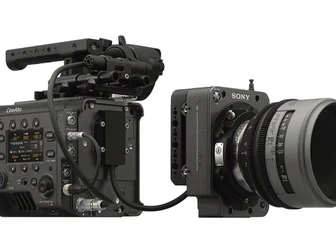
If I'd told you Monday that the week's loudest number would belong to a camera head that isn't even a camera yet, you'd have guessed wrong. Sony's Rialto 65 was announced October 29, priced at $80,000, and doesn't ship until the first half of 2027.
The quieter story is worse for anyone with a shopping list. On October 27 Canon told investors it expects to raise prices starting next year because components keep getting more expensive.
And the number that ties both together is from CIPA: camera makers shipped 19.8% fewer full-frame bodies than a year earlier, while the money they brought in went up. Fewer cameras, higher prices. That's the week in one line.
Sony priced the 65mm format: $80,000
Sony's Rialto 65 Camera Extension System (CBK-6510XS) attaches to a VENICE 2 body to turn it into a 65mm-format camera. In a press release dated October 29, from an event in San Diego, Sony put a US MSRP of $80,000 on it, with availability tentatively in the first half of 2027. The sensor measures 53.75mm wide by 35.83mm high, roughly 2.2 times the imaging area of a 35mm full-frame sensor, and reads out 9.6K Open Gate. Sony lists dual base ISO at 2500 and 10000, with over 15 stops of dynamic range at the lower base. Recording stays internal in 16-bit X-OCN, so the VENICE 2 body you already own does the work.
Two modes. Extension Mode detaches the camera head from the body over a cable, for confined spaces and handheld work; Studio Mode bolts the head straight on. The 4.5-metre cable ships with the camera; the 12-metre one is $9,000 extra, and the drop-in ND filter kit is another $8,000. The head weighs roughly 1.5kg, and VENICE 2 bodies will need firmware version 6.00 or later.
Here's where my brain snagged. The Rialto 65 was first shown at Cine Gear Expo back in June, so the sensor and the format weren't news this week. The news is the number: at $80,000, the head costs 16.3 Sony FX5 bodies at their $4,898 body-only price. That's not a lens-adjacent accessory. That's a second camera in a rental house's pricing spreadsheet.
And the extension part is what I'd want to see in the wild first. A 65mm sensor on a head separated from the body by four and a half metres of cable is not a rig I've ever seen in production. Sony says large-format perspective is now reachable in situations that were previously awkward. I'd rather a rental house told me how it behaves in a corridor, in rain, with a gimbal operator.

Canon says memory costs go into the price from next year
This is the story I'll actually be quoting at people, and it's not a product announcement. It's an answer in Canon's own Q&A session.
Canon published its third-quarter 2026 results on October 27, then held an analyst meeting Q&A. The Imaging business unit did fine — net sales of ¥294.9 billion, up 16.3% year over year, operating profit of ¥46.8 billion, up 22.7%. Interchangeable-lens unit sales declined on Middle East conflict and soft China demand, but new full-frame models expanded and network cameras did the heavy lifting. Canon's own Q3 analysis shows higher memory prices cutting ¥19.8 billion from operating profit, partly offset by ¥7.8 billion from pricing.
And then there's the answer that actually matters for buyers. Asked how Canon plans to handle supply shortages driving higher costs in 2027, the company said: "For components that are in short supply, we are using every possible means to secure the quantities we need for next year. As a result, we expect higher procurement costs, but our policy is to offset those increases through price increases from next year onward."
That's a company telling you, in writing, that a price increase is the plan — not a possibility, the plan. Canon's presentation also notes that printed circuit board and electronic component shortages have emerged since August on growing AI-related demand, and that Canon lowered its camera sales projection because of those shortages alongside the Middle East conflict and China weakness.
I want to be careful how much weight to put on this. Canon's memory costs are real, and Fujifilm has been flagging raw material pressure since August. But AI datacenter demand isn't the only thing pulling on supply — Canon's filing lists a supplier fire alongside the AI-driven constraint as causes of the Medical business's production problems, which dropped operating profit 61.5% year over year.
Still. If you're holding a shopping list, the practical reading is this: the prices you've been anchoring on for a couple of years are not a reliable guide to what you'll pay in 2027. That's not a prediction that every body goes up. It's a notice of which way the manufacturers are leaning.
CIPA's August numbers: fewer cameras, more money
CIPA's August data, published October 1 and picked up widely this week, is the numbers behind the pricing story.
Between January and August, CIPA members shipped about 5.7 million digital cameras, down 3.2% from the same months of 2025, while shipped value rose 3.7% to roughly ¥572 billion. Interchangeable-lens bodies fell 9.3% in units to 4.01 million. Mirrorless, now 92% of interchangeable-lens shipments, fell 6.2% in units while value rose 3.4%.
The split that matters: cameras with 35mm-or-larger sensors dropped 19.8% in units and 6.5% in value. Smaller-sensor models fell 3.2% in units but gained 14% in value. DSLRs fell 35% in units. Fixed-lens compacts rose 15.3% in units to 1.69 million, and in August alone compacts shipped 244,822 units against 184,163 in 2025.
Nikon Rumors, publishing the analyst ZoetMB's breakdown of the same CIPA numbers, has cut his full-year ILC body forecast to between 6.0 and 6.35 million, which would put 2026 back around 2023 levels.
Read that as one story, not five: full-frame bodies are the shrinking part of a shrinking market, and value per unit is going up because the mix is shifting toward expensive models with fewer buyers. Fixed-lens compacts are the only category CIPA members shipped more of year to date, and they grew from a small base.
One number cuts the other way, though: the lens-to-body ratio moved from 1.50 to 1.57. People are buying fewer bodies and more glass. If you already have a body you like, that's arguably good news.
The rest of the week, quickly
Hasselblad's X2D II 100C is now running Linux. Developer Radium Wang's open-source firmware research has been pushed further: a Reddit user got XFCE running on the camera, and separate custom firmware adds video recording to a body that doesn't do it out of the box and that Hasselblad has signalled no intention of adding. Wang has also gotten Apple CarPlay working on it. None of it is supported and Hasselblad has announced nothing, but a medium-format camera running a desktop environment is a fun artifact.
Japan's first DJI and Hasselblad dual-concept store opened in Omotesando. DJI's distributor Sekido grand-opened it on October 31 — two floors at La Porte Aoyama, with a permanent indoor drone flight cage and one-on-one consulting in three languages. DJI says its video camera market share in Japan passed 70% earlier this year, and Hasselblad's X2D II 100C has been selling out at Japanese retailers despite a price north of a million yen.
Cooke rebuilt its S4/i Super 35 primes for full frame. The S4 FF/i is six T2.0 primes from 18mm to 100mm in PL or LPL mount, $15,000 each, so $90,000 for the set.
Sirui's new Swift series is $149 for everything. The 20mm f/2.4 and 40mm f/2.2 are $149 for each of the six mount variants on Sirui's own store — E, L and X for both focal lengths.
Thypoch's first autofocus prime is a 23mm f/1.4 for $349 on Fujifilm X, undercutting Fujifilm's own $1,049 23mm f/1.4 by a factor of three.
Viltrox's AF 35mm F1.4 Pro is listed at $663.20 right now, a launch discount on the $829 MSRP for Sony E and Nikon Z. It's the third lens in Viltrox's f/1.4 Pro line; the full set costs under $2,000.
Sigma's FP2 goes on sale November 11 at $2,199 body-only, or $2,749 bundled with either the 50mm F2 DG Contemporary or the EVF-21 viewfinder, built around a 24.5-megapixel partially stacked sensor with 6K Open Gate.


Two cheap oddments. Godox's iM10 mini flash is 23 grams and $24.90, with no TTL and no high-speed sync. XTU's S7 Pro Max action camera puts a 1/1.28-inch RYYB sensor and 14 stops of dynamic range in a body at $179.99.
Three numbers worth keeping
$80,000. The Rialto 65's US MSRP. Whatever you think of 65mm, Sony has put a public price on it, and that tells you where large-format sits in the professional hierarchy.
19.8%. The year-over-year drop in full-frame interchangeable-lens body shipments, January through August. The market for the cameras most of us write about is shrinking faster than the market overall.
$149. Sirui's price for a full-frame autofocus prime, on two focal lengths, across three mounts. That's the floor under this category right now, and the number every other brand has to answer.
What I'd actually do with this
I've been shooting street and cityscape work on a Micro Four Thirds body — a GH7 with the OM 12-40mm — for the better part of two years, so I'm the least affected person in this entire roundup. An $80,000 cinema extension head is not a rounding error in my budget. But there's a version of this week that reaches me anyway. Canon's answer says the manufacturers have decided component costs get passed on. CIPA's data says full-frame bodies are shrinking 19.8% while value per unit rises. Together they describe a market where the buyer who waits for a price drop is waiting on something that isn't coming, and where the practical move is to buy the body you actually want on the merits, not on a discount that has stopped being a reliable assumption.
The cheap end of the week is the part that matters to me. $149 for a 20mm f/2.4 and a 40mm f/2.2, $349 for a 23mm f/1.4 on X, $663 for a 35mm f/1.4 in E or Z — fast glass where the new price is not the old price. If you're building a kit, this is a better week to look than to wait.
And for anyone who reads an $80,000 camera head as a curio: Sony ships it in the first half of 2027, on a body you already own, through a cable, in a format most lenses don't cover natively. I'd rather watch what rental houses do with it than guess now.