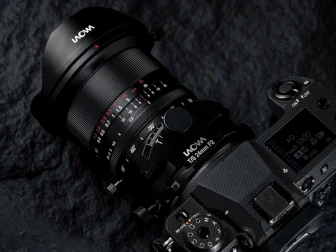
Venus Optics has officially launched the Laowa 24mm f/2 Zero-D Tilt-Shift lens for full-frame mirrorless mounts and medium-format bodies, setting an unexpected benchmark in a niche that usually moves at the speed of architectural renovation.
At f/2, it is currently the fastest tilt-shift lens manufactured for full-frame or medium-format mirrorless systems. For context, the industry benchmarks in wide-angle perspective control—Canon's TS-E 24mm f/3.5L II and Nikon's PC-E 24mm f/3.5D—sit nearly 1.6 stops slower. Even in medium format, Fujifilm's GF 30mm f/5.6 T/S demands significantly more ambient light before you can see what you are composing on a dim location.
A fast tilt-shift lens sounds like a contradiction in terms until you think about interior architectural shoots at blue hour or night-sky exposures where keeping vertical lines parallel without perspective software cropping is the entire goal.
The Physical Package
Venus Optics built the 24mm f/2 around 13 elements in 10 groups, incorporating two aspherical elements, five extra-low dispersion (ED) elements, and four high-refractive-index elements. The company markets it under its "Zero-D" moniker, aiming for near-zero optical distortion straight out of the camera.
The physical dimensions match what you would expect from a specialized mechanical barrel:
- Shift range: ±12mm
- Tilt range: ±10°
- Barrel rotation: 360° rotating collar with click detents
- Dimensions: 93mm in diameter by 119mm in length
- Weight: approximately 860g (1.9 lbs)
- Front filter thread: 77mm
- Minimum focus distance: 0.25m (9.8 in) with a 0.19x maximum magnification
The mechanical movement is fully manual. There are no electronic contacts across the initial production batches, meaning aperture control and focusing remain mechanical dials.
Medium Format Coverage Without Reduction
Perhaps the most technically intriguing aspect of the design is its 67mm image circle. That diameter is substantial enough that Venus Optics offers native mounts for Fujifilm GFX and Hasselblad XCD alongside the standard full-frame mounts (Sony E, Nikon Z, Canon RF, and L-Mount).
Typically, adapting full-frame tilt-shift glass onto medium-format sensors forces severe restrictions on shift travel before mechanical vignetting cuts into the corners. According to Venus Optics, the 24mm f/2 retains its full ±12mm shift and ±10° tilt range across Fujifilm GFX and Hasselblad XCD bodies. On a 44x33mm GFX sensor, the 24mm focal length yields an effective field of view roughly equivalent to an 19mm ultra-wide in 35mm terms, making it a compelling alternative to native medium-format architectural glass.
Low Light and Astrophotography Relevance
Why put an f/2 maximum aperture on a lens designed to live on a tripod stopped down to f/8 or f/11?
In traditional architectural photography, you stop down to preserve edge sharpness across shifted planes. But stopping down becomes a liability in two specific scenarios: blue hour interior balancing and nightscapes.
When balancing interior room fixtures against twilight through large window facades, shooting at f/2 allows photographers to keep ISO levels down while preserving short exposure times that avoid blowing out interior practical lights. In astrophotography, having tilt capability at f/2 opens creative depth-of-field wedges across foreground rocks or flora while keeping star trails tight during 15-second exposures.
The trade-off is handling. At 860 grams, the Laowa 24mm f/2 is not light, and manual-only operation means focusing wide open before stopping down for metering on camera systems without electronic aperture simulation.
Pricing and Mount Options
Venus Optics is pricing the Laowa 24mm f/2 Zero-D Tilt-Shift at $1,249 USD across all mount variants (Sony E, Nikon Z, Canon RF, L-Mount, Fujifilm GFX, and Hasselblad XCD). Shipping begins immediately through authorized photographic retailers.
Alongside the 24mm release, Venus Optics confirmed that its existing 55mm f/2.8 and 100mm f/2.8 Tilt-Shift 1x Macro lenses are now shipping in native Hasselblad XCD mounts at identical $1,249 pricing.