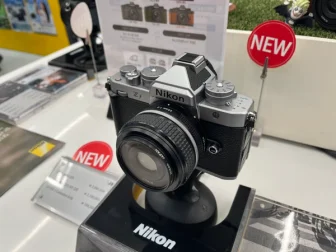
Nikon Zf: Where Retro Design Meets Modern Tech
I'll be honest — when Nikon first started teasing a retro-style full-frame mirrorless, I rolled my eyes a little. Another nostalgia play? Another camera company pretending it's 1983? But then I actually picked up the Zf, and man… it's one of those bodies that feels better in your hands than it looks in the press shots. And it looks pretty damn good in the press shots.
The first thing that hits you is the weight. Not heavy, but dense. Solid. It's around 630 grams body-only, which is heavier than my Panasonic Lumix GH7 with the OM SYSTEM 12-40mm f/2.8 PRO II attached, but it carries that weight differently. The magnesium chassis feels like one block of metal, and the brass top plate dials — ISO, shutter speed, exposure compensation — have this satisfying mechanical click that modern cameras usually fake with electronics. I found myself twisting them even when the camera was off. It's weirdly therapeutic.
The Dials Are the Whole Vibe
Nikon didn't just slap some retro cosmetics on a Z6 II and call it a day. The Zf has dedicated mechanical dials for shutter speed, ISO, and exposure compensation. There's also a tiny LCD on the top plate that shows your aperture when you've got a native Z lens attached. It's adorable. It's also genuinely useful when you're shooting waist-level or from the hip and don't want to light up the rear screen.
But here's the thing — if you're coming from a modern Nikon Z body, the dial workflow takes some retraining. I kept reaching for the front and rear command dials out of habit. After about half a day of shooting, though, something clicked. You start setting ISO with your left thumb, shutter speed with your right forefinger, and aperture via the lens ring or the front dial. It's slower than program mode, sure, but it forces you to think. And for street photography or deliberate landscape work, that's not a bad thing at all.
I did fumble it once during a quick grab shot. A guy on a bike rode past with perfect late-afternoon light, and I instinctively tried to spin the rear dial to change shutter speed. Nope. Wrong dial. Missed it. My fault, but the Zf punishes muscle memory if you're not committed to the retro layout.
Image Quality: It's Basically a Z6 II, and That's Fine
Inside that pretty body is a 24.5MP full-frame BSI CMOS sensor paired with the EXPEED 7 processor. If that sensor sounds familiar, it's because it's essentially the same one from the Z6 II. So image quality is excellent, with clean files up to ISO 6400 and totally usable results at 12800 if you expose properly. Dynamic range is around 14 stops, which means you can pull shadows without everything turning into mush — handy for those high-contrast street scenes where you're too slow to bracket.
The EXPEED 7 chip does bring better autofocus than the Z6 II, though. Subject detection for people, animals, vehicles, and birds works well in real-world use. I tested it on some friends' dogs at a park, and the eye-tracking stuck like glue even when the dogs were running toward me. It's not quite Z8/Z9 level, but it's a big step up from the older generation.
For video shooters, the Zf does 4K 60p, but only with a crop. 4K 30p is full-width, and 1080p goes up to 120fps for slow motion. There's 10-bit internal recording via N-Log, which is great if you grade in Resolve like I do with my GH7 files. But honestly? If video is your main thing, the Zf is a weird choice. The fully articulating screen crowd will hate the tilting screen, and there's no full-size HDMI. I'd grab a GH7 or S5IIX before this for hybrid work.
That Screen Though
Speaking of the screen — it's a 3.2-inch tilting touchscreen. Not fully articulating. As someone who shoots a lot of video and weird angles, I missed the flip-out screen from my GH7. For stills, the tilting design is fine. For vlogging or self-recording, it's annoying. Nikon clearly positioned this as a stills-first camera, and the screen choice proves it.
The EVF is a 3.69-million-dot OLED panel. It's bright, sharp, and responsive. I had no issues using it in bright midday sun, which is more than I can say for some cheaper EVFs I've used. The magnification is 0.8x, so it feels immersive without being tunnel-like.
Build and Handling in the Real World
The Zf is weather-sealed, which I appreciate. I took it out on a drizzly afternoon in Hong Kong — not monsoon-level, but steady enough that I was worried — and it kept working without complaint. The grip is small, almost like an old film SLR. If you've got big hands or you're using a heavy lens like the 24-70mm f/2.8 S, you'll want the optional grip extension. I used it with the 40mm f/2 SE and the 24-70mm f/4 S, and while the smaller primes felt balanced, the f/2.8 zoom made my wrist ache after a couple of hours.
Button layout is mostly good, but the playback button placement on the top left took me a while to get used to. And the dual card slot situation is… odd. One SD UHS-II slot and one microSD slot. I get that microSD saves space, but it feels cheap on a $2000 camera. Most pros I know would rather have two full-size SD slots. I'd rather have one SD and one CFexpress Type B, honestly, but Nikon was clearly chasing that compact retro body.
Who Is This Camera Actually For?
Look, the Nikon Zf is not a rational purchase. If you want the best image quality per dollar, buy a Z6 II used or wait for a Z6 III sale. If you want a video powerhouse, look elsewhere. If you want the absolute best autofocus, save for a Z8 or Z9.
But if you're the kind of photographer who gets excited about dials, brass, weight, and the tactile joy of shooting — the Zf delivers in a way that few modern cameras do. It's a camera that makes you want to go outside and take pictures. And at the end of the day, isn't that the whole point?
Compared to my GH7, the Zf is bigger, heavier, and less flexible for video. But for stills — especially street, travel, and casual portrait work — it's a genuinely lovely tool. I'd still grab my GH7 for a run-and-gun gig or a hike where every gram matters. But for a weekend wandering around the city with one prime lens? The Zf would be high on my list.
Final Thoughts
The Nikon Zf is a camera with a strong personality. It's not trying to be everything to everyone. It's a love letter to Nikon's film-era design language, built around a thoroughly modern sensor and processor. The result is something that feels special — flaws and all.
Is it perfect? No. The microSD slot is silly, the grip is small, and the video features are just okay. But the shooting experience is so engaging that I kept forgiving those quirks. If you've been waiting for a digital FM2, this is probably the closest thing Nikon has ever made.
For more technical deep-dives, Gerald Undone has a solid breakdown of the autofocus and rolling shutter on his channel: https://www.youtube.com/c/GeraldUndone. And DPReview's full review is worth a read if you want lab-tested dynamic range numbers: https://www.dpreview.com/.
Sample Images and Real-World Output
I didn't do formal test charts with the Zf because, honestly, who shoots test charts for fun? What I did do was walk around for three days with the 40mm f/2 SE attached and shoot everything — alleyways, coffee shops, street signs, friends, dogs, puddles. The files have that clean, modern Nikon look. Colors are accurate without being boring, and the RAW files give you plenty of room to push in post.
One thing that surprised me was how nice the monochrome modes are. Nikon put some effort into the black-and-white JPEG profiles, and they actually look good straight out of camera. I usually shoot RAW only, but I found myself switching to RAW + JPEG just to preview those monochrome looks on the rear screen. It's a small thing, but it fits the retro vibe perfectly.
Low-light performance is solid. I shot a dimly lit restaurant scene at ISO 12800, and while there was noise, it was the kind of fine grain that cleans up nicely in Lightroom. The IBIS also helps a lot — I got sharp handheld shots down to about 1/4 second with the 40mm lens. That's not magic, but it's genuinely useful when you don't want to crank the ISO.
The Lens Pairing Question
The Zf looks best with small primes. The 40mm f/2 SE is the obvious match — compact, sharp enough, and it shares the retro silver finish. The 26mm f/2.8 is even smaller, basically a pancake, and makes the Zf feel like a fancy point-and-shoot. If you mount the 24-70mm f/2.8 S, the combo works great optically but loses some of the charm. It starts feeling like any other professional mirrorless setup.
I wish Nikon had made a few more compact Z primes with matching aesthetics. A 20mm f/2.8 or an 85mm f/1.8 in that silver finish would be instant buys for a lot of Zf owners. For now, the 40mm and 26mm are the sweet spots.
What I'd Change
If I were designing the Zf Mark II, here's my short list: give it a fully articulating screen or at least a better tilt mechanism for vertical video, swap the microSD slot for a second full-size SD slot, add a slightly deeper grip as standard, and give us a proper full-size HDMI port. Oh, and maybe a slightly bigger battery. The EN-EL15c is fine for a day of casual shooting, but if you're hammering the shutter or shooting video, you'll want a spare.
That sounds like a lot of complaints, but they're all minor. The core experience — the dials, the build, the sensor, the autofocus — is excellent. Nikon made a camera that people will actually want to own, not just spec-sheet compare.
Should You Buy It?
If you shoot mostly stills and you value character over pure spec-sheet dominance, yes. The Zf is one of the most enjoyable full-frame cameras I've used in years. It's not the fastest, the smallest, or the cheapest, but it might be the one you reach for most often.
If you're a hybrid shooter, a sports photographer, or someone who needs the absolute latest autofocus wizardry, probably not. The Zf knows what it is, and it's not apologizing for it. I respect that.
For me, the Zf sits in that rare category of cameras that are fun enough to make you a better shooter just because you want to use them more. And compared to my trusty GH7 setup, that's saying something.