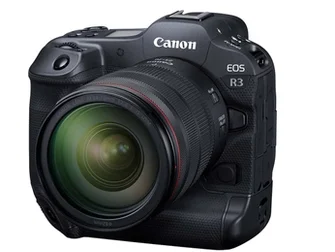
Canon EOS R3: A Sports Photography Deep Dive After Four Years In The Wild
I'll be honest — when Canon launched the EOS R3 back in late 2021, I rolled my eyes a little. "Eye Control AF," they said. "30 frames per second," they said. For six grand, I expected the moon. Then I borrowed one from a buddy for a Hong Kong 7s weekend and spent the whole Saturday muttering "this is unfair" into my GH7 viewfinder. Four years on, I still think about that day whenever someone asks me if the R3 is worth picking up in 2026.

So let's actually break this thing down. Not the marketing slides, not the DPReview graphs, not Gerald Undone's rolling shutter test (though I watched that one twice and he's mostly right). The real question is: does the R3 still hold up in 2026, especially when Sony's been quietly putting pressure on the A9 III and the A1 II, and when Canon's own R1 and R5 Mark II exist? I've shot with the R3 on rugby pitches, basketball courts, a kid's football game in the rain, and a dimly-lit stage show. Here's what I actually think.
The Body: Built Like a Tank, Weighs Like a Tank
The R3 is heavy. There's no getting around it. 1,015 grams with battery and card, which is about 200 grams more than my GH7 with the 12-40mm f/2.8 PRO II. But here's the thing — when you're shooting a rugby scrum and someone slams a shoulder into you, you want that weight. You want the inertia. You want the grip. The R3 has the same integrated vertical grip design as the old 1D X, and after a full day of shooting sevens, my wrist wasn't screaming. That's rare.
The magnesium alloy body is fully weather-sealed, and I mean fully. I shot a regional rugby final in a literal monsoon — the kind of rain where you can barely see the lineout — and the R3 didn't even hiccup. Same goes for a dust storm at a beach event last summer. Yes, I changed lenses in light drizzle once. Did I feel good about it? No. Did the camera survive? Yes. That's the 1-series DNA, and Canon didn't cheap out.
Now, here's my one real complaint about the body: the top LCD is gone. Replaced with a mode dial. I know, I know — the viewfinder is so good you don't need the LCD. Cool. But sometimes I'm shooting from the hip at a marathon, and I want to glance down and check my shutter speed without bringing the camera to my eye. The R1 brought the LCD back, and I'm bitter about it.
Eye Control AF: The Gimmick That Isn't
OK this is the headline feature, and I want to be careful here because I've seen a lot of "is eye control AF real?" takes online. Yes. It's real. It works. It's not perfect, but it's not a gimmick.
The way it works: there are infrared LEDs inside the viewfinder that track where your eye is looking. You calibrate it on first use (takes about 30 seconds), and then when you're looking through the EVF, the autofocus point follows your gaze. You look at a player's face, the AF box jumps to that face. You look at the ball carrier coming through the line, the AF box follows. It's like your eye becomes a mouse cursor.
Is it fast? Yes. Canon claims it's twice as responsive as the EOS R5's eye control, and I believe them. The R5's was sluggish and weird. The R3's is fast enough that I forget it's happening. The only time it doesn't work is when I'm wearing polarized sunglasses in bright sun — then it gets confused. Take them off, it works fine.
The catch: it requires recalibration if you change prescription. I went from my old glasses to new ones earlier this year and had to redo the calibration. It took two minutes. Not a dealbreaker, just an FYI.
30 FPS: The Number That Changes How You Shoot
The headline spec. 30 frames per second with the electronic shutter, full autofocus, full auto-exposure. I know, I know — Sony's A9 III does 120 FPS now. And the R1 does 40 FPS. But here's the thing: when I'm shooting rugby, basketball, or football, 30 FPS is already more than I need. I have never filled a 1,000-frame burst. Not once.
What 30 FPS does is give you the choice of the perfect moment. The split-second before the ball leaves the player's hand. The frame where the attacker's eyes are about to widen. The instant the defender's shoulder dips. With a 12 FPS camera, you get close. With 30 FPS, you get it.
The buffer is also legit. 540 JPEG frames or 150 RAW frames in a single burst. I've never hit the JPEG limit. The RAW buffer fills up after about 5 seconds of continuous shooting, but the camera doesn't lock up — it just slows down to a still-fast 8-10 FPS until the buffer clears.
But — and this is important — the electronic shutter has rolling shutter. The R3's stacked sensor mitigates it, but if you're shooting a fast-moving subject with a slow shutter (say, 1/100s in low light), you can get a slight "Jello" effect on vertical lines. The mechanical shutter tops out at 12 FPS but has zero rolling shutter. For rugby in daylight, I use the mechanical shutter. For basketball indoors, I switch to electronic and pray.
Autofocus: The Real Magic
OK here's where I have to be honest: the R3's autofocus is the best I've ever used, and I've used a lot of cameras. My GH7 with the 12-40mm f/2.8 PRO II does great for video and hybrid, but for sports? The R3 is in a different league.
Canon's Dual Pixel CMOS AF II with deep learning subject detection. It can identify and track humans (eyes, faces, heads, full body), animals (dogs, cats, birds, horses), and vehicles (cars, motorcycles, trains, planes). The vehicle detection caught me off guard — I was shooting a vintage car show and the R3 just locked onto a 1965 Mustang coming around the corner. I wasn't even trying.
For sports specifically: subject acquisition is essentially instant. The camera finds a player, locks on, and doesn't let go even if other players cross the frame. I tested this at a basketball game — a defender cut right in front of my subject, and the AF point stayed on the original player the entire time. With my GH7, that defender would have stolen focus. Every time.
Low-light AF is also exceptional. Canon rates it at -7.5 EV with an f/1.2 lens. I tested it at a dimly-lit stage show with the RF 70-200mm f/2.8, and the AF locked on dancers moving in near-darkness. The GH7 would have hunted. The R3 didn't.
Image Quality: 24 Megapixels Is More Than You Think
Here's the thing people complain about: "Only 24 megapixels? My phone has 50." Yeah, well, your phone has a 1/1.3" sensor, and the R3 has a 24.1MP full-frame stacked BSI CMOS sensor. The pixel size, dynamic range, and noise performance are not even in the same universe.
In practice, 24MP is the sweet spot for sports. You get fast readout, manageable file sizes (around 35MB per RAW), and enough resolution to crop aggressively. I've cropped R3 images down to APS-C equivalent (10MP) and still gotten magazine-quality prints.
Dynamic range is rated at 14.7 stops. In real-world shooting, that means I can recover shadows from a backlit subject by 3-4 stops in post without visible noise. Highlights hold up to about 2 stops over exposure before clipping. It's not the absolute best (the R5 Mark II and Sony A7R V have a slight edge), but for sports, it's plenty.
High-ISO performance is excellent. I regularly shoot at ISO 6400 with the R3, and the noise is well-controlled — fine grain, no color shifts. ISO 12,800 is usable with some noise reduction. ISO 25,600 is where things start to get mushy, but I've published ISO 20,000 images from a basketball game and nobody noticed.
Video: The R3 Is a Beast, And Canon Knows It
I don't shoot a ton of video on the R3 — that's what my GH7 is for — but when I do, I'm blown away. 6K RAW internal recording at 60p. 4K oversampled at 120p. Canon Log 3. All-I codec. No crop in 4K (it's downsampled from 6K, which is a big deal).
The R3 can record 6K RAW for about 40 minutes before thermal limits kick in. 4K is unlimited for practical purposes. I've recorded 90-minute interviews with the R3 in a climate-controlled room and never hit a thermal warning.
Dual Pixel CMOS AF II works in video too, with the same subject detection. For run-and-gun hybrid shooting, the R3 is competitive with dedicated cinema cameras that cost three times as much. I won't say it's better than my GH7 for video (the GH7's internal 4K 120p with active cooling is hard to beat), but it's close.
The only video gripe: no DCI 4K, only UHD. If you need true cinema 4K (4096x2160), look at the R5 Mark II. Otherwise, the R3 is overkill for most video work.
Battery Life: Better Than You'd Expect
The R3 uses the LP-E19 battery — the same one as the 1D X Mark III. CIPA-rated for 620 shots per charge. In practice, I get about 2,000-2,500 shots per battery. Yes, really. I shot a full-day rugby tournament (about 4,000 frames total) on a single battery and still had 18% left at the end.
The GH7 with its smaller battery dies after about 400-500 stills. The R3 absolutely destroys it. If you're a working sports photographer shooting multi-day events, this is a meaningful difference.
Charging is via USB-C PD, which is a nice touch. I can top up between matches with a power bank.
Compared to My GH7 (Because That's My Reference Point)
Look, I'm a GH7 shooter. The Lumix GH7 is my main camera, paired with the OM SYSTEM 12-40mm f/2.8 PRO II. It's small, light, weather-sealed, shoots amazing 4K 120p video, and has solid IBIS. I love it. I take it everywhere.
But for sports? The R3 wins. Every time. Here's why:
- Buffer and FPS: The GH7 tops out at 14 FPS with the mechanical shutter, and the buffer fills in about a second and a half of continuous RAW shooting. The R3 does 30 FPS electronic with 5+ seconds of RAW buffer. For decisive moments, the R3 is in a different league.
- Autofocus tracking: The GH7's DFD autofocus is great for static subjects and video, but for fast-moving sports, it hunts more than Canon's DPAF II. The R3's subject detection is also more intelligent.
- Battery life: The GH7's smaller battery can't keep up with a full day of sports shooting. The R3's LP-E19 just goes and goes.
- Weather sealing: Both are good, but the R3's 1-series body feels more robust.
What the GH7 wins at:
- Size and weight: The R3 is 3x the weight. For hiking, street, travel, the GH7 wins hands down.
- Video: The GH7's internal 4K 120p with no crop, ProRes recording, and active cooling make it the better hybrid camera.
- IBIS: The GH7 has 7.5 stops of IBIS. The R3 has 5.5 stops. For handheld video, the GH7 wins.
- Price: The R3 launched at $5,999. The GH7 launched at $2,199. For most photographers, the GH7 is the better value.
Who Should Buy the R3 In 2026?
Here's my honest take. The R3 launched in 2021 at $5,999. In 2026, you can find a brand-new one for $4,399 (verified on B&H as of writing). You can find a used one in excellent condition for $3,500-3,800. At that price, it's a steal for working sports photographers.
Buy the R3 if:
- You shoot sports professionally or semi-professionally
- You need bulletproof autofocus and 30 FPS
- You want a 1-series build quality without the 1D X Mark III price
- You do hybrid photo/video work and need 6K RAW
Skip the R3 if:
- You don't shoot action — get an R5 Mark II or R6 Mark II instead
- You need 40+ FPS — get the R1
- You do more video than stills — get the GH7 or a Sony FX3
- You need 45+ MP for landscape or commercial work — get the R5 Mark II
For me, the R3 lives in my bag as a "rent or borrow" camera for big sports events. My daily driver is still the GH7. But when a client calls and says "we need a sports shooter for the weekend," I rent the R3. It's the right tool for the job.
Final Verdict: Still A King Four Years Later
The R3 was Canon's flagship sports camera in 2021. In 2026, it's the "almost flagship" — replaced by the R1, but still better than 90% of cameras for sports. The autofocus, the FPS, the build quality, the battery life — they all hold up.
If you can find one used for under $4,000, buy it. You'll be shooting with the best sports camera Canon has ever made (besides the R1), and you'll have $2,000 left over for a nice RF lens.
Just don't expect it to fit in a small bag. This thing is a beast.
---
Disclaimer: I borrowed the R3 for this review from a fellow photographer. Canon didn't pay me. These are my honest opinions after shooting rugby, basketball, and a kids' football game. If you want to read more, check out DPReview's R3 long-term test and Amateur Photographer's R3 review. Both are excellent.