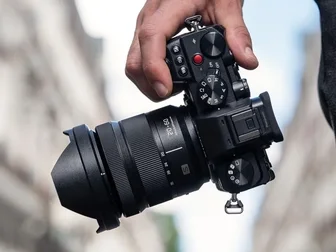
Quick Verdict & 2026 Value Proposition
Originally released in late 2020, the **Panasonic Lumix DC-S5** remains in 2026 one of the most astonishing bargains on the secondhand camera market. For a street price of **$750 to $880 USD**, it offers a professional 24.2-megapixel full-frame CMOS sensor with Dual Native ISO, internal 10-bit 4:2:2 V-Log recording, 5-axis Dual I.S. 2 stabilization, and dual SD card slots in a rugged magnesium chassis.
Its sole Achilles' heel is Panasonic's older **Contrast-Detect DFD (Depth from Defocus)** autofocus system. Because it lacks phase detection (which arrived in the newer S5 II), continuous autofocus can hunt and pulse during video recording, particularly in 24p cinema modes. For filmmakers pulling focus manually, landscape photographers, studio portrait shooters, and static multi-cam streaming setups, the original Lumix S5 provides image quality indistinguishable from cameras costing three times its price.
Buying Decision | Summary
**Buy if...** | You want full-frame 10-bit 4:2:2 V-Log video, superb low-light image quality, and dual card slots on an absolute shoestring budget under $850.
**Skip if...** | You rely entirely on continuous face/eye tracking autofocus for run-and-gun solo vlogging or fast-moving action sports (get the S5 II instead).
**2026 Value Rating** | **9.4 / 10** for budget manual filmmakers & stills photographers; **6.5 / 10** for continuous autofocus vloggers.
Price & Market Availability (November 2026)
At sub-$800 used, the Lumix S5 competes directly against older 8-bit full-frame bodies like the Sony A7 III ($950–$1,100 used) and Canon EOS R ($800–$900 used), completely outclassing both in internal 10-bit video color fidelity and dynamic range.
Key Technical Specifications
Parameter | Official Specification | Practical Impact
**Sensor** | 24.2MP Full-Frame CMOS (35.6 x 23.8 mm) | Excellent dynamic range, low noise, and no optical low-pass filter (OLPF) for maximum sharpness.
**Dual Native ISO** | Base ISO 640 & ISO 4000 (in V-Log) | Ultra-clean low light performance; shadows at ISO 4000 remain remarkably grain-free.
**Autofocus System** | **225-area Contrast DFD AF** | Fast for single shot (AF-S); tends to pulse/hunt during continuous video (AF-C) with moving subjects.
**Video Recording** | 4K 10-bit 4:2:2 up to 30p; 4K 60p (1.5x APS-C crop) | 14+ stops of dynamic range in pre-installed full V-Log/V-Gamut.
**Recording Limits** | 30 minutes in 10-bit modes; unlimited in 8-bit | Requires restarting clips every 30 minutes when shooting high-bitrate 10-bit projects.
**Image Stabilization** | 5-axis Dual I.S. 2 (Up to 6.5 stops) | Rock-steady handheld shooting for both stills and video.
**Viewfinder & LCD** | 2.36M-dot OLED EVF (0.74x); 3.0" 1.84M-dot Touch LCD | Articulating free-angle touchscreen makes framing high and low angles effortless.
**Card Slots** | **Dual SD Card Slots** | Slot 1: UHS-II; Slot 2: UHS-I. Provides simultaneous backup or overflow recording.
**Battery Life** | DMW-BLK22 (~440 shots CIPA, ~470 shots power-save) | High-capacity battery shared with the S5 II and GH6/GH7. Supports USB-C power delivery.
**Weight & Dimensions** | 132.6 x 97.1 x 81.9 mm; **714g (with battery and SD)** | Ergonomic, weather-resistant magnesium alloy body with deep grip.
How It Compares: Lumix S5 vs Lumix S5 II vs Sony A7 III
Feature | **Lumix S5** | **Lumix S5 II** | **Sony A7 III**
**Autofocus** | Contrast DFD (225 pts) | **Phase Hybrid AF (779 pts)** | Fast Hybrid AF (693 pts)
**Internal Video Depth** | **10-bit 4:2:2** | **10-bit 4:2:2** | 8-bit 4:2:0 only
**Color Science / Log** | Full V-Log (14+ stops) | Full V-Log (14+ stops) | S-Log2 / S-Log3 (prone to 8-bit banding)
**Continuous 4K Limits** | 30 mins (10-bit) | **Unlimited (Active fan)** | 30 mins (overheats easily)
**HDMI Port** | Micro HDMI (Type D) | **Full-Size HDMI (Type A)** | Micro HDMI (Type D)
**EVF Resolution** | 2.36M-dot OLED | **3.68M-dot OLED** | 2.36M-dot OLED
**Avg Used Price (2026)** | **$750 – $880** | **$1,350 – $1,480** | **$950 – $1,100**
In-Depth Analysis: The Real-World Strengths & Flaws
1. The 10-Bit V-Log Superpower at Sub-$900
Most sub-$1,000 used full-frame cameras (such as the Sony A7 III or original Nikon Z6) record 8-bit video files internally. When you attempt to grade 8-bit footage or push dynamic range, gradients break apart into unsightly digital posterization and banding artifacts.
The Lumix S5 records **10-bit 4:2:2 internally** with Panasonic’s broadcast-standard **V-Log/V-Gamut**, capturing over 14 stops of dynamic range. Colorists can manipulate shadows, pull back highlight rolls, and apply cinematic film conversions with the same grading latitude as a dedicated cinema camera.
2. Autofocus: The Reality Check
You must understand what you are buying: the original S5 relies on Panasonic's DFD contrast technology. In single autofocus (AF-S) for still photography, the camera locks onto subjects in a fraction of a second. However, in continuous tracking (AF-C) during video recording, the contrast algorithm constantly modulates focus forward and backward to verify sharpness.
This causes the background to "breathe" or pulse, particularly at wide apertures like f/1.8. If your primary goal is pointing the camera at yourself while walking and talking, the AF pulse will frustrate you. If you pull focus manually, use focus peaking, or lock focus on a tripod, this issue is irrelevant.
3. Durability & Ergonomics
Unlike plasticky entry-level cameras, the S5 features a rugged magnesium alloy skeleton with comprehensive weather seals around every dial, button, and port door. The grip is deep and comfortable, even with heavy telephoto lenses attached. The inclusion of dual SD card slots provides peace of mind for wedding shooters who cannot afford a corrupted memory card.
Target Audience & Final Recommendation
- Budget filmmakers, indie cinematographers, and film school students who need 10-bit color grading on a strict budget. - Landscape and architectural photographers who prioritize dynamic range, high-res 96MP tripod modes, and rugged weather sealing. - Studio portrait and product photographers who shoot with manual focus or single-point AF. - Multi-camera live streamers using clean HDMI output.
- Solo vloggers, wedding videographers, and event documentarians who depend on flawless, set-and-forget face and eye tracking autofocus. The extra $500–$600 for the S5 II is well worth the upgrade for its 779-point Phase Detection AF and full-size HDMI port.