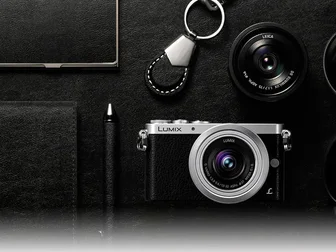
Quick Verdict & The Cult Status of the GM1
Launched in late 2013, the **Panasonic Lumix DMC-GM1** remains an engineering marvel: the smallest interchangeable-lens Micro Four Thirds camera ever manufactured. Measuring just **98.5 x 54.9 x 30.4 mm** and weighing a mere **204 grams** (including battery and SD card), the GM1 is physically smaller than a standard pack of playing cards, yet it houses the exact same 16.0-megapixel Live MOS sensor found in the enthusiast-level Lumix GX7.
In 2026, driven by a global resurgence in vintage digital aesthetics, everyday carry (EDC) minimalism, and TikTok appreciation for micro-cameras, the Lumix GM1 has transitioned from a forgotten oddity into a coveted cult classic. Selling for **$280 to $380 USD on the secondhand market**—more than double its 2019 used low—the GM1 offers a tactile, magnesium-alloy photographic experience that fits comfortably inside a jeans pocket.
Buying Decision | Summary
**Buy if...** | You want the absolute smallest interchangeable lens digital camera ever made, paired with tiny pancake primes (like the 14mm f/2.5 or 20mm f/1.7) for discreet street photography and daily carry.
**Skip if...** | You need in-body image stabilization (IBIS), an electronic viewfinder (EVF), long battery life, or modern 4K video recording.
**2026 Value Rating** | **9.0 / 10** for pocket EDC collectors & street shooters; **4.5 / 10** for all-around hybrid video creators.
Price & Market Availability (November 2026)
*Buyer Caution:* Due to its cult collector demand, beware of units with peeling synthetic leatherette, cracked corner plastics, or sticky top dials. Always confirm the battery latch and sensor cleanliness before purchasing.
Key Technical Specifications
Parameter | Official Specification | Practical Impact
**Dimensions** | **98.5 x 54.9 x 30.4 mm (3.88 x 2.16 x 1.20 in)** | Significantly smaller than a Fujifilm X100VI or Sony RX100 VII. Truly pocket-sized.
**Weight** | **204g (with battery & SD card)** / 173g (body only) | So light you will forget it is in your jacket pocket or sling bag.
**Sensor** | 16.0MP Live MOS (17.3 x 13.0 mm) | Proven GX7 sensor with rich color rendering and good dynamic range up to ISO 1600.
**Shutter Mechanism** | **Miniaturized Stepper-Motor Mechanical + Electronic** | Mechanical shutter up to 1/500s (flash sync 1/50s); silent electronic shutter up to 1/16,000s.
**Lens Mount** | Standard Micro Four Thirds Mount | Compatible with all native Panasonic, Olympus/OM System, Leica, and Sigma MFT lenses.
**Image Stabilization** | **None in body (IBIS)** | Relies strictly on optical stabilization built into Panasonic lenses (Mega / Power O.I.S.).
**Display** | 3.0-inch 1,036k-dot Fixed Touchscreen LCD | Responsive capacitive touch for touch-to-focus and touch-shutter; screen does not tilt.
**Viewfinder (EVF)** | **None** | All framing is done via the rear LCD screen.
**Flash** | Built-in pop-up flash (GN 5.6 equivalent) | Clever manual lever pops up a miniature flash. **No hot shoe** for external flashes.
**Video Capabilities** | 1080p Full HD at 60i / 30p (AVCHD / MP4) | Decent casual 1080p clips, but lacks modern 4K resolution or flat picture profiles.
**Battery Life** | DMW-BLH7 (680 mAh, ~230 shots CIPA) | Small battery capacity; carrying two to three spare batteries is mandatory for a full day.
The Engineering Marvel: How Panasonic Made It So Small
To fit an interchangeable-lens Micro Four Thirds system into a body smaller than most compact point-and-shoot cameras, Panasonic had to rethink conventional camera architecture:
1. The Custom Stepper-Motor Shutter
Standard mirrorless focal-plane shutters rely on spring-tensioned mechanisms that take up significant vertical and horizontal volume. Panasonic eliminated the traditional spring mechanism and engineered a tiny **stepper motor** to actuate the mechanical shutter curtains. - The mechanical shutter handles exposures from **60s to 1/500s**. - For speeds between **1/500s and 1/16,000s**, the camera automatically switches to an electronic rolling shutter. - *Trade-off:* Because of the small stepper motor, flash sync is limited to a slow **1/50s**.
2. Magnesium Alloy Monocoque Structure
Rather than building an internal plastic chassis wrapped in thin metal skins, the GM1 utilizes a rigid **magnesium alloy shell** where internal circuit boards and sensor mounts attach directly to the exterior walls, reducing dead volume and maximizing physical durability.
3. Pop-Up Flash Mechanism
Even with the extreme space constraints, Panasonic engineered a miniature pop-up flash that tucks flush into the top plate. A spring-loaded mechanical slider releases the flash, which can even be gently tilted back with an index finger to bounce light off a ceiling for soft portrait lighting.
Best Lenses to Pair with the Lumix GM1
Mounting a heavy zoom lens onto the GM1 ruins its balance. To maximize the pocketable genius of this camera, pair it with these compact lenses:
1. **Panasonic Lumix G Vario 12-32mm f/3.5-5.6 Mega O.I.S.:** The lens designed specifically for the GM1. Collapses down to 24mm in depth, weighs only 70g, and provides optical image stabilization with a versatile 24-64mm equivalent range. 2. **Panasonic Lumix G 14mm f/2.5 II ASPH:** A tiny pancake prime weighing just 55g. Makes the entire camera package slim enough to slip into a shirt pocket. 3. **Panasonic Lumix G 20mm f/1.7 II ASPH:** Delivers superb optical sharpness and rich background bokeh in dim lighting while adding almost no bulk. 4. **Olympus M.Zuiko 45mm f/1.8:** A featherweight 116g portrait lens that provides 90mm equivalent framing with beautiful subject separation.
GM1 vs GM5 vs GX85: Which Pocket Lumix Fits You?
Feature | **Lumix GM1** | **Lumix GM5** | **Lumix GX85**
**Body Weight** | **204g** (Lightest) | 211g | 426g
**Dimensions** | **98.5 x 54.9 x 30.4 mm** | 98.5 x 59.5 x 36.1 mm | 122 x 70.6 x 43.9 mm
**Electronic Viewfinder** | **None** | Built-in 1.16M-dot EVF | Built-in 2.76M-dot EVF
**Hot Shoe** | None (Pop-up flash only) | **Full Hot Shoe** (No pop-up) | **Full Hot Shoe + Pop-up**
**In-Body I.S. (IBIS)** | **None** | None | **5-axis Dual I.S.**
**Rear Screen** | Fixed 3.0" Touch | Fixed 3.0" Touch (16:9) | Tilting 3.0" Touch
**Avg Used Price (2026)** | **$280 – $380** | **$450 – $600** (Rare) | **$380 – $460**