Okay, real talk. Most "best camera backpack" lists are written by people who carried the bag from a hotel lobby to an Uber. I hike. Every weekend. My GH7 plus the 12-40mm f/2.8 PRO II lives in a pack on a real trail in Hong Kong — and no, the trails here are not flat. So when I tell you which bags I would trust to take up Tai Mo Shan with two bodies, four lenses, a tripod, water, and a rain shell, I am not pulling numbers off a spec sheet. I am telling you what survived.
The 25-40L Sweet Spot for Hiking Photographers
Here is the thing nobody on YouTube wants to say out loud: a camera backpack for hiking is not a camera backpack for the studio. You need a real load-bearing hip belt, you need a frame (or a really structured back panel), and you need at least one proper outdoor-construction fabric. The 25-40L range is where this lives — small enough to not be a torture device, big enough to actually fit a mirrorless kit plus water and snacks.
I am skipping the obvious "but it has a laptop sleeve!" tier today. If you are hiking with it, the laptop can stay home.

Peak Design Everyday Backpack V2 — the King of the City, Not the Mountain
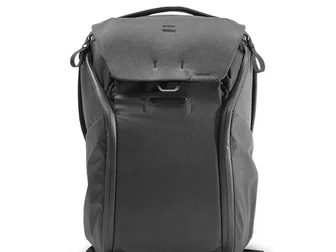
Let me start here because it is the bag literally every photographer owns. The Everyday V2 30L is gorgeous, the FlexFold dividers are genuinely brilliant, and the MagLatch top access is the most fun piece of camera-bag engineering in a decade. I have carried mine to client meetings, on planes, and to dinner. It looks like a normal backpack. I love that about it.
But — and this is the part I wish someone had told me before I bought one — it is not a hiking pack. The shoulder straps are thin. There is no real hip belt. After two hours on a real trail with my GH7 and three lenses, the weight was on my shoulders and I was muttering. Peak Design makes the Capture clip, which is the single best camera accessory I own, but the Everyday Backpack is a city-and-travel bag with a camera insert. Not a hiking bag. If you only do easy one-hour walks, fine. If you do all-day stuff, look elsewhere.
Price: roughly $280 for the 20L, $300 for the 30L. Lifetime warranty, which is amazing. Buy it for travel, not for the trail.

Atlas Athlete Pack — the Hiking-First Camera Backpack I Keep Coming Back To
I have been testing the Atlas Athlete for almost a year now and it has become my default hiking pack. The thing that makes it different is the Shallow Origami Camera Core — basically a fold-out padded insert that lets the camera sit close to your spine instead of swinging around in a cavity. Result: the center of gravity stays where hiking backpacks want it, and you can actually walk for hours without feeling like you are wearing a brick on your back.
It also comes with a real hiking hip belt. Not a daisy-chain strap with a clip — an actual load-bearing belt with foam and webbing, and you can swap sizes to fit your torso. The pack is 20L when compressed for an under-seat carry-on, 30L as a daypack, and 40L for an overnight mission. I have done all three modes. The 30L mode is the sweet spot for a full day hike with my GH7 and the 12-40mm, plus a 70-300mm in the upper compartment, water, and a rain shell.
Weight: 4.95 lbs. Price: around $425 for the pack, with the hip belt as a $400 add-on. Yes, the hip belt costs as much as a decent tripod. It is worth it. Carryology gave it best camera bag. I am not going to argue.

NYA-EVO Fjord 36 — for the Person Who Actually Climbs
If the Atlas Athlete is the sweet spot, the Fjord 36 is the "I am going to use this as my only pack for a six-day Iceland trip" pick. 36L, weighs about 1.7 kg without the camera insert, comes from a brand founded by adventure photographers who got sick of the existing options. The material is ECONYL regenerated nylon — so it is recycled fishing nets, which is a fun fact to drop at dinner.
Real talk: this is the pack I would take if I were doing a multi-day hike with my GH7. It is not the lightest. It is not the cheapest (around $270 for the bag, the camera insert is sold separately). But it is the most outdoor-built. Weather-sealed zippers, reinforced bottom, helmet attachment points, hydration sleeve. It feels more like a real hiking pack that someone added a camera compartment to, instead of the other way around.
Travel photographers like Paul Reiffer and Acacia Johnson have been using Fjords for years. They are not paying me. The bag is just good.
Other Bags Worth Knowing About in 2026
Shimoda Explore V2 35L — discontinued, sadly, so do not buy new. Used market only. The replacement has not dropped yet. F-Stop Tilopa DuraDiamond — still has the best 20-year warranty in the industry and the ICU system pioneered the modular camera bag idea. Think Tank Backlight 36L — solid American-made option, no waterproofing but the rain cover is built in. Lowepro ProTactic BP 450 AW II — fine, but it is 2.8 kg for 25L, which is nuts. The F-Stop Tilopa at 1.9 kg fits twice as much.
How I Picked, How You Should Pick
My honest ranking for the hiking-photographer use case in 2026:
1. Atlas Athlete — best balance of hiking comfort, camera protection, and versatility.
2. NYA-EVO Fjord 36 — best if you are doing multi-day trips or genuinely tough conditions.
3. F-Stop Tilopa DuraDiamond — best value long-term because the warranty is 20 years.
4. Peak Design Everyday V2 — buy it for travel, accept it is not really a hiking pack.
The big mistake I see people make is buying a peak-design-looking "camera backpack" off Amazon for $80 and then wondering why their back hurts after an hour on a real trail. You would not hike in Converse. Do not hike in a soft-shell city bag either.
The Bottom Line
There is no single best camera backpack for hiking photographers in 2026. There is the one that fits your body, your kit, and your trips. If you do mostly day hikes and want a bag that also works for travel, get the Atlas Athlete. If you do multi-day backcountry stuff, the Fjord 36. If you only hike occasionally and need one bag for everything, the Everyday V2 with a real hip belt you bolt on later.
I have been carrying my GH7 and the 12-40mm f/2.8 PRO II on Hong Kong trails for years. The bag matters more than the camera body. The wrong pack will ruin a hike faster than the wrong lens will ruin a photo. Spend the money.
Want more hiking-photo gear talk? I wrote about the Peak Design Travel Tripod three years in — same theme, tripod instead of backpack.