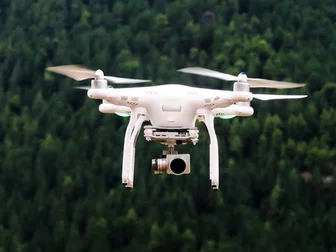
Why I finally caved and bought drone filters
For the longest time I thought drone filters were a scam. Like, the Mavic already shoots flat D-Log-M, right? Why would I slap another piece of glass in front of a gimbal camera that already struggles with weight? But then I flew over this lake at golden hour last fall, and the water looked like a giant mirror — except not the good kind. More like a blown-out sheet of silver. My GH7 with the OM 12-40mm would've handled it with a polarizer in two seconds. The drone? Total mess.
That was the day I admitted filters matter for aerial landscape work. Not every filter, though. Most kits are overpriced junk that adds vignetting and makes the gimbal work harder. So after a year of testing, losing a few in grass, and one very sad crash into a creek, here's what I actually recommend.

ND filters: the only way to keep motion looking natural
Drone cameras have tiny sensors and fixed apertures. That means in bright daylight you're stuck at a shutter speed that makes everything look twitchy. Clouds jitter. Water turns into a strobe. Even slow pans feel nervous. An ND filter is basically sunglasses for the sensor — it lets you drop the shutter to 1/50s or 1/60s so motion looks cinematic instead of security-camera-ish.
I mostly use ND8 and ND16 on my drone. ND8 is the workhorse for partly cloudy days. ND16 is for harsh midday sun or bright snow. Some people swear by ND32 for desert work, and yeah, if you're shooting sand dunes at noon, go for it. For 90% of landscape stuff though, ND8 and ND16 cover you.
Polarizers: not magic, but close over water
A circular polarizer on a drone is a little weird because you can't rotate it by hand. The good kits let you thread it to a preset angle before takeoff, or they build the polarization into the mount at a fixed orientation. It's not perfect, but when the angle lines up — haze cuts, foliage pops, and water goes from chrome to glass.
Here's the catch: polarizers eat about a stop and a half of light. On a drone that already hates low light, that matters. I only fly the polarizer when I know the scene has reflective surfaces worth taming. Forest streams, waterfalls, coastal rocks — yes. Open fields at sunset — probably not.
What to look for in a kit
First, weight. Every gram matters on a gimbal. Cheap metal rings can throw off balance and cause micro-vibrations. I look for aluminum or magnesium frames that are specifically matched to the drone model. Second, optical quality. If the filter adds softness or color cast, it's worse than no filter. Third, the case. Sounds dumb, but when you're swapping filters on a hillside, a decent case saves you from losing a $60 disc in the grass.
Also — and this is important — make sure the kit is made for your exact drone. A filter for the Mavic 3 Pro will not fit the Air 3S. The gimbal geometry is different and you can physically damage the camera if the filter bumps the housing during startup.
My top picks right now
For DJI Mavic 3 Pro shooters, the Freewell Bright Day 4K Series is hard to beat. The ND8/PL and ND16/PL combos are genuinely useful, the coatings are clean, and the threading is smooth. It's not cheap, but I've had zero gimbal errors with theirs.
If you're on a Mavic Air 3 or Air 3S, the K&F Concept magnetic ND set is a great budget option. The magnets are strong enough that I haven't lost one yet, and the color neutrality is surprisingly good for the price. Just don't expect the same flare resistance as the premium brands.
For Mini 4 Pro pilots, I honestly think the DJI official ND filters are the safest bet. Third-party options exist, but the Mini gimbal is so small that tolerances matter a lot. I've seen cheap filters cause the gimbal to calibration-fail on startup.
If you want the deep technical breakdown, Gerald Undone has a great video on why shutter angle matters for drone footage.
What I skip entirely
Variable NDs for drones. Just no. They're thick, heavy, and the cross-polarization can do weird things to wide-angle drone lenses. Also skip any kit that claims 'universal fit' across multiple drone models. That's a red flag.
And please, don't buy a 12-filter mega pack unless you know exactly why you need each one. Most people use three filters max. The rest just sit in the case and make you feel guilty.
Final thought
Drone filters won't fix bad composition or boring light. But on a good landscape day, the right ND or polarizer can turn a decent aerial clip into something that actually feels cinematic. Start with an ND8 and an ND16. Add a polarizer once you know the kind of scenes you fly most. And for the love of god, test the gimbal calibration on the ground before you launch with a new filter.
My GH7 will always be my main landscape camera, but the drone has earned its place in the bag. Filters were the last piece of the puzzle. Now if only I could stop crashing them into trees.