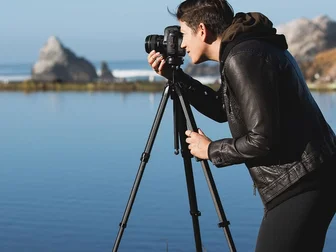
Three years and a lot of airline luggage tags
I bought the Peak Design Travel Tripod in carbon fiber back in 2023 for a single reason — I was tired of lugging my old Manfrotto 190XPro through Hong Kong MTR stations at 5am. That thing is solid, no question, but it's also a beast. The bag was so wide I had to angle it past strangers on the escalator like I was carrying a surfboard. The Peak one? Water-bottle diameter. Sold.
Three years later, the carbon version is sitting at 1.27kg on my bathroom scale, still deploys in about ten seconds when I'm not fumbling, and has been on maybe 60 flights and a hundred day trips. So yeah — this is a real-world take, not a one-week honeymoon review. Spoiler: I still use it. But there are a few things I wish someone had told me before I dropped the cash.
The thing that actually saves your back
Let me just say it: the folding design is not a gimmick. When I pack for a hiking trip to Lantau Island with the GH7 and the OM 12-40mm f/2.8 PRO II, the tripod goes into the side pocket of my Shimoda Action X30. The whole camera kit — body, two lenses, tripod, Peak Design capture clip — fits in one bag. With the old Manfrotto I had to bring a separate tripod sling. That alone changed how I shoot.
Peak claims the deploy time is 9.6 seconds and honestly that's about right when you don't fight the leg locks. The cam-style locks are the only thing that genuinely annoys me because they have a learning curve. First month I was cussing at them in the dark trying to feel the open/close direction. Now it's muscle memory, but it took longer than I expected.

Stability — the part I was actually worried about
I'm not going to pretend this is as stable as my friend's Really Right Stuff TVC-34. It isn't. The carbon legs flex a bit when I've got the GH7 fully extended at eye level and the wind is doing its thing. But for a 1.27kg travel tripod, it's ridiculous how much abuse it takes. I've shot 30-second exposures at ISO 100 handheld-free on a windy Tung Ping Chau afternoon and gotten keepers.
The ball head is the unsung hero. It's a weird asymmetric design that looks like it shouldn't work, but the single big tightening knob controls everything smoothly. Compared to my GH7 on a Manfrotto 405 geared head, the Peak is faster but less precise. For travel and run-and-gun I take the Peak every time. For studio product shots I still want geared.

The quirks that will either bug you or not
Couple of things that genuinely piss me off. First: the center column. To get the ball head to rotate freely you have to extend the column slightly — a real head-scratcher the first time. Why? I dunno. Peak designed it that way so the folded package is smaller, but it's still a small "WTF" moment for new users.
Second: the phone mount. There's an integrated one tucked into the center column. Cool idea. In practice it's fiddly, it doesn't hold my iPhone 15 Pro Max securely with a thick case, and I just use a Peak Capture clip on my belt instead. Honestly I would trade the phone mount for a built-in bubble level but I guess that's a me problem.
Third — and this is the controversial one — the price. $599 for carbon fiber, $399 for aluminum. The aluminum is 200 grams heavier and honestly fine for most people. I caved for the carbon because I was hiking a lot and every gram mattered. If you're a studio photographer who occasionally travels, save the $200 and get the aluminum. The performance is nearly identical.
Three years of wear — what actually broke
Here's the part I was most curious about when I started writing this: did anything actually fail? Honestly, almost nothing. One of the rubber feet came unglued after about 18 months — Peak sent me a replacement under the lifetime warranty, no questions. The anodizing on the leg sections has some scuff marks from being knocked around in overhead bins, but it's purely cosmetic. The center column has a tiny scratch from a stupid moment trying to deploy on a rocky beach. That's it.
Compare that to a $200 AmazonBasics tripod I owned for 14 months where the leg lock completely seized. The Peak feels like it was built by people who actually carry cameras for a living. That matters.

Who should actually buy this
Look, I'm biased because I shoot MFT and travel a lot. The GH7 + 12-40mm f/2.8 PRO II combo is already light, and the Peak tripod complements that kit perfectly. If you're shooting a Canon R5 with a 24-70 f/2.8 and you need max stability, the Peak still works but you'll feel the limits faster than I do.
Buy it if: you travel more than four times a year, you carry a single body + 2-3 lens kit, and you value pack size over absolute max stability. Skip it if: you shoot mostly in a studio, you need a video fluid head (Peak sells a separate video head conversion kit), or you're a landscape photographer who needs 200mm telephoto stability in 30mph wind.
I was going to write "highly recommended" here but that sounds like an ad. Let me just say: it's been in my kit for three years, I haven't replaced it, and I don't see myself replacing it for at least another three. That's the highest compliment I can give a piece of gear.

One more thing — the warranty experience
I mentioned the foot came unglued. I emailed Peak support a photo on a Sunday night. They replied Monday morning with a prepaid shipping label. New feet arrived Thursday. No "did you drop it," no "is it within the return window," no runaround. For $599 gear, that level of customer service is part of the value. It's why I keep buying their stuff even when it costs more than the competition.
Anyway, that's my honest take. Three years, dozens of trips, one minor warranty claim, and zero regrets. If you want to read the original tech breakdown DPReview did when the tripod launched, here's the link: DPReview Travel Tripod review. Otherwise — go shoot something.