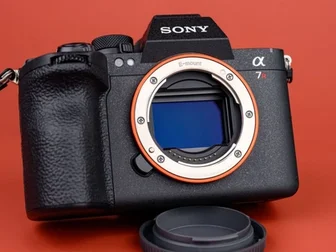
Twenty years of Alpha
I was not yet shooting with a digital camera on June 5, 2006, but Sony was just starting to make the most consequential bet in its imaging history. That's the day the company announced the Alpha 100 — a 10.2MP APS-C DSLR built on the bones of the Konica Minolta mount it had just acquired. Inside the body, the SteadyShot INSIDE system became the first in-body image stabilization to be offered as a body feature, paired with every compatible lens.
Twenty years later, Sony says the Alpha mount now spans 70+ bodies and an entire E-mount lens system. The a7R VI started shipping in early June at $4,499.99 USD — and it just took the crown for the highest dynamic range of any full-frame camera Photons to Photos has tested. Two milestones, twenty years apart, same line on the spec sheet.
The a7R VI dynamic range test that broke the chart
Bill Claff from Photons to Photos published the numbers on June 4, and they're not subtle. The a7R VI hits 12.55 PDR (Photographic Dynamic Range) at base ISO 100 with the mechanical shutter — that's about a full stop better than the a7R V (11.69 PDR) and the highest score ever recorded for a normally-used full-frame sensor. The only thing that beats it is the a7R III's pixel-shift multi-shot mode, which requires a tripod, Sony's external stitching software, and perfectly stationary subjects.
The electronic shutter loses about a stop at base ISO (11.4 PDR), but the gap closes by ISO 640 where the two shutter modes converge. Translation: for action or street work above ISO 640, you can shoot fully electronic with zero dynamic range penalty. For tripod landscape at base ISO, the mechanical shutter is your friend.

How Sony pulled this off — the DGO trick
The reason is something image-sensor specialist Adam Horshack pointed out to PetaPixel: the a7R VI almost certainly uses Dual Gain Output (DGO) on its mechanical shutter. The sensor reads each exposure twice, once at low gain and once at high gain, then combines them to get the best of both worlds — clean shadows and bright highlights from a stacked sensor architecture. Historically stacked sensors have struggled to match traditional BSI designs in dynamic range, so this is a meaningful engineering win.
Sony also added a brand-new battery (the NP-SA100, 2,670 mAh, rated 710 shots CIPA) and a 9.44M-dot OLED viewfinder that the company claims is roughly three times brighter than conventional EVFs. The BIONZ XR2 processor with integrated AI handles Real-time Recognition AF+ with skeletal-based pose estimation — overkill for landscapes, useful for events and hybrid shooters.
A milestone and a release in the same week
June 5, 2026 was the anniversary. June 2026 is when the a7R VI hits shelves. That timing is probably a coincidence but it lands well. The Alpha 100 in 2006 was an "outsider" camera — Sony had never made a DSLR before and was betting on inherited Konica Minolta technology. The a7R VI in 2026 is Sony flexing twenty years of accumulated sensor engineering, BIONZ processor generations, and lens ecosystem depth.
Yang Cheng, VP of Imaging Solutions at Sony Electronics, put it this way in the official announcement: "The Alpha 7R series stands for image quality you can trust on screen, in print, and in the most demanding conditions. The Alpha 7R VI takes that further with the speed, intelligence, battery life, and viewfinder quality our creators have been asking for."

Should you upgrade?
If you're on an a7R IV or V, the jump isn't free — $4,500 — but the dynamic range bump is real, the AF system is meaningfully better, and the new battery alone is roughly 1.3× the capacity of the FZ100. If you're coming from older A7R bodies or a different system, this is the high-resolution mirrorless camera to beat in 2026.
For the full deep-dive, the PetaPixel review is here:
PetaPixel a7R VI dynamic range article. Happy 20th, Alpha.