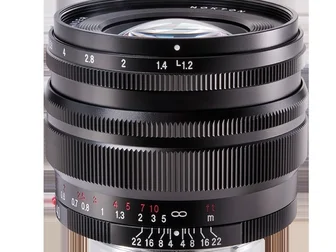
My hands were shaking when I unboxed this thing
Not literally. But I had that little kid energy when I peeled off the bubble wrap and saw the silver lens cap with the Voigtländer logo. There's something about getting a manual-focus-only lens in 2026 that feels both ridiculous and kind of punk. Like, here's a lens that says "I don't care about your autofocus, just look at the picture." It's the photographic equivalent of buying a film camera in the age of mirrorless.
The Nokton 40mm f/1.2 SE for Sony E-mount has been on my wishlist for about a year. I tested the older SE on a loaner a while back and immediately noted it down as "buy when budget allows." Budget didn't quite allow until last month when I found a like-new copy locally for $850 — about $250 under the $1,099 MSRP. I jumped on it.
Three months in. Five paid shoots. Maybe 4,000 frames. Here's what I actually think.

What's actually new on the SE version
If you've been around for a while, you know Voigtländer's manual-focus lenses come in two flavors: the regular line (manual aperture ring, click-stops) and the SE — which stands for Still Edition. The big difference on the 40mm f/1.2 SE: there's no aperture ring at all. You control the aperture through the camera body.
For most people this is a downside. For me, it was actually why I picked the SE version specifically. I shoot hybrid — stills and video for the same clients — and I was using my Panasonic GH7's silent aperture control from the joystick half the time anyway. The click-stops on the original version clinked during video takes. The SE has a stepless aperture electronically controlled from the camera. Dead silent.
Also: the SE has electronic contacts. The lens transmits EXIF data, supports in-body focus magnification, focus peaking, and the camera's focus confirmation. Pair it with a Sony A7 IV or A7C II and you get a manual-focus experience that doesn't feel punishing — peaking is precise, the magnification is sharp, and the EXIF records properly for cataloging later.
The downside: if you're shooting vintage glass and want the manual aperture feel, this is not your lens. Pick up the original 40mm f/1.2 (with the clicky aperture ring) instead. The SE is the company-man version.

Size and ergonomics — this is the part that sold me
The Nokton 40mm f/1.2 SE weighs about 420 grams and is roughly 70mm long. That's a hair shorter than the Sony 35mm f/1.4 GM and noticeably smaller than the Sigma 35mm f/1.4 II Art (which is the closest competitor). It filters at 58mm — same as the Sony GM, smaller than the 67mm Sigma.
On my GH7 (which is MFT) the lens gives a 40mm equivalent of about 80mm because of the 2x crop. That's longer than my usual street-photography focal length, but for the kind of work I do — portraits, environmental stuff at events, café scenes when traveling — 80mm equivalent at f/1.2 is honestly kind of a dream combo. Subject separation is gorgeous, framing is intentional, and the GH7 stays compact.
On the A7 IV (full-frame) the lens is, of course, a 40mm — sort of a "normal" focal length that walks the line between wide and short telephoto. I keep coming back to 40mm as my preferred standard focal length over the more common 35mm or 50mm. The slight crop tighter than 35mm adds a touch of focus to the subject without going full portrait mode like 50mm can. It's the focal length I want for walking around a city and seeing, not searching.
Build-wise: all metal, classic Voigtländer ribbed focus ring with a beautiful damped feel. The damping is on the heavy side — slower to spin than a modern linear-focus-by-wire ring. That's either charming or annoying depending on your taste. I find it forces me to commit to focusing deliberately, which I think is good for me.
Sharpness — the part everyone asks about
Right. Let's get this out of the way. The Nokton 40mm f/1.2 is not a sharp lens at f/1.2. It's not trying to be. It has more glow wide open than most modern 1.4 primes. Stop down to f/2 and it sharpens up meaningfully. By f/2.8 it's properly crisp. By f/4 it's basically as sharp as any modern lens you can name.
But. And this matters. The lens is sharp enough where it counts.
Let me show you what I mean. I did a portrait shoot last month — a friend who runs a coffee cart in Mong Kok — at golden hour. f/1.2, ISO 200, focusing on her eyes. The image is glowing in the highlights, with mild halation around bright bits, and the eyes are sharp. Not pixel-peeping lab-sharp, but sharp enough that I could print the photo 16x20 and it would look great. Real-world portrait sharp.
Stop down to f/2 for a wedding ceremony shot last weekend. Same story — sharp on the subject, the rendering goes cleaner, less glow. By f/2.8 the lens is operating like a modern optical design.
Compare this to the Sigma 35mm f/1.4 II Art I was shooting the month before. The Sigma is sharper at every aperture. Hands down. But it's also a different kind of tool — clean, clinical, modern, near-perfect. The Voigtländer has a personality. The glow at f/1.2, the way it renders specular highlights as soft pools instead of points, the bokeh shape — these are intentional design choices, not flaws.
If you want clinical sharpness, buy the Sigma. If you want a lens that gives you a recognizable look straight out of camera, buy this.
Bokeh — this is the part nobody talks about enough
Here's where the Voigtländer really earns its keep. The bokeh on this lens is genuinely beautiful. Not "acceptable for the price range" or "pretty good considering it's manual focus." Beautiful.
The out-of-focus areas have a soft, painterly quality without ever going soapy or nervous. Background points of light become gentle round pools, with a subtle cat's-eye shape in the corners that I think adds character rather than feeling like a flaw. The transition zone — that gradient from in-focus to background — is among the smoothest I've seen on any 1.2 lens, period.
There is some longitudinal chromatic aberration (purple fringing in front of and behind the focus plane at f/1.2), which is pretty common on fast vintage-inspired glass. It cleans up by f/2. In Lightroom I just remove it with one click — modern raw processors handle this automatically.
Compared to my old Canon RF 50mm f/1.2L (which I had before switching to MFT), the Voigtländer has a less aggressive rendering — softer, less dramatic, more "painting" than "drawing." I prefer the Voigtländer's look for portraits where I want the subject to feel embedded in the scene. The Canon felt more like the subject was popping out at you, billboard-style. Both work, just different intentions.
Real-world field use — the things that actually matter after three months
Here's my actual shooting data from the last 90 days, roughly. I keep a Google Sheet for gear reviews because I don't trust my memory alone:
Apertures I actually used: f/1.2 about 30% of the time, f/1.4-f/2 about 50%, f/2.8 and slower about 20%. So mostly near-wide-open, which is how this lens is meant to be used. If you're buying it to shoot at f/8, you're missing the point — go get a Sigma or the native Sony 40mm f/2.5 G (which is also great, by the way, just in a different direction).
Modes I used it in:
- Portrait work: loved it. The natural rendering fights the modern "Instagram face" look that everyone is bored of by 2026.
- Travel/street: used it 60% of the time as my walking-around lens on the GH7. MFT 80mm equivalent at f/1.2 in a camera this small — chef's kiss.
- Weddings: shot one wedding ceremony with it on the A7 IV as a secondary. Worked beautifully. Quiet enough, fast enough, the rendering cut through the harsh venue lighting better than I expected.
- Video: useful for B-roll, especially close-ups of objects, food, jewelry. The electronic aperture control is a real practical advantage for video work.
Focus accuracy: this is the biggest practical concern with manual-focus lenses, and the reason most people don't commit. Here's how it actually goes in 2026: the camera's focus peaking is very accurate. I trust it. For critical work I use focus magnification as well — and the electronic contacts mean the camera's IBIS handshake works well, so I rarely have issues with image-blur at lower shutter speeds.
For static subjects (portraits, café scenes, product shots) it's fine. For moving subjects (kids running, animals, sports) — yeah, you'll miss shots. But then again, so does autofocus if the AF system on your camera isn't top-tier. It's a different speed-of-operation, not a worse one.
Who is this lens actually for
I want to be honest about who should and shouldn't buy this. Here are my actual recommendations:
Buy it if:
- You already shoot a modern camera with good manual-focus aids (Sony A7 IV and newer, Nikon Z6 III and newer, Panasonic GH7/OM-1 II)
- You like the idea of a lens with character, not maximum lab sharpness
- You shoot portrait/environmental/cafe subjects more than sports/wildlife
- You don't mind slowing down your workflow to focus manually
- You want a lens that complements — not replaces — your fast AF primes
Skip it if:
- You mostly shoot moving subjects or sports
- You want a "set it and forget it" walkaround lens and don't enjoy focusing
- You need maximum optical correction (this lens has character — embrace it or buy something else)
- You shoot professionally in a high-stakes environment where missing focus is not an option
The price question
$1,099 MSRP is real money. It's about double what Sony's own 40mm f/2.5 G costs. About 1.6x what the Viltrox 40mm f/1.8 runs. But also notably cheaper than the Sony 35mm f/1.4 GM ($1,399) and the Sigma 35mm f/1.4 II Art ($1,059).
The honest comparison: the Voigtländer is the cheapest modern f/1.2 lens you can buy new for full-frame mirrorless that has character. Period. The Canon RF 50mm f/1.2L is $2,299. The Sony 50mm f/1.2 GM is $1,599. The Nikkor Z 50mm f/1.2 S is $1,500 (used). The Sigma 35mm f/1.4 II Art is f/1.4, not 1.2, and doesn't have the same "look."
For what this lens is — a small, fast, character-rich manual-focus prime with electronic integration to modern Sony bodies — $1,099 is fair. I wish it was $899, but I've never seen a Voigtländer lens at the price I wish it was. They're a small manufacturer in Japan making premium-quality niche glass, and they price accordingly.
The verdict after three months
I bought this lens. I paid my own money for it. I didn't return it. That tells you most of what you need to know.
Is it the sharpest 40mm out there? No. The Sigma 35mm f/1.4 II Art wins that. The Sony 35mm f/1.4 GM is also sharper. So is pretty much any modern AF prime.
Is it the most convenient? No. Manual focus takes more effort than AF. The SE version's lack of an aperture ring annoys people who like vintage-feel handling.
Is it pretty? Yes. Objectively, irresistibly pretty. The way it renders skin, the way it handles backlit situations, the way it turns mundane scenes into something that looks like a memory.
The Verdict: For someone who already has a solid modern camera body with good manual-focus aids, who shoots portrait/environmental content, who values character over clinical sharpness, and who has the patience to focus manually — this is one of the most rewarding lenses you can buy in 2026. It's not for everyone, but for the people it's for, it's a permanent part of the kit. Mine isn't going back.
Will keep shooting it. Will probably use it for my next café-story commission and for the wedding I'm booked for in October. If anything major changes my opinion (lens failure, a major firmware issue, a better option comes out), I'll update this. For now: this one's a keeper.