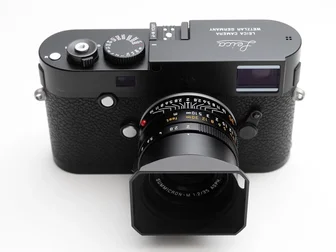
Why I keep coming back to fifty-year-old glass
I want to talk about something I probably shouldn't admit in public: most of my favorite photos from the last two years were taken with lenses older than I am.
Not all of them. I still reach for my OM 12-40mm f/2.8 PRO II on the GH7 for actual jobs. That combo is honest-to-god reliable, and I trust it with paid work. But on weekends, on personal projects, on the random Tuesday night when the light is doing something weird and I want to just walk — I've got a small wooden box on my desk that has a Leica Summicron 35 from 1978 in it, an old Nikkor 50mm f/1.4 AI-s, a Canon FD 28mm that's literally older than most of my friends, and a couple of M42 screw-mount primes I bought for like $40 each. None of these lenses autofocus. None of them talk to my camera's electronics. Two of them are slightly bent from getting dropped. And I keep going back to them anyway.
So this is going to be a real, opinionated thing about adapting vintage manual lenses to modern mirrorless bodies. The good, the bad, the slightly embarrassing parts. If you want a clean comparison chart and a B&H affiliate link dump, go read DPReview. This is more "I've been doing this for five years and here's what actually works" energy.
Let me just start with the most basic question —
Do modern mirrorless cameras actually play nice with old manual lenses?
Short answer: yes, shockingly well. Way better than DSLRs ever did.
Here's the thing. Old manual-focus lenses — we're talking Leica M, Nikon F, Canon FD, M42 Pentax screw mount, Contax/Yashica, Olympus OM — all of them were designed for a totally different era of camera. Mechanical focus, mechanical aperture, the photographer doing the work. On a DSLR you'd slap one on with an adapter and get a confirmation dot if you were lucky. There was no focus peaking, no magnified live view, no exposure simulation that actually helped. You were basically shooting blind.
Mirrorless changed everything. The EVF shows you the actual image. Focus peaking lights up the in-focus edges in whatever color you pick. Magnified view lets you nail manual focus at f/1.4 wide open without guessing. And most bodies — Sony A7/A7 IV, Nikon Zf, Fuji X-Pro3, even my GH7 — handle adapted glass with basically zero drama. The camera doesn't care. The lens doesn't care. You just have to do the focusing yourself, which, yeah, is the whole point.
I'll be specific. I've shot a 1969 Leica Summicron 35mm on a Sony A7 IV and the EVF was so good I could nail focus on a moving kid's eye at f/2. No AF needed. That's not something you could do in 2010.

What adapters actually work (and what is a waste of money)
OK so the adapter world is a minefield. There are like forty different M-to-E adapters on Amazon and most of them are made of cheese. Let me cut through it.
For Leica M glass on Sony E, Nikon Z, or Fuji X: get a TechArt or a Voigtländer adapter. Spend $80-150. The cheap $25 ones feel OK at first, then develop play after six months and your lens starts wobbling on the mount. Not worth it. TechArt is my go-to. Solid feel, the bayonet locks with a satisfying click, no slop.
For Canon FD on Sony/Nikon/Fuji: the K&F Concept adapter is fine. Like $35. The Metabones FD-to-E is fancier but $200+ and you don't need it unless you're using speed-boosting (which is for video nerds, mostly). Save your money.
For Nikon F (pre-G, the AI and AI-s era) on Sony E: get one with an aperture ring control. The dumb adapters force you to stop down via the lens's own aperture ring, which works fine for stills but is a pain for video. The "dumb" adapters are $20. The smart ones (TechArt again) are $250. Get the dumb one unless you're doing hybrid work.
For M42 screw mount (Pentax Takumar, Zeiss Jena, older Soviet stuff): the cheapest M42-to-E adapter is fine. $12. They don't have moving parts. Just screw the lens on.
One thing I will say: don't buy "focus-confirmation" adapters. They don't actually work reliably on mirrorless bodies because the phase-detect system doesn't read contrast properly through cheap adapters. Save your money.
The lenses that are actually worth hunting for
Here's where I'll get spicy. There are a thousand vintage lenses out there. Most of them are bad. Some of them are legendary. And the prices have gone genuinely insane in the last five years. So let me tell you what's worth it in 2026.
The cheap kings
Anything M42 (Pentax Takumar 50mm f/1.4 in Super-Multi-Coat version is the GOAT for the price — I paid $60 for mine, it's magical at f/2.8). Helios 44-2 58mm f/2 (Soviet, $25, swirly bokeh that people lose their minds over). Canon FD 50mm f/1.4 SSC (the older one with the metal focus ring, not the later plastic one). All under $100, all genuinely fun.
The mid-tier sweet spot
Leica Summicron 35mm f/2 v3 (the 1970s version with the built-in hood) runs $400-700 depending on condition. It's the best 35mm lens I've ever used and I will fight anyone who says otherwise. The Nikkor 50mm f/1.4 AI-s is $200-300 and it's just — yeah, it does everything right. The Canon FD 28mm f/2.8 SSC is the best wide normal you can buy for under $300.
The grail tier (and why I do not own most of them)
Leica Summilux 50mm f/1.4 ASPH (current, $5,500) is genuinely worth it if you're a working photographer and you know why. The vintage Summilux 50mm f/1.4 v1 ("King of Bokeh") is $3,000+ now and the prices have gone up 4x in five years. I am not paying that. Carl Zeiss Contax 50mm f/1.4 Planar (the MMG version) is $1,500-2,000 and is one of the best manual focus lenses ever made. But honestly — the difference between the $300 Nikkor 50mm f/1.4 AI-s and the $2,000 Zeiss Planar is like 8% on a chart and 50% in your bank account. Unless you're getting paid for the shots, it's not worth it.
I'll be honest with you — the boom in vintage lens prices is partially because of mirrorless cameras. The whole "I can use my 1968 lens on my 2026 body" thing made people who never used manual focus suddenly want to. And the market responded. Three years ago I got a Leica Summicron 35 v3 for $380. Last month I saw the same lens in similar condition go for $720.
How the glass actually behaves on a modern body
A few things nobody tells you when they sell you on the "vintage lens life."
Chromatic aberration. Old lenses, especially wide angles shot wide open, will have purple or green fringing on high-contrast edges. The Summicron 35 is mostly clean. The Canon FD 28 f/2.8 is clean. The Helios 44-2 is a mess at f/2 — like rainbow spaghetti mess. You can fix some of it in post but it's annoying when you're shooting backlit.
Focus breathing. This is the one that gets hybrid shooters. Vintage lenses change focal length when you focus close. A 50mm lens becomes a 55mm or 58mm when you focus on a close subject. For stills this doesn't matter. For video, it's distracting. Modern cinema lenses fix this. Vintage lenses almost never do.
Flare resistance. Old coatings are way worse than modern coatings. Shoot a vintage lens into backlight and you'll get veiling flare and reduced contrast. Sometimes it looks beautiful and dreamy. Sometimes it looks like you accidentally smeared vaseline on the front element. Roll the dice.
Color rendition. This is the magical part. Modern lenses render colors clinically. Old lenses render colors opinionatedly. The Summicron has this warm, slightly amber bias that makes golden hour look like scripture. The Takumar 50 has this greenish-yellow tint that's honestly terrible in overcast light and gorgeous in summer sun. You start learning which lens for which light, and then suddenly you're a painter with three brushes and you know when to use each.

What I actually shoot with (and when)
Right now my adapted-glass rotation is:
Leica Summicron 35mm f/2 v3 — my default. Street, environmental portraits, the lens I grab when I don't know what I'm shooting. $450 a few years ago, now worth double, worth every penny.
Nikkor 50mm f/1.4 AI-s — low light, indoor stuff, the look I want when I'm trying to capture someone being themselves. $280. Bought it for the price of dinner for two.
Canon FD 28mm f/2.8 SSC — landscapes, city stuff when I want a wider view. $220. Sharp as hell stopped down, dreamy at f/2.8.
Helios 44-2 58mm f/2 — portraits with swirly bokeh when I want the shot to look like 1973. $30. Makes people look like they're in a movie.
I don't take these on paid jobs. The risk of a random focus miss when a client is paying me is too high. But for everything else — personal work, weekends, the kind of photography that actually makes me happy — they're what I reach for.
The honest verdict
Here's what I think, after five years of doing this:
Adapting vintage manual lenses to modern mirrorless cameras is one of the most genuinely fun things you can do as a photographer in 2026. It's cheaper than modern glass, it gives you access to designs that haven't been made in 40 years, and it makes you a better photographer because you actually have to think about focus.
Is it for everyone? No. If you shoot sports, kids, events, anything that moves fast, autofocus wins. Manual focus is a luxury. But if you shoot street, landscape, environmental portraits, still life, anything where you can slow down — try it. Get a $60 Takumar. Slap it on your Sony or Nikon with a $30 adapter. Spend a weekend walking around with it. You'll either get it or you won't.
I got it. Hard.
And yeah — sometimes the image quality isn't as clinical as my modern lenses. The corners are softer. There's a tiny bit of purple fringing. The bokeh isn't as smooth as my 12-40mm f/2.8 PRO II at the same aperture. But the photos have this... I don't know, this texture that modern glass doesn't have. It's not technically better. It's just more me.
That's what vintage glass gives you. Not perfection. Just a more interesting version of yourself.