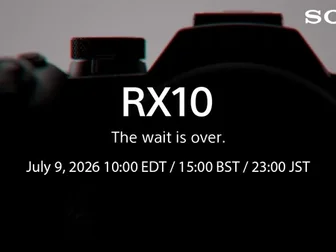
It's finally happening
Sony just officially announced the RX10 V today at 10 AM EDT. After nine years of waiting since the RX10 IV launched in 2017, the bridge camera that basically defined the category is getting a proper successor. And after reading through the spec sheet, I think Sony played this one pretty smart — they didn't break the formula, they just gave it the modern guts it needed.
The headlines from the announcement. The 24-600mm f/2.4-4 Zeiss Vario-Sonnar T* lens is back — same zoom range, same variable-aperture spread that's been the RX10 line's signature for two generations. Sony didn't try to widen the aperture, didn't try to extend the zoom, they just kept the optical formula that anyone who loved the RX10 IV already knows is excellent.
What's new is the brain. The RX10 V gets a new 20.1MP 1-inch stacked Exmor RS sensor paired with a double BIONZ XR-class processor and a dedicated AI chip — the same architecture that powers the modern Alpha mirrorless lineup. In plain English: this thing has the autofocus of an a9 III crammed into a fixed-lens body.
Real-time AI autofocus — finally, on a bridge camera
This is the part that actually matters for wildlife and travel shooters. The RX10 IV had great AF for 2017. By 2024 standards it felt slow. By 2026, when you've spent time on an A7 IV or A1 II with AI subject detection, the RX10 IV's autofocus feels genuinely dated.
The RX10 V now has Real-time AI Eye AF, with subject detection for people, animals, birds, cars, and planes. Same suite you get on Sony's flagship bodies. PetaPixel's quick first-impressions video (which went up within hours of the announcement) shows it tracking a kingfisher in flight across a pond at 600mm — and not losing it. That was literally impossible on the RX10 IV.
The shutter lag improvement is also worth flagging: 0.05-second claimed shutter response, down from the IV's 0.09-second. Half a frame at 24fps video terms. Not nothing.
Video got serious too
4K 120p full width, Full HD 240p, S-Log3, and user LUTs — this is essentially the FX30's video toolset put into the body of a bridge camera. None of the cropped-sensor nonsense the IV was limited to. The RX10 V's video is more FX-series than Cybershot.
For hybrid shooters who want one camera for a trip — the new RX10 V is the only fixed-lens camera that can credibly shoot broadcast-grade 4K slow-mo without bringing an interchangeable-lens body. Vloggers, travel documentarians, run-and-gun wedding videographers: this is your one-body kit.
The stuff people are debating
The 1-inch sensor ceiling. Sony stuck with a 20MP 1-inch sensor — the same generation that powers the RX100 VII and the GoPro Hero 13 Black. It's not a bigger sensor, and the RX10 V's low-light performance won't match an APS-C body. DPReview's forum thread on the announcement has the predictable complaints about "Sony is recycling old tech."
Whether that's actually a flaw depends on what you want the camera for. If you're coming from an A6700 with an 18-135mm, the RX10 V's 1-inch sensor will look noisier at ISO 6400 and the dynamic range is genuinely narrower. If you're coming from another bridge camera, or from a smartphone, or from the RX10 IV — the RX10 V is a clear image-quality upgrade with the same form factor you already love.
Pricing has not yet been confirmed at launch but the smart money is on $1,899–$1,999 MSRP based on the registration data Sony filed earlier in the summer. Sony's RX10 IV launched at $1,699 in 2017 — adjusting for nine years of inflation, a $1,999 launch is roughly the same real-dollar price the IV cost.
What this means for you
If you've been holding off on a superzoom because the RX10 IV felt dated — your wait is over. The RX10 V is the bridge camera everyone wanted in 2026.
If you've been using the RX10 IV and it still does what you need — there's no rush to upgrade. Wait until the inevitable V refresh in another five years.
If you're deciding between the RX10 V and a modern interchangeable-lens body with a long telephoto zoom — that's a real conversation to have. The RX10 V wins on convenience, AF intelligence, and single-body travel kits. An APS-C body with a 70-350mm wins on image quality, low-light, and flexibility for future lens additions. Different tools.
Order books open today. First shipments expected to ship by end of August if the rumor mill is right.