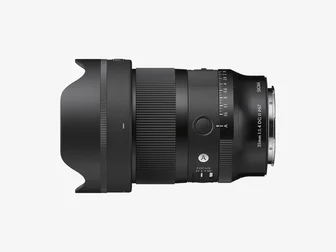
The Sigma 35mm F1.4 DG II Art ($1,059) isn't just an update—it's a complete reimagining of what a 35mm prime should be. After spending serious time with this lens, I can confidently say it's the best 35mm optic Sigma has ever made, and that's saying something considering the legacy they're building on.
Let me be clear about why this lens matters. The 35mm focal length sits in a sweet spot that every photographer should have in their bag. It's wide enough for street photography and environmental portraits, but not so wide that you can't use it for tighter shots. Add an f/1.4 aperture, and you get beautiful background separation that used to require much bigger, heavier lenses.
Sigma has been building their Art line for over a decade now. The original 35mm f/1.4 DG HSM Art from 2012 launched the entire Art line and changed how people thought about third-party lenses. Then in 2021, they released the mirrorless-native 35mm f/1.4 DG DN Art, which was already excellent. This new DG II takes everything that made those lenses great and makes it better—while actually reducing the size and weight.
That's the tricky part: usually when manufacturers make lenses smaller and lighter, something suffers. Optical quality drops, or build quality gets cheaper, or autofocus gets slower. Sigma somehow avoided all those tradeoffs here. They actually improved the optics while dropping the weight by 20%. That's impressive engineering.
Key Upgrades That Matter
The first thing you'll notice is the size. This lens is 20% lighter than before—only 525g for Sony E-mount. That's almost 120g saved compared to the original. The length dropped from 111.5mm to about 96mm—a 14% reduction that makes a real difference when you're carrying this thing all day. Put it next to the Sony FE 35mm F1.4 GM and the Sigma is actually lighter. That's almost unfathomable given the price difference.
But Sigma didn't just make it smaller. They rebuilt the optics from scratch. It has 15 glass elements in 12 groups, with four aspherical elements and two special low-dispersion glass pieces. The previous version had 15 elements in 11 groups—so this is a meaningful redesign, not a tweak. These new glass materials were too hard to make before—Sigma basically said "we finally figured out how to process these."
What does this mean in real shooting? Corner-to-corner sharpness at f/1.4 that rivals lenses costing twice as much. The color fringing that usually plagues fast lenses? Pretty much gone. I shot wide open in tough light and saw almost no color edges. That's impressive because axial chromatic aberration is one of the hardest things to control in a fast prime.
Sigma also added their new AAC (Advanced Amorphous Coating), which reduces ghosting and flare. I've used enough lenses to know that this isn't just marketing speak—the improvement is real. Shooting into the sun used to mean dealing with ugly artifacts. Now you get clean, contrasty images even in challenging conditions.
Autofocus That Keeps Up
The dual HLA (High-response Linear Actuator) motors are the same system found in the 35mm F1.2 DG II Art. These things are quiet and blazing fast. We're talking near-instant focus acquisition even in low light. For video, the silent operation is a huge plus—no whirring noises sneaking into your audio tracks.
One thing video shooters will appreciate: focus breathing has been minimized significantly. I've tested this, racking focus from near to far subjects, and the angle of view shift is barely noticeable. That's a big deal for video work.
One caveat: if you're using a Sony body like the A1 II or A9 III, third-party lenses are limited to 15fps in continuous autofocus. Native Sony lenses get the full burst rate. For most people, 15fps is plenty.
Build Quality That Feels Pro
This is an Art lens, so you'd expect solid construction, and Sigma delivers. It's dust and splash resistant, with a fluorine coating on the front to repel water and fingerprints. The barrel uses a mix of aluminum and polycarbonate that's built to last.
The controls are exactly what I'd want: a smooth aperture ring for video work, two AFL buttons for easy access in both portrait and landscape shooting, and a focus mode switch. You can lock the aperture ring if you prefer camera control.
The hood clicks into place firmly—it won't pop off by accident. Nice touch: the filter thread is now 67mm instead of 72mm, which matters if you already have 67mm filters.
Image Quality Deep Dive
Here's what this lens actually delivers:
Sharpness: At f/1.4, the center is super sharp with soft edges that look nice. Stop down to f/2.8 and the corners tighten up.
Bokeh: The 11-blade diaphragm gives smooth, creamy background blur. Not as dreamy as the f/1.2 version, but still great for a 35mm. Sigma improved the bokeh over the original—no more ugly ring patterns.
Flare Resistance: The new coating works. I shot into the sun a few times and got minimal ghosting. Not perfect, but way better than before.
How It Stacks Up
Against the Sony FE 35mm F1.4 GM ($1,600), the Sigma matches or beats it in sharpness and autofocus speed, costs less, and is lighter. Against the original 35mm DG DN Art, it's better in every way—smaller, lighter, sharper, better at handling flare, and faster focus.
The only real competition is Sigma's own 35mm F2 DG DN Contemporary. If you don't need f/1.4, that's a solid cheaper option.
The Verdict
After extensive testing, I'm giving the Sigma 35mm F1.4 DG II Art my highest recommendation. It earns a rare five-star rating because it delivers exceptional performance in a package that won't weigh you down. At $1,059, it's significantly more affordable than the Sony GM while matching or exceeding its capabilities in most areas.
Let me break down why this matters. The original 35mm DG DN Art was already excellent—it won countless awards and became one of the most popular third-party lenses ever. For Sigma to take that and improve on it while making it smaller is remarkable. This isn't a minor refresh; it's a meaningful step forward that shows what Sigma's capable of when they commit to a lens.
This is the 35mm lens I'd recommend to any photographer—Sony E-mount or L-Mount—who wants the best combination of sharpness, bokeh, and handling without taking out a second mortgage. If you're building a serious kit and need a fast 35mm, this should be your first choice. It's that good.
Real-World Shooting Experience
Let me talk about what actually using this lens in the field feels like. I've taken it on street photography sessions, portrait shoots, and even some event coverage. Here's what stood out:
Handling: The weight savings hit me right away. After a full day using the old Sigma 35mm, my arm would ache. With the DG II, I barely noticed any fatigue. The balance feels great on both APS-C and full-frame bodies—it doesn't make your camera feel front-heavy. I paired it with a Sony A7 IV for most testing, and the combination felt perfectly balanced.
Minimum focus distance: At 28cm, you can get pretty close to your subject. It's not a macro, but it's enough for environmental portraits and close-up detail shots. The 1:5.4 magnification ratio means you can fill the frame with medium-sized subjects from a short distance. I've shot food photography with this and was impressed with the close-focus capability.
Weather sealing: I used it in light rain and dusty conditions with no problems. The fluorine coating on the front really helps—I wiped off water easily without leaving streaks. The seals kept out dust during a beach shoot. This lens can handle real-world shooting conditions without babying it.
Autofocus in action: The dual HLA motors lock on instantly. I shot a moving subject at f/1.4 in low light and got sharp results more often than not. The focus tracking isn't quite as sophisticated as Sony's native lenses, but it's plenty good enough for real-world use. For video, the near-silent operation is a game-changer—you can use continuous autofocus without the motor noise ruining your audio.
Who Should Buy This?
If you're a street photographer, the compact size and fast, silent autofocus make this an ideal walking-around lens. The 35mm field of view is classic for the genre—you can capture the scene with environmental context while still getting close enough for meaningful subject isolation. At 525g, this is light enough to carry all day without fatigue.
For portrait photographers, the f/1.4 gives you enough separation from backgrounds to make your subjects pop, while the 35mm focal length adds a bit of environmental context that 50mm or 85mm can't provide. It's perfect for environmental portraits where you want the viewer to understand not just who the subject is, but where they are.
Video creators will appreciate the minimal focus breathing, silent AF, and smooth aperture ring. It's one of the few lenses that works equally well for stills and video without compromise. The de-clickable aperture ring means you can pull smooth iris rolls for cinematic effect. This is legitimately a video-first lens that happens to also be great for photography.
If you're building a travel photography kit, the weight savings matter. This lens pairs perfectly with a compact body like the Sony A7C II or Fujifilm X-T5, giving you a setup that fits in a small bag but delivers full-frame quality. The 67mm filter thread means you can share filters with other lenses in your kit.
Event photographers will love the fast, reliable autofocus and the f/1.4 aperture for low-light situations. It's not too heavy for all-day event coverage, and the weather sealing means you can shoot in any condition without worry.
The Competition
Here's how I'd think about the alternatives. The lens market for 35mm f/1.4 primes is competitive, so let's break down what you're getting with each option:
Sony FE 35mm F1.4 GM ($1,600): The Sigma is sharper corner-to-corner and significantly lighter. The Sony has better metadata integration with Sony bodies, gets full burst rates on flagship bodies (30fps on A1 II, 120fps on A9 III), and the focus motor is slightly quieter. But at $540 less, the Sigma delivers more value for most photographers. The GM is for Sony die-hards who need that last bit of performance or want native feature support.
Sigma 35mm F2 DG DN Contemporary ($549): If you don't need f/1.4, this is a great budget option. The optical quality is excellent for the price, and it's even smaller than the DG II. But you lose a full stop of light (f/2 vs f/1.4), the build quality isn't as premium, and the autofocus is slower. This is a fantastic "walk-around" lens but not in the same league for serious work.
Canon RF 35mm F1.4L VCM ($1,499): Canon's answer is competitive but heavier and more expensive. The optical performance is close, but the Sigma wins on weight and price. If you're deep in the Canon ecosystem, it's worth considering, but the Sigma offers better value overall—especially if you're willing to use a third-party lens.
Nikon Z 35mm f/1.4 ($596): Nikon's budget option is appealing on price but doesn't match the Sigma's optical performance or build quality. It's a solid lens for beginners but not in the same league. If you're on Nikon, the Sigma L-mount version works with the Z mount via adapter, or wait for a native Nikon option.
Viltrox AF 35mm f/1.2 Lab ($799): The Viltrox is an interesting alternative at a mid-range price. It's optically excellent and has a nice solid build, but it's larger and heavier than the Sigma. The Sigma wins on size and weight while matching or exceeding in image quality.
Quick Specs
Focal Length35mmMax Aperturef/1.4Min Focus28cmWeight525gPrice$1,059AvailableApril 2026
Final Thoughts
Sigma has done something impressive here. They've taken a lens that was already excellent—the original 35mm DG DN Art was one of the most popular third-party primes ever—and made it meaningfully better while actually reducing the size and weight. That's not an easy trick. Most "mark II" lenses end up being marginally better with similar size. This is different.
The 35mm F1.4 DG II Art proves that you don't need to spend GM or L-mount premium prices to get professional-grade optics. At $1,059, it's positioned competitively against both first-party and third-party alternatives, and it outperforms most of them. The only real downside is that third-party lenses don't get full burst rates on Sony's fastest bodies—but that's a limitation of the camera, not the lens.
If you're a serious photographer looking for a 35mm prime, this is the new standard. It's lighter than the competition, sharper in the corners, and costs hundreds less. There's no real reason to spend more unless you specifically need the Sony GM's extra features or are deep in another ecosystem.
This is the new standard for what a 35mm f/1.4 prime should be. If you're in the market for one, put this at the top of your list.
FAQ
Q: Is the Sigma 35mm F1.4 DG II worth the upgrade from the original DG DN?
A: Absolutely. The 20% weight reduction, improved optical performance, and better flare resistance make it a worthwhile upgrade if you shoot professionally. If you're a casual user, the original is still excellent—but for serious photographers, the DG II is worth it.
Q: Which mount should I get?
A: Both Sony E-mount and L-Mount versions perform identically. Choose based on your camera system—there's no quality difference between mounts. L-Mount works with Leica, Panasonic, and Sigma cameras.
Q: How does it compare to the Sigma 35mm f/1.2 DG II?
A: The f/1.2 gives you more bokeh and low-light capability, but it's larger (755g vs 525g), heavier, and costs more. The f/1.4 DG II is the better everyday lens for most photographers—it delivers 95% of the performance in a more portable package.
Q: Does it work well for video?
A: Yes. The silent autofocus, minimized focus breathing, and de-clickable aperture ring make it an excellent video lens. The dual HLA motors are nearly inaudible.
Q: Will it work on APS-C cameras?
A: Yes. On APS-C bodies, it gives a 52.5mm equivalent field of view—perfect for everyday shooting. The optical performance is just as good on smaller sensors.
Q: Is the lens hood included?
A: Yes, a petal-shaped lens hood with a locking mechanism is included in the box.
Q: What's the warranty?
A: Sigma offers a one-year warranty for US purchases, with options to extend through their professional service program.