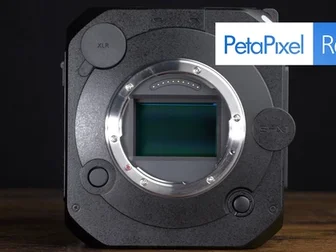
The Varicam era at Panasonic is effectively over, and the camera closing it wears a Lumix badge. Panasonic unveiled the Lumix SHX1 on November 17 — a compact box-style cinema camera that folds the company's professional AV and consumer imaging divisions into a single product, and the first compact cinema camera to carry Lumix branding, according to PetaPixel's announcement coverage.
Panasonic itself frames the SHX1 as the union of two legacies: Varicam's cinema pedigree and the S1H, the 2019 Lumix model that first pushed cinema-grade video into a mirrorless body. The practical result is a camera that costs $4,699.99 body-only, $5,499.99 in a kit with the XLR Handle Unit AU-XHU1 and Control Grip AU-GRP1, with shipping slated for January 2027.
Under the box shell, this is the S1 II's video pipeline with a few deliberate deltas. The 6K full-frame partially stacked CMOS sensor carries Dual Native ISO and Dynamic Range Boost, good for roughly 15 stops of dynamic range when shooting V-Log. ARRI's LogC3 comes preinstalled alongside Panasonic's own log curve, and Phase Hybrid autofocus covers 779 points with the same AI subject detection as the S1 II.
Recording tops out at 6Kp30 and 5.1Kp60 in 4:2:0 10-bit, plus a 3.8Kp48 4:2:2 10-bit mode that did not exist on the S1 II. Open Gate recording and in-camera anamorphic de-squeeze are on board, and the thermal design supports unlimited 4Kp120 capture.
Then there is the list of things Panasonic left out, which is where this camera gets opinionated. There is no internal ND filter — PetaPixel calls it "an odd exclusion given the target market" — so screw-in filters or a matte box are mandatory. 12-bit RAW comes in both ProRes RAW and BRAW flavors, but BRAW cannot be recorded to the CFexpress Type B or SD card slots and demands an external SSD instead.
In his same-day review, Jordan Drake scored the SHX1 7.5/10. The body weighs 948 grams, lands near a RED Komodo in size, and adds a top-mounted 1.84M-dot LCD with four-axis articulation — unusual for this class, and genuinely useful for shooting above eye level. The buttons drew complaints for their mushy, unresponsive feel, and an attached SSD stretches startup to nearly ten seconds, a real annoyance for run-and-gun work. On the plus side, the in-body stabilization is the best Drake has seen in a box-style camera, drawing directly on the S1 II's five-axis system with Dual IS 2 support when paired with OIS lenses.
Autofocus is reliable but a step behind Sony's and Canon's latest implementations, he found — humans and animals are detected and tracking is sticky, just not rock-solid.
The competitive field is crowded. RED's Komodo-X 6K ($4,995) and Blackmagic's Pyxis 6K ($2,249) both record heavily compressed RAW internally, something the SHX1 refuses to do without an SSD; neither offers IBIS, and their autofocus lags far behind. Sony's FX5 — the one that finally started shipping last week after months of delays — records compressed X-OCN RAW internally, takes an optional EVF, and has more dependable autofocus. The SHX1 counters with markedly stronger stabilization and industry-standard connections.
That IBIS point is the one that gets my attention. My handheld street work runs on a GH7 with the 12-40mm f/2.8 PRO II, and the only reason I can handhold a Micro Four Thirds rig down to 1/15s on the street and still come home with sharp frames is the stabilization holding the frame still. Nobody puts IBIS in a box camera — RED doesn't, Blackmagic doesn't — and Panasonic just did. For handheld documentary work, that changes the math against both of them.
Who is this for? Event shooters will still land on the Sony, and budget-first filmmakers get more per dollar from the Pyxis. But for commercial and documentary operators who rig in odd places and shoot handheld, a full-frame box camera with working IBIS and a $4,700 price tag is a combination that did not exist last week.
Panasonic also confirmed the AU-LPU1 Live Production Unit arriving in early 2027, which turns the SHX1 into a remote camera — the use case where a box body stops being a compromise and starts being the point.