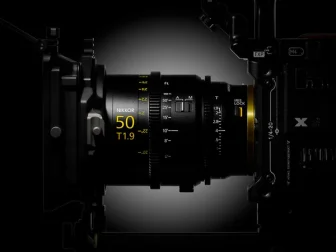
Nikon Is Finally Building Its Own Cinema Glass — Nine Lenses Covering RED's VV Sensor
Nikon announced on September 8 that it's developing nine cinema lenses in the Nikkor Z Cinema T1.9 VV series — the first time Nikon has built a true cinema prime lineup, and the first Nikkor series with an image circle large enough for RED's V-RAPTOR [X] VV sensor. The first confirmed lens is the 50mm T1.9 VV.
This is the cinema-industry payoff of Nikon's 2024 acquisition of RED. For years, Nikon Z-mount shooters who wanted serious video glass had to adapt Canon EF cinema lenses or use third-party options. Now Nikon is building native Z-mount cinema primes, designed in coordination with RED's cinema expertise.
What was actually announced
Nikon is developing nine lenses total in the Nikkor Z Cinema T1.9 VV series. The only focal length named so far is the 50mm T1.9 VV. The other eight have not been announced. All nine lenses will:
- Share the same T1.9 aperture
- Feature "highly precise" autofocus
- Cover the V-RAPTOR [X] VV sensor — a 40.96 × 21.60 mm chip that's larger than full-frame 36 × 24 mm
- Be the first Nikkor lens series with an image circle that large
No pricing, no release dates for any of the nine lenses. Nikon has not announced when the 50mm — or any of the other eight — will be shown publicly or shipped. The company says it's developing the series and will share more information later.
Why the RED connection matters
When Nikon completed the acquisition of RED in April 2024, Nikon IR disclosed an acquisition cost of ¥13.167 billion for fiscal Q1 2024 (the original press release did not give a dollar figure). Since then, RED has shipped V-RAPTOR [X] in a native Nikon Z mount and Nikon has launched the ZR — both Full Frame bodies — alongside the KOMODO-X (Super 35) and V-RAPTOR XE / V-RAPTOR [X] (VV) cameras under the Z CINEMA brand. The new T1.9 VV series is the first NIKKOR lens line designed natively for the RED VV image circle. Earlier Z-mount Nikkor glass worked on RED bodies through the Z system, but no Nikkor cinema prime had been built specifically to cover V-RAPTOR [X]'s 40.96 × 21.60 mm sensor.
The new T1.9 VV series is the first line designed from scratch in the post-RED era. The image circle is the headline: 40.96 × 21.60 mm. That's wide enough for RED's VV sensor without vignetting, meaning you can shoot full-sensor VV video with native Nikkor glass. No adapters, no cropping, no compromises.
For RED V-Raptor owners, this is huge. They've been waiting for native Nikon glass that fully covers their sensor. For Nikon Z shooters doing video, this is huge too — finally a real cinema lens lineup, not just adapted stills primes.
What T1.9 means in practice
T1.9 refers to a T-stop — the cinema industry's standard measurement of how much light a lens actually transmits to the sensor, accounting for optical absorption inside the glass. It is not directly interchangeable with an f-number (which describes only the geometric aperture); a T1.9 cinema lens is not equivalent to an f/1.9 stills lens. T1.9 sits on the fast end for cinema primes, but it's not unusual: Canon's CN-E primes ship at T1.5 and T1.3 across most focal lengths, and Sigma's FF High Speed Cine line is dominated by T1.5. So this Nikkor is calibrated in the same ballpark as existing high-speed cinema glass — just for the VV image circle.
The autofocus is described as "highly precise" but no specs on speed, tracking, or supported framer rates. For cinema use, autofocus is increasingly common — Sony's cinema line, Canon CN-E, and Sigma's cine primes all support it. Nikon's decision to include AF makes sense for hybrid shooters and documentary work.
What we don't know yet
- Pricing — no indication. Cinema primes can run $5,000 to $20,000+ per lens
- The other eight focal lengths — no leaks, no rumors
- Actual release dates — none disclosed. Nikon has only said the series is in development.
- Whether Nikon will make a matching set of cine zooms, or just primes
- Whether the lenses will support the PL mount that most cinema cameras use, or stay Z-mount only
The development announcement only shows the 50mm, and Nikon explicitly warns "the appearance of the actual product may differ from the photo shown above." So the production lens could look meaningfully different from the render.
My take
This is the most consequential Nikon announcement of 2026 so far. Nikon has been quiet on cameras this year — only two lenses released and no camera bodies — and the cinema lens lineup is a major strategic move.
The V-Raptor VV coverage is the headline. RED's cinema cameras are used on major Hollywood productions, and Nikon's ability to make first-party glass for them opens up a real cinema business for Nikon. Combined with the Nikon ZR cinema body announced in 2025, Nikon now has a credible cinema system — something Canon and Sony have had for years.
For stills photographers, this news is mostly indirect. But it does suggest Nikon is investing in Z-mount R&D at a serious level, which bodes well for future stills lens development too. If Nikon can build cinema lenses covering VV, they can build any lens.
When the 50mm T1.9 VV does ship, it will be a strong statement from Nikon. A full nine-lens lineup, if and when it lands, would make Nikon's cinema system a legitimate competitor to Canon and Sony. We'll know more when Nikon decides to share more.
Editor's note (2026-09-10): The original version of this article contained several factual errors in passages beyond what Nikon officially announced — including an unsourced NAB 2027 timeline claim, a $115 million acquisition figure for RED (Nikon's IR documents cite ¥13.167 billion), an incorrect statement that Nikon's Z Cinema line only covered Super 35, and an oversimplified T-stop vs. f-stop explanation. Those passages have been corrected. Nikon has not announced a release date for any of the nine lenses.
For now, this is a development announcement — a serious one, with concrete product specs, but no shipping product yet. Worth watching closely.