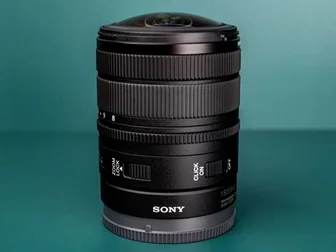
Sony's First E-Mount Fisheye in 20 Years: The FE 8-14mm f/3.5 G
Sony finally closed a gap that has bugged E-mount shooters for two decades. The new FE 8-14mm f/3.5 G Fisheye is the first first-party full-frame fisheye zoom for E-mount — and the first full-frame Sony fisheye of any kind since the A-mount 16mm f/2.8 in 2006. Yes, twenty years.
The big number here is weight. At 314 grams (0.69 lbs), the 8-14mm G is the kind of lens you actually toss in your bag "just in case." Canon's competing RF 7-14mm f/2.8-3.5 L tips the scales at 476g, so Sony undercut it by 34% while going slightly narrower at the long end. The 8-14mm is also a constant f/3.5 — not as fast as the Canon f/2.8-3.5 — but at this focal length the extra stop rarely matters.
What you actually get
The lens is a 16-element, 13-group design with internal zoom and internal focus, so nothing extends or rotates during use. Constant f/3.5 across the whole 8-14mm range. At 8mm, you get a circular fisheye — those signature round, wraparound frames — and at 14mm it becomes a diagonal fisheye filling the full frame. So one lens covers two very different looks, which is genuinely useful for creative work.
Autofocus is driven by two linear motors, and Sony specifically tuned it for the 120 fps burst mode of the A9 III and similar bodies. Close focus is 0.15 m (5.9 in) for frame-filling shots, with a 0.22x magnification. The 7-blade aperture is circular. Independent focus, zoom, and aperture rings, with AF/MF/FH and zoom lock switches.
For VR creators, this is the headline feature. Pair two of these on the Venice Extension System Mini and you get a 64mm interpupillary distance setup that mimics human eyes — usable for stereoscopic 3D VR production. That's a real professional workflow, not a marketing checkbox.
Real-world shooting
The 8-14mm is built for four scenarios: landscapes, architecture, sports, and video production. Sony specifically called out "many, many requests" from users over the years for a first-party fisheye. The fact that it took until 2026 to ship is a sign of how specialized this niche is — but it also tells you Sony saw enough demand across landscape and video to make it worth the R&D.
At 314g, this lens is a different beast from the typical big prime. You can handhold it for long landscape sessions without arm fatigue, and it balances well on gimbals for video. The rear filter holder is a nice touch — front filters aren't possible on fisheyes, so this gives you creative options for ND and diffusion work.
One real-world comparison worth noting: the Canon's f/2.8-3.5 is brighter, but for landscape and architectural shooting (where fisheyes shine) you rarely need f/2.8. For sports, the Sony's wider 8mm end and lighter weight probably matter more than a stop of aperture.
Pricing and availability
The Sony FE 8-14mm f/3.5 G Fisheye ships in October 2026 at MSRP $1,599.99 USD / $1,999.99 CAD. UK retail is £1,500, EU €1,700. Pre-orders opened September 8 at Sony and major dealers.
Sony will show the lens at IBC 2026 in Amsterdam starting September 11, where you can try it in person.
My take
I've been waiting for a Sony first-party fisheye since I switched to E-mount in 2014. The Canon RF 7-14mm L has been the only real option for full-frame mirrorless users, and it's a fine lens — but it's also heavy, expensive, and Canon-only. The Sony 8-14mm G is meaningfully lighter, cheaper, and slots into the E-mount ecosystem cleanly.
The trade-offs are real: f/3.5 instead of f/2.8, no front filter thread, narrower 8mm (vs Canon's 7mm) start. For most landscape and architecture shooters, none of these matter much. For video shooters who want a versatile ultra-wide with VR capability built in, the Sony is the obvious choice.
If you've been eyeing a fisheye for E-mount and holding off on third-party options, the wait is over. This is a real Sony lens, with real Sony autofocus, at a real Sony price. For most E-mount shooters, that's the only endorsement that matters.