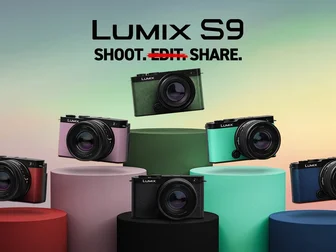
Quick Verdict & 2026 Buyer's Snapshot
The **Panasonic Lumix DC-S9** is Panasonic's boldest and most polarizing full-frame mirrorless camera. By stuffing a 24.2-megapixel full-frame sensor with on-chip **Phase Hybrid AF** and 5-axis in-body image stabilization into a featherweight 403g rangefinder-style body, it delivers full-frame cinematic image quality in a package smaller than many Micro Four Thirds bodies.
However, achieving this ultra-compact form factor required severe, intentional engineering compromises: the S9 has **no electronic viewfinder (EVF)**, **no mechanical shutter** (relying 100% on an electronic rolling shutter), a **cold accessory shoe with no flash contacts**, and strict **15-minute recording limits** in 4K/6K. It is not an all-around hybrid workhorse like the S5 II; it is an unapologetic, specialized tool built for mobile-first content creators, travel vloggers, and street photographers who live and breathe custom color grades.
Buying Decision | Summary
**Buy if...** | You want full-frame bokeh, exceptional low-light performance, Phase Hybrid AF, and instant social publishing via the dedicated physical **Real-Time LUT** button and Lumix Lab smartphone workflow.
**Skip if...** | You shoot flash photography (no flash sync possible), frequently shoot fast-action sports under fluorescent gym lighting (rolling shutter banding), or record long-form podcast/interview video without interruptions.
**2026 Value Rating** | **8.8 / 10** for travel creators & street shooters; **5.5 / 10** for commercial studio work.
Price & Market Availability (November 2026)
Key Technical Specifications
Parameter | Official Specification | Practical Impact
**Sensor** | 24.2MP Full-Frame CMOS (35.6 x 23.8 mm) | Full-frame depth of field and excellent high-ISO low-light signal-to-noise ratio.
**Autofocus** | **Phase Hybrid AF (779 points)** | Fast, tenacious subject tracking for humans, animals, cars, and motorcycles. Eliminates DFD pulsing.
**Shutter System** | **Electronic Shutter Only (1/8000s to 60s)** | **NO mechanical shutter**. Completely silent operation, but subjects moving rapidly may show rolling shutter tilt.
**Flash Photography** | **Not Supported** | The top shoe is a **cold shoe** (mechanical mounting only). There are no electrical pins for flash triggers or TTL strobes.
**Image Stabilization** | **5-axis Dual I.S. 2 (Up to 6.5 stops)** | Exceptional sensor-shift stabilization enables handheld video walking shots and low-shutter street captures.
**Video Recording Limits** | 6K/4K: **15 minutes**; FHD: **20 minutes** | Hard firmware cutoff to protect the compact uncooled chassis from overheating.
**Video Codecs** | 6K 30p (3:2 open gate), 4K 60p (1.5x crop), MP4 Lite | Supports 10-bit 4:2:2 internal V-Log and lightweight MP4 Lite optimized for 30-second mobile transfers.
**Real-Time LUTs** | Dedicated physical "LUT" button on rear panel | Load up to 39 custom 3D LUTs directly into the camera via the Lumix Lab smartphone app.
**Viewfinder & Monitor** | **No EVF**; 3.0" 1.84M-dot Free-Angle Touch LCD | Must compose entirely using the rear articulating screen. Challenging under direct harsh midday sunlight.
**Storage & Ports** | 1x SD (UHS-II), Micro HDMI Type D, USB-C 3.2, 3.5mm Mic | Single card slot beside battery. **No 3.5mm headphone jack** for audio monitoring. Micro HDMI requires gentle handling.
**Dimensions & Weight** | 126.0 x 73.9 x 46.7 mm; **403g (body only) / 486g (with battery & SD)** | One of the lightest full-frame mirrorless bodies ever manufactured.
The S9 Reality: Crucial Architectural Tradeoffs
1. The Electronic-Only Shutter: What It Means in Practice
Unlike conventional mirrorless cameras that include a physical focal-plane shutter, the S9 uses purely electronic sensor scanning. For 90% of travel and landscape photos, this is an asset: the camera is 100% silent and induces zero shutter shock.
However, because the sensor readout speed is approximately 1/25th to 1/30th of a second, high-speed lateral motion (such as a speeding train or golf club swing) will display noticeable rolling shutter "jello" skew. Furthermore, indoor artificial lighting running on alternating current (cheap LED fixtures or older ballasts) can cause horizontal banding lines across your frames.
2. The Real-Time LUT Revolution
The true genius of the S9 is its integration with the **Lumix Lab App**. Creators can create, import, or download 3D LUTs (.vlt or .cube files), beam them to the camera over Bluetooth/Wi-Fi, and bind them directly to the physical LUT button.
When you press the shutter or record button, the camera bakes the color profile directly into the video or JPEG files in real-time. Paired with Panasonic's **MP4 Lite** format (a 50Mbps 4:2:0 10-bit container cropped to 3.8K 30p open-gate), files transfer to an iPhone or Android device in under 15 seconds, ready for instant posting to Instagram, TikTok, or YouTube Shorts without ever opening computer editing software.
3. Thermal Management & Strict Recording Limits
To achieve its 403g body without an internal fan, Panasonic installed strict firmware recording timers: - **6K / 4K / C4K:** Maximum 15 minutes per continuous clip. - **Full HD:** Maximum 20 minutes per clip.
After hitting the limit, you can immediately restart recording, provided ambient temperatures have not triggered a thermal warning. For short cinematic b-roll clips, vlogging snippets, and social media reels, 15 minutes is more than sufficient. For recording 60-minute church ceremonies or business conferences, the S9 is the wrong tool.
How It Compares: Lumix S9 vs Lumix S5 II vs Sony A7C II
Feature | **Lumix S9** | **Lumix S5 II** | **Sony A7C II**
**Body Weight** | **403g** | 740g | 514g
**Sensor & Megapixels** | 24.2MP Full Frame | 24.2MP Full Frame | 33.0MP Full Frame
**Autofocus** | Phase Hybrid AF (779 pts) | Phase Hybrid AF (779 pts) | BIONZ XR AI AF (759 pts)
**Electronic Viewfinder** | **None** | 3.68M-dot OLED EVF | 2.36M-dot OLED EVF
**Shutter Type** | **Electronic only** | Mechanical + Electronic | Mechanical (EFCS) + Electronic
**Flash Shoe** | **Cold Shoe (No contacts)** | Full Hot Shoe | Full Multi-Interface Hot Shoe
**Continuous 4K Limits** | **15 Minutes** | **Unlimited (Active fan)** | ~45–60 mins (Thermal throttles)
**Card Slots** | 1x SD UHS-II | 2x SD UHS-II | 1x SD UHS-II
**Real-Time LUT Workflow** | **Dedicated Physical Button** | Available in menus | Creative Looks only
**Avg Used Price (2026)** | **$1,050 – $1,180** | **$1,350 – $1,480** | **$1,650 – $1,800**
Best Lenses for the Lumix S9
To preserve the compact, pocketable philosophy of the S9, match it with lightweight prime lenses: 1. **Panasonic Lumix S 26mm f/8 (Manual Focus Pancake):** Extremely thin (0.7 inches) and weighs just 58g. Turns the S9 into an everyday carry snap-shooter. 2. **Panasonic Lumix S 18-40mm f/4.5-6.3:** The purpose-built compact zoom lens for the S9, delivering true ultra-wide 18mm vlogging perspectives in a 155g retracting barrel. 3. **Panasonic Lumix S 35mm f/1.8 & 50mm f/1.8 Primes:** Exceptional optical quality, fast f/1.8 aperture for subject separation, and shared 67mm filter threads.
Frequently Asked Questions (FAQ)
Can I attach a flash to the Lumix S9?
No. The Lumix S9 top mount is a **cold shoe** without electrical synchronization pins. It cannot trigger external speedlights, studio strobes, or hot-shoe wireless triggers. Continuous LED video lights can be mechanically mounted, however.
Can you monitor audio with headphones on the S9?
The S9 includes a 3.5mm microphone input for external audio capture, but it **lacks a 3.5mm headphone output**. You can monitor audio levels via on-screen peak meters, but real-time acoustic monitoring is not supported.
Does the S9 overheat easily?
The S9 relies on firmware timers (15 mins in 4K) rather than heat-triggered sudden shutdowns. Under typical room temperatures (20°C–25°C), it reliably reaches the 15-minute mark without warning flags. In direct desert sunlight, surface temperatures rise, but it remains stable within its timed parameters.