Friday News, September 11: Canon EOS R1 v1.3.2, Insta360 Luna Pro, SIRUI Saturn V2, DZOFILM Arles Zooms, and Leitz iD Mount
A quiet-but-steady week in the imaging world. No earth-shaking flagship, but plenty of useful news if you own, or are about to buy into, the right system. Here is what landed between September 8 and 11.
Canon EOS R1 and R5 Mark II get a maintenance firmware
Canon dropped firmware updates on September 10 for both flagship-class full-frame mirrorless bodies: the EOS R1 picks up version 1.3.2, the EOS R5 Mark II gets a paired update. Digital Camera World and Newsshooter covered the release the same day.
The R1 changelog is short: a fix for a live view delay when shooting with the EOS Multi Remote app, a fix for linked receiver cameras failing to capture when the sender is on an FTP server, and improved operational stability. The R5 Mark II gets similar multi-remote and stability fixes plus a fix for unwanted restarts when shooting Dual Pixel RAW. The full notice is on Canon USA support pages.
This is the kind of update working sports shooters want after two years with the R1: no headline features, no surprise AF changes that might break a workflow. Install it before the next match
Source: Digital Camera World, September 10, 2026 · Canon USA EOS R1 support
Insta360's Luna Pro finally goes global
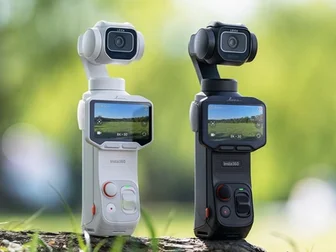
Insta360 launched the Luna Pro gimbal camera worldwide on September 10 for $599.99, after a China-only debut on August 20. It joins the existing Luna Ultra ($769.99) as a single-lens, lighter alternative. PetaPixel, TechRadar, and Photo Rumors all covered the global launch.
The Luna Pro keeps the Ultra's main imaging stack: a Type 1 sensor paired with a Leica Summicron lens at around a 20mm equivalent f/1.8, a 3-axis mechanical gimbal with FlowState stabilization, and a detachable 2-inch OLED touchscreen that doubles as a wireless remote from up to 20 meters away. The Pro drops the Ultra's secondary 3x telephoto module; in return, it is about 20 grams lighter and noticeably cheaper.
Video specs include 8K up to 30p in Dolby Vision, 4K at 120p slow-motion, 1080p at 240p, and built-in timecode for multi-cam work. Color science brings the Leica-tuned profiles plus 10-bit I-Log. TechRadar's review notes the Luna Pro undercuts the Ultra by about $170 in the US but only £50 in the UK, which makes the Pro's value proposition awkward in that market. The protective case is also simpler, a rubber cap instead of a hard shell.
For vloggers who already own a DJI Pocket 4 and have been waiting for a real Leica-lens alternative, the Luna Pro is the most credible answer so far this year. Insta360 still ships normally in the US while DJI's consumer lineup remains tangled up in import-authorization limbo, which makes this the only "new" gimbal camera a lot of creators can actually buy right now.
Source: PetaPixel, September 10, 2026 · PRNewswire official announcement
SIRUI's Saturn V2 anamorphics get a horizontal/vertical switch
SIRUI announced the Saturn V2 35mm, 50mm, and 75mm T2.9 1.6x full-frame anamorphic prime set on September 9, with Newsshooter covering it the next day. The headline feature is mechanical: rotate the lens 90 degrees on the camera and switch between horizontal and vertical anamorphic looks without unmounting the glass.
The series covers full-frame sensors up to a 45mm image circle, supports Sony E, Leica L, and Canon RF mounts, with 0.8 MOD gears, a 10-blade iris, a 1.6x squeeze, and 2.84:1 or 2.4:1 desqueeze ratios. The three-lens set retails for $1,699. SIRUI is marketing it as "One Lens, Two Visual Languages," and the pitch is fair given that vertical anamorphic content is now its own deliverable for social-first cinematographers.
Anamorphic lenses at this price point almost always carry some optical compromise, and the spec sheet doesn't include distortion or breathing numbers. Worth waiting for a hands-on test before committing to a paying client On paper, this is the cheapest path into a dedicated anamorphic look for full-frame mirrorless right now.
Source: SIRUI Store, September 9-10, 2026 · Newsshooter, September 10, 2026
DZOFILM pads its Arles cine line with two T2.6 zooms
DZOFILM opened pre-orders on September 8 for the Arles 25-75mm T2.6 and Arles 65-180mm T2.6, two full-frame cinema zooms that give the Arles system continuous coverage from 25mm to 180mm at a constant T2.6. The Society of Photographers and other outlets picked it up the same day.
Both zooms are parfocal, share front diameters and gear positions, and weigh under 1.8 kg each. Each lens retails at $2,899 individually; the two-lens hard-case kit is $5,199. Shipping begins in late September 2026. The Arles system now totals 11 primes and 2 zooms, effectively a complete zoom-trim kit for indie and documentary work. Pricing under $3k per zoom for a constant T2.6 parfocal full-frame cine lens was basically impossible five years ago.
Source: DZOFILM Arles announcement, September 8, 2026
Leitz adds an iD Mount with lens metadata to HUGO and SUMMILUX-C
Leitz Cine introduced the optional iD Mount on September 10 for its HUGO and SUMMILUX-C cinema lens lines. The new mount is a passive metadata interface: when paired with a compatible camera, the mount carries static /i lens metadata (lens name, focal length, serial number, distortion map, and shading map) recorded with every clip. ProVideo Coalition has the full breakdown.
VFX teams can pull up the exact optical profile of whichever HUGO or SUMMILUX-C lens was on a shot, undistort it precisely, and re-apply the original lens character after compositing. It also helps during reshoots: you know exactly which lens and focal length was used on the original take. The mount does not transmit live focus or iris telemetry; it is persistent lens identity and characterization only, not Cooke /i-style real-time data.
New HUGO and SUMMILUX-C lenses can be ordered with the iD Mount factory-installed. Existing owners can ship their lenses back for an upgrade, with the mount pre-encoded with their specific lens's optical maps. The mount itself is priced at $500 per piece, with the Leitz iD Mount Update Base (the programming dock) at $320 for either PL or LPL. Both are available now through Leitz Cine and authorized partners.
This is the kind of infrastructure play that quietly reshapes high-end cinema production. Cooke /i and ARRI LDS have been the gold standard for years; Leitz's static-metadata approach is a lighter-weight alternative that costs less and works on older lenses you already own. For narrative work where the lens choice ends up in the grade, this matters more than any new T-stop.
Source: ProVideo Coalition, September 10, 2026
My take
A maintenance firmware, a cheaper gimbal camera, an anamorphic with a clever switch, two more cinema zooms, and a metadata mount do not make for a viral week.
But that is the point. The Sept 8-11 window is what a "normal" week in modern imaging looks like: incremental refinements to existing flagships, a steady drip of cine-lens releases for working pros, and metadata infrastructure quietly added to gear you will still be using in five years. Saturday's weekly roundup will catch anything missed here.