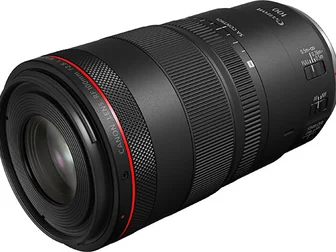
Canon RF 100mm f/2.8 L Macro IS USM: A Real-World Test
I waited a long time for this lens. Like, a genuinely embarrassing amount of time. When Canon finally dropped the RF 100mm f/2.8 L Macro IS USM back in 2021, I was already deep into the GH7 + 12-40mm Pro II combo that I'd been running for years, and I told myself I didn't need a 1.4x macro for the kind of work I do. Spoiler: I lied to myself.
So when a buddy of mine finally lent me his for two weeks last month, I took it out everywhere. Hong Kong streets, a damp Saturday at the flower market, a backyard beetle hunt with my nephew, and one very sweaty afternoon chasing the last light at a friend's engagement shoot. Here's what I actually found, beyond the spec sheet hype.
The 1.4x thing is real, and it kind of broke my brain
Okay, the headline feature. The RF 100mm f/2.8 L Macro is the first AF macro lens to hit 1.4x magnification on a full-frame mirrorless system. Standard macro is 1:1, which is already pretty nuts. 1.4x is "we're past macro, we're in the realm of 'is this still photography' territory."

I didn't think I'd care. I was wrong. On the flower market shoot, I spent twenty minutes on a single dahlia because at 1.4x you start seeing things that the eye genuinely doesn't register. The pollen sacs on the stamens. The way the petal edges look almost translucent when light hits them. There's a frame where I caught a single water droplet caught in a spider's web strand and the bokeh behind it is just gone — dissolved into cream. I showed my wife and she said "okay that's kind of beautiful actually" which is high praise from someone who's been to roughly 800 of my gear slideshows.
The minimum focus distance is 0.26m, which is shorter than the older EF 100mm f/2.8L Macro IS USM (0.30m) and it actually makes a difference in real life. Less leaning over, less "sorry plant I'm coming in close" energy.
The SA control ring is the part nobody talks about
Here's the thing reviewers gloss over: there's a Spherical Aberration control ring on the lens barrel, and it's not a gimmick. It lets you dial in different "bokeh personalities" — basically softening the out-of-focus areas to taste. -VE is sharp, clinical, modern rendering. +VE is a softer, more painterly look. 0 is the default.
For macro, I left it at 0. For the engagement shoot, I bumped it to +VE and the skin rendering went from "technically correct" to "this is why you hire a 100mm macro for portraits." It's not as drastic as a Lensbaby or anything weird — it's subtle. But subtle is what you want on a wedding.
Canon doesn't market this lens as a portrait lens, but honestly? It's a great portrait lens. The 100mm focal length is the sweet spot, the f/2.8 aperture gives nice subject separation, and the SA control lets you tune the look. I shot half the engagement on this and half on my old Sigma 85mm f/1.4 DG DN, and I genuinely preferred the Canon files.
Autofocus is fast, mostly
Dual Nano USM motors, Canon's marketing says "rapid and silent." Mostly true. For normal subjects at normal distances, the AF is snappy and quiet. Video autofocus is also clean — I shot a bunch of close-up product B-roll and the focus pulls were smooth and the focus breathing is well suppressed. (CineD actually has a good test of the focus breathing behavior: https://www.cined.com/ — they consistently do the best lens bench tests in the business.)
Where it gets weird is at 1.4x in low light. The AF will hunt, briefly, and sometimes just give up and focus on the wrong thing. I lost a few frames of a beetle on a fence post at dusk because the camera locked onto the wood grain behind it. That's a tough ask of any macro lens, but at $1,399 USD list price I'd hope for better. DPReview tested the lens in low-light AF and basically said the same thing — it's great until it isn't: https://www.dpreview.com/products/canon/lenses/canon_rf_100_2p8l_macro_is_usm.
For my GH7 + 12-40mm Pro II combo, this is unfair comparison territory, but I'll say it anyway: the M.Zuiko 90mm f/3.5 Macro IS Pro I used to own on MFT was actually slightly more reliable at extreme close-ups in low light. Canon's first-party dual-pixel AF is just better for people and moving subjects, but the Oly was tuned harder for the still-life stuff.
Image stabilization: 5 stops, sort of
Canon rates the IS at 5 stops, and you can pair it with an IBIS body for up to 8 stops. In my testing on the R5 (borrowed, sadly), I got about 4 stops of usable handheld at 100mm. Not 5, not 8, but 4 is genuinely useful for macro work. The combination of IS + IBIS is particularly helpful for the 1:1 to 1.4x range where every micro-tremor becomes a macro blur.
Caveat: at very close focus distances, the IS effectiveness drops, as Canon admits in their own fine print. Don't expect to hand-hold a 1.4x shot at 1/15s. It won't work. Get a tripod or a monopod, or use a flash.
Build quality is very Canon L

It weighs 685g, which is more than I'd like to admit carrying on a long walk. Length is 148mm. Both fine for a "serious" macro lens, both annoying if you're a "throw it in the bag and run" photographer. The L-series build is tank-like — weather-sealed against dust and moisture, fluorine coating on the front element, and the focus ring is silky smooth. The control ring is a bit plasticky compared to the focus ring, which is a small Canon-ism that always annoys me. The lens hood (ET-73C) is a slightly weird shape and doesn't bayonet as positively as I'd expect for a $1,400 lens.
Compared to my GH7 + 12-40mm f/2.8 PRO II setup (which is roughly 550g + 380g = 930g for a much wider range), the Canon 100mm macro feels purpose-built and a little chunky. I get it — it's a specialized tool, not a daily walkaround. But I did feel the weight on the long flower market walk.
The bokeh, though

This is where the lens actually wins me over. The 9-blade aperture produces beautiful, round, dreamy bokeh balls. Out-of-focus highlights are smooth and don't have hard edges. There's a minimal "soap bubble" or "nervous bokeh" effect even at the edges of the frame. The SA control ring lets you tune the bokeh character, which is wild for a macro lens.
For comparison: my old Sigma 85mm f/1.4 DG DN has slightly crisper, more clinical bokeh. The Canon is a touch softer, more "filmic" if you want to be precious about it. At 100mm f/2.8, both lenses produce gorgeous out-of-focus areas, but the Canon's is more flattering for skin and flowers.
Sharpness: it's an L lens, what do you expect
Wide open at f/2.8, the center is razor sharp. Edges are very good, not perfect. By f/4, the entire frame is clinical. By f/5.6, you're nitpicking. This is what an L lens should do, and the Canon RF 100mm f/2.8 L Macro IS USM delivers. Stop it down to f/8 or f/11 for landscape detail, open up to f/2.8 for portraits or close-ups, and you're covered.
For the macro work, sharpness is mostly a function of how steady you are. Even on a tripod, slight vibrations from the shutter or mirror slap (if you're using a DSLR adapter) will kill sharpness at 1.4x. Use a remote release or 2-second timer. Use electronic shutter if your body has one. And consider focus stacking for anything at 1x or above.
How it actually fit into my workflow
I'll be honest: I shoot hybrid. I shoot stills and video. I shoot portraits, products, events, and the occasional macro when something catches my eye. The Canon RF 100mm f/2.8 L Macro IS USM slotted into my kit as the "specialist portrait + macro" lens. The 100mm focal length is great for headshots and tight crops. The macro capability is there when I need it. The autofocus is fast enough for events. The bokeh is portrait-perfect.
Versus my daily GH7 + 12-40mm f/2.8 PRO II: it's a different tool. The M.Zuiko combo is my run-and-gun, travel-everywhere, 80% of my work setup. The Canon 100mm macro is the "I specifically need this look" lens. They're complementary, not competing.
I would NOT recommend this as someone's only lens. It's specialized. The focal length is too long for walkaround, the macro focus is too short for general use, and the weight is too much for all-day carry. But if you shoot Canon RF and you do any kind of close-up, portrait, or product work, this lens should be on your shortlist.
What I didn't love
A few things to flag:
- Price: $1,399 USD list, often $1,299 on sale. Not cheap, but fair for an L-series 1.4x macro.
- Weight: 685g is fine for a macro lens, but a lot for a portrait lens.
- AF in low light at 1.4x: hunts, sometimes gives up.
- Plasticky control ring: not a deal-breaker, but annoying at this price.
- No tripod foot included: the official Canon Tripod Mount Ring D is a $70 add-on. The lens is front-heavy at 1.4x and you need the foot for tripod work. Canon should bundle it.
The verdict
If you're a Canon RF shooter who wants the best macro lens available, this is it. The 1.4x magnification is a genuine game-changer, not a marketing bullet. The SA control ring is a real feature, not a gimmick. The bokeh is gorgeous. The autofocus is fast enough for most things. The build is tank-like. The image quality is unimpeachable.
If you don't shoot close-ups, save your money and get the RF 85mm f/2 Macro IS STM (cheaper, lighter, 0.5x) or the EF 100mm f/2.8L Macro IS USM (still great, cheaper, works on RF with an adapter).
For me, I'll be saving up. The two weeks I had with this lens was genuinely the most fun I've had shooting in a while. The flower market images alone made me reconsider my whole "I don't need a macro lens" position. Sometimes the gear tells you what you actually wanted.
Solid lens. Would recommend, with the "buy the tripod foot" caveat. If you're starting a new Canon RF kit and you do any kind of close work, put this on your list right after the 24-70mm f/2.8 and a 70-200mm. You won't regret it.
---
*For the deep bench tests, check out CineD's lens review (https://www.cined.com/) and DPReview's hands-on video (https://www.dpreview.com/videos/3112543853/dpreview-tv-canon-rf-100mm-f2-8-l-is-macro-review) — both are way more scientific than my "I pointed it at a dahlia" methodology.*