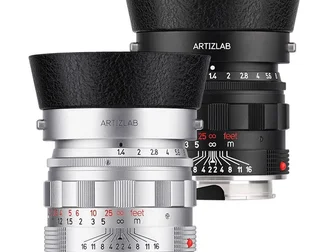
Artizlab has introduced the Classic-M 1:1.4/50mm, a manual-focus prime for Leica M-mount that directly clones the 7-element optical formula and compact envelope of the classic Leica Summilux 50mm f/1.4 (E43). Distributed through Funleader at $399 in black and silver chrome, the lens targets shooters who want the Mandler-era glow and vintage rendering without paying $2,500+ for a collector-grade Leica original.
Instead of trying to pass MTF bench tests or chasing clinical corner sharpness wide open, Artizlab's formula embraces the specific optical quirks of the 1960s Walter Mandler design: noticeable spherical aberration and gentle flare at f/1.4, a 12-blade rounded diaphragm for circular specular highlights, and a rapid transition to crisp micro-contrast once stopped down past f/2.8.
The 0.45m Dual-Range Tradeoff
Mechanically, the barrel uses aluminum alloy with a brass focusing helicoid, keeping total weight to 189g (6.67 oz) with a 43mm front filter thread. The defining mechanical choice is a dual-range helicoid: on Leica M bodies, the mechanical cam couples to the optical rangefinder from infinity down to the standard 0.7m limit. Once you twist past the 0.7m tactile stop, the lens continues focusing down to 0.45m.

That extra 25cm close-focus extension is genuinely useful for food or detail shots when shooting via EVF (like the Visoflex), live view on an M10/M11, or adapted to Sony E and Nikon Z. But rangefinder purists should note the obvious caveat: between 0.7m and 0.45m, your optical viewfinder patch decouples completely—you are guessing or switching to a screen.
Where the Real Risks Lie
At $399, the Classic-M undercuts the near-$1,000 asking price of limited-run brass replicas from Light Lens Lab, while offering a much lighter daily-carry package. But paper specifications tell you nothing about the two failure points that make or break budget M-mount optics: helicoid damping consistency and factory rangefinder cam calibration.
On a 50mm f/1.4 at 0.7 meters, depth of field is razor thin. A cam ground off by even 0.03mm means an eye in sharp focus in your viewfinder patch lands blurry on the sensor. Until production copies land in hands to verify whether the helicoid stays grease-smooth without play, and whether the optical cam is truly calibrated to Leica standards out of the box, treat this as a promising budget revival with unverified mechanical tolerances.