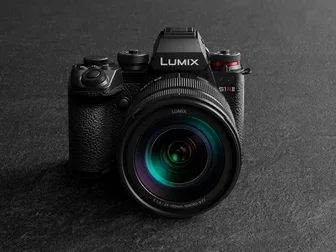
Quick Verdict & The Used Market Miracle of the S1R
Originally launched in 2019 at a premium MSRP of **$3,699 USD**, the **Panasonic Lumix DC-S1R** was built without compromise as Panasonic’s ultimate high-resolution still photography instrument. Featuring a 47.3-megapixel full-frame CMOS sensor without an optical low-pass filter (OLPF), an extraordinary **187-megapixel tripod High-Resolution mode**, a class-leading **5.76-million-dot OLED viewfinder**, and a tank-like magnesium alloy chassis, it was engineered to rival medium format image quality.
In 2026, selling for **$1,150 to $1,350 USD used** on MPB, KEH, and eBay, the Lumix S1R has quietly become one of the most astonishing value bargains in modern digital photography. For less than the price of an entry-level crop-sensor body, commercial studio photographers, landscape artists, and architectural documentarians can acquire a 47MP pro body that out-resolves almost anything in its price class.
Its sole compromise is Panasonic's older **Contrast-Detect DFD autofocus**. It does not feature Phase Detection AF, making it unsuitable for fast-action sports or tracking video subjects. But for deliberate, tripod-mounted, studio-tethered, or single-shot fine art photography, the S1R remains a photographic titan.
Buying Decision | Summary
**Buy if...** | You need maximum commercial resolving power (47.3MP raw files or 187MP composites), a breathtaking 5.76M-dot EVF, and pro studio tethering for under $1,350 used.
**Skip if...** | You shoot handheld run-and-gun video, fast-action sports tracking, or want a lightweight travel camera (the S1R body weighs 1,016g with battery and memory card).
**2026 Value Rating** | **9.6 / 10** for studio, landscape, and architectural stills; **5.8 / 10** for sports and run-and-gun video.
Price & Market Availability (November 2026)
At sub-$1,300 used, the S1R competes against 24MP entry-level bodies like the Sony A7 III or Canon EOS R8, but delivers double the resolving power, vastly superior weather sealing, and professional dual-card redundancy.
Key Technical Specifications
Parameter | Official Specification | Practical Impact
**Sensor** | 47.3MP Full-Frame CMOS (36.0 x 24.0 mm) | **No low-pass filter (OLPF)**; captures microscopic fabric weaves and architectural textures.
**High-Resolution Mode** | **187-Megapixel Sensor-Shift Mode (Tripod)** | Combines 8 sensor-shift shots into a massive **16,736 x 11,168 RAW file** (approx. 330 MB per file).
**Electronic Viewfinder** | **5.76-Million-Dot OLED EVF (0.78x magnification)** | Exceptional clarity with zero pixelation; switchable 60fps / 120fps refresh rate.
**Rear Monitor** | 3.2" 2.1M-dot Triaxial Tilting Touchscreen LCD | Tilts upward, downward, and vertically sideways for low-angle portrait orientation framing.
**In-Body Stabilization** | **5-axis Dual I.S. 2 (Up to 6.0 stops)** | Allows sharp handheld exposures with slow shutter speeds despite the high pixel density.
**Autofocus System** | 225-area Contrast DFD AF with Deep Learning | Fast and pinpoint for single stills (AF-S); hunts in continuous video tracking (AF-C).
**Storage Slots** | **1x CFexpress Type B / XQD + 1x SD (UHS-II)** | High-speed CFexpress slot clears heavy 47MP burst buffers instantaneously.
**Build & Durability** | Heavy-duty magnesium alloy frame; freeze-proof to -10°C | Complete weather sealing around all dials and seams. Survives extreme mountain blizzards.
**Weight & Dimensions** | 148.9 x 110.0 x 96.7 mm; **1,016g (with battery & card)** | Substantial, ergonomic body with a massive handgrip that balances large pro lenses effortlessly.
Why the S1R Is an Unbeatable Studio Bargain in 2026
1. Per-Pixel Acuity and Dynamic Range
Unlike sensors that use anti-aliasing filters to blur high-frequency details and prevent moiré, the S1R has no low-pass filter. Paired with high-resolution L-mount glass, every single one of its 47.3 million pixels renders razor-sharp detail. The dynamic range is broad, allowing commercial retouchers to lift underexposed shadows with minimal noise penalty at ISO 100 and ISO 200.
2. The 187-Megapixel High-Resolution Mode
When locked onto a sturdy studio tripod, activating High-Resolution Mode shifts the sensor across 8 half-pixel steps. The camera samples complete red, green, and blue color data at every pixel location, eliminating Bayer color interpolation artifacts and yielding a true **187-megapixel file (16,736 x 11,168 pixels)**. For archival museum reproduction, fine-art landscape prints, and high-end automotive commercial photography, it rivals $30,000 digital medium format backs.
3. The 5.76M-Dot EVF Experience
The electronic viewfinder in the S1R was years ahead of its time. With 5.76 million dots of OLED resolution and optical glass elements designed by Leica, looking through the viewfinder feels identical to looking through an optical glass prism—bright, distortion-free, and natural.
Critical Tradeoffs to Accept
1. **Physical Weight:** At over 1 kilogram body-only, the S1R is not designed for casual neck-strap vacation travel. It is a studio and tripod workhorse. 2. **DFD Autofocus:** If you shoot children running indoors or birds in flight, the S1R's contrast-detect autofocus will frustrate you compared to phase-detect cameras. For portrait models, product stills, landscapes, and architecture, single-point AF is fast and 100% accurate.
Target Audience & Final Recommendation
- Studio portrait, product, and commercial photographers looking for 47MP detail and pro tethering for **under $1,350 USD**. - Landscape and architectural fine-art photographers who prioritize 187MP tripod composite detail and class-leading EVF resolution. - **Who Should Look Elsewhere:** Street photographers, casual vacationers, or run-and-gun videographers (consider the Lumix S5 II or Lumix S9 instead).