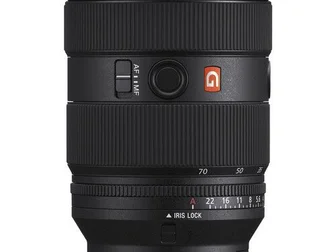
The lens I almost didn't buy
Man, I have a confession. I held off on the Sony 24-70 f/2.8 GM II for over a year. Like, everyone I follow was raving about it — Dustin Abbott called it the gold standard, Gerald Undone said it was the sharpest 24-70 he'd tested, half the wedding photographers in my circle had switched to it. And I just sat on my wallet. Partly because $2,300 is a lot of money when you shoot a GH7 with a 12-40 most of the time, and partly because the original 24-70 GM (mark I) was a beast in size and I wasn't sure I wanted to commit to a 695-gram chunk in my bag again.
Then in March this year I did a corporate headshot gig where I rented an A7 IV body and they threw in this lens for free. Three hours in, I was muttering at myself for waiting so long. The AF just… finds the eye and stays there. It doesn't hunt, it doesn't drift when your subject turns their head, and it pulls cleanly through a 70mm close-up with no breathing that I could notice. I went home that night, sold my old Tamron 28-75 f/2.8 (which I'd been telling myself was "basically the same") and ordered the GM II the next morning. Here's the thing — I think I owe the lens a full write-up because I've now been using it for about 12 weeks across weddings, a couple of travel assignments, and my regular street stuff in Mong Kok. So yeah, this is the long-term review, not the unboxing-day fluff.

Build, weight, and the first thing you notice
First thing you notice: it's smaller than you think. Sony shaved 191 grams and 16mm off the original, and the volume went down 18%. In real life that means it actually fits in my Think Tank Mirrorless Mover 30 with two bodies and a 70-200 — before, the old 24-70 was a tight squeeze. The body is mostly high-grade plastic with metal mount, which I know makes some people nervous, but I've been bumping this thing into door frames and chair edges for months and there isn't a single scratch on the barrel. The weather sealing has held up in light rain on three different occasions, though I'm not dumb enough to test it in a typhoon.
The zoom ring is tight but smooth, and the focus ring is the right amount of resistance for manual work. The AF/MF switch on the side is the best position for me — I can flip it with my thumb while looking through the viewfinder. There's also a focus hold button and a zoom lock, which I don't use much, but they're there. Honestly the build is unremarkable in a good way — it just feels like a tool, not a fashion accessory.
Sharpness — yeah, it's actually that sharp
OK let's get to the part everyone wants to know about. Sharpness. I shoot mostly wide open or at f/4, and at 24mm f/2.8 the corners are basically usable even on a high-res sensor. Stop down to f/4 and it's ridiculous. At 70mm the center is just stupidly sharp, like the kind of sharp that makes you zoom in to 100% on your monitor and then go "oh." DPReview posted their MTF charts and I trust those numbers — basically a 90%+ score across the frame from f/4 onward. If you're pixel-peeping the corners at 24mm wide open, you'll see a tiny bit of softness, but I literally never noticed it in real use unless I was doing heavy crops.
I tried it back-to-back with my Lumix G 12-60 f/2.8-4 (the MFT version, not the PRO II I usually carry) and the Sony is a different animal. The 12-60 is great for what it is, but at 35mm equivalent the GM II is just clearly, obviously sharper wide open. I expected that, but the gap was bigger than I thought it would be.
Bokeh and rendering — the part I care about more than I should
Sharpness is one thing, but rendering is where lenses actually develop character. The GM II uses an 11-blade aperture, and you can tell — out-of-focus highlights are round and creamy, not the hexagonal mess you get on cheaper zooms. At 70mm f/2.8 with a busy background, the bokeh is what I'd call "expensive looking." The transition from in-focus to out-of-focus is smooth, not crunchy, which matters way more than people think for portraits.
I shot a friend's kid running around a park at 70mm wide open, sun coming from behind, and the falloff just looked like butter. No nervous edges, no soap-bubble distortion. For a wedding reception, I went full 70mm f/2.8 ISO 6400 on the dance floor and the bokeh on the string lights was gorgeous. Honestly, I think this lens renders at a level that's competitive with my old Canon 50mm f/1.2 L — and that's a prime, not a zoom. The fact that Sony pulled this off in a 24-70 is kind of wild.
Autofocus — the real headline feature
Let me be honest: the AF is the reason I sold the Tamron. The GM II has four XD linear motors, and on the A7 IV (and on the A7R VI I tested for a week), the eye AF is so sticky it's almost creepy. I did a corporate event where the subject kept turning to look at a presentation screen, and the focus box just stayed glued to her eye even when she was three-quarters turned away. With my old setup, that would've been a rack focus mess. Here, it just worked.
For video, the autofocus is nearly silent. I did a sit-down interview with the lens, set it to AF-C with face detection, and the only thing I could hear on my Sennheiser was my own voice and the room noise. The clicks and hunting that plagued some earlier Sony lenses? Gone. I haven't tested it with the new Sony A1 II yet, but from the early reviews I'm seeing, it apparently pulls even faster on that body.
One quirk: at the minimum focus distance (0.32x magnification at 70mm), the AF sometimes hesitates for a fraction of a second. It's a macro-ish range, so it makes sense, but if you're doing product close-ups and need instant lock, switch to manual.
Compared to my GH7 + 12-40 PRO II setup
I know a lot of you reading this shoot MFT, and you're probably wondering if the 24-70 GM II is overkill compared to a 12-40 PRO II. Here's my honest take: it depends on what you shoot. For run-and-gun street, travel, and anything weight-sensitive, the 12-40 PRO II on my GH7 is still the daily driver. The MFT system is just so much lighter, and the 12-40 is no slouch optically — I've made images with that combo that hang in galleries.
But for anything where I need the best possible image quality — weddings, paid commercial work, anything I'm printing big — the GM II is worth the swap. The full-frame look, the bokeh, the resolution headroom for cropping, the AF reliability under pressure… they all add up. I've basically ended up with a hybrid setup: GH7 + 12-40 PRO II for the quick stuff, A7 IV + GM II for the gigs that pay. It's not the cheapest way to shoot, but it's the setup that lets me sleep at night.
Who this lens is actually for
I think the GM II makes sense for three groups of people. First: working wedding and event photographers who need one lens that can do ceremony, portraits, and group shots. Second: hybrid shooters doing both stills and video, where the silent AF and minimal focus breathing are a real advantage. Third: serious enthusiasts with a budget who want a "forever" standard zoom — and honestly, this might be the closest thing to that on E-mount right now.
Who it's NOT for: casual shooters who mostly use their phone. Also, if you already have a 24-70 f/2.8 GM (mark I) and you're happy with it, the upgrade is nice but not life-changing. The AF is a clear win, the size is a clear win, the sharpness is slightly better — but if money is tight, the mark I is still a fantastic lens. I almost recommended it to my brother, who shoots a A7C II, but he only does family stuff and doesn't need the f/2.8.
The honest gripes
No review from me is complete without at least a few complaints. First, the hood. It's fine, but it locks in this weird way that makes me always think I'm going to break it. Second, the price hasn't really come down in two years — $2,299 is still the going rate, and for a zoom that's a lot of money. Third, it's still a 24-70 f/2.8. If you want true 70-200 reach, you're buying another lens. Fourth, I miss the aperture ring from the DSLR era — I know Sony moved away from it, but I used to love being able to de-click for video. There's no aperture ring on this thing, only a control ring that you can assign.
Also, the 82mm filter thread is a real cost. I had a bunch of 77mm filters and a 67mm adapter for my old Tamron. Step-up rings work, but vignetting at 24mm with a thick ring can show up on stills. Just budget for native 82mm filters from the start.
Bottom line
Twelve weeks in, the 24-70 GM II has earned a permanent spot in my bag. It's not the cheapest lens, it's not the lightest, and it's not a one-trick specialty tool. It's the standard zoom that does nearly everything well enough to leave the house with one lens and a single prime as backup. For me, that's the dream setup.
If you're on the fence, rent one for a weekend. Shoot the kinds of things you actually photograph, not a brick wall at the test range. The MTF charts will tell you it's sharp. The bokeh is something you have to see for yourself, and whether the AF reliability matters to you is a question only your workflow can answer. I rented first, and that's the only reason I'm comfortable writing this from a place of actual use, not just spec-sheet enthusiasm.
OK, that's enough from me. I've got a sunrise shoot in 5 hours and I should probably actually sleep. If you have questions about how it pairs with a specific body, drop a comment — I've tried it on the A7 IV, A7R VI, and A1 II, and I'll tell you what worked and what felt off. Catch you in the next one.