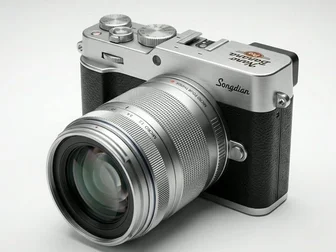
Executive Overview: The Expansion of the Micro Four Thirds Alliance
On February 12, 2026, **OM Digital Solutions Corporation** and **Panasonic Entertainment & Communication Co., Ltd.** issued a joint announcement confirming that **Shenzhen Soda Digital Technology Co., Ltd.**—the manufacturing company behind the consumer camera brand **Songdian (松典)**—officially joined the **Micro Four Thirds System Standard group**.
In an era where legacy Japanese camera manufacturers have systematically retreated from the entry-level photography market to focus on high-margin, professional full-frame bodies, this announcement marks a significant turning point for the mirrorless ecosystem.
By joining the alliance, Shenzhen Soda Digital gains access to the established optical blueprints, electrical pinout protocols, and mount geometry of the Micro Four Thirds standard. This development has the potential to introduce a new wave of accessible, interchangeable-lens cameras at price points that traditional manufacturers have abandoned.
This analysis breaks down the corporate background of Soda Digital, examines how the MFT licensing framework operates, explores the technical challenges of developing interchangeable-lens cameras, and evaluates the broader market impact for photographers.
Who is Shenzhen Soda Digital (Songdian)?
Outside of domestic Asian e-commerce ecosystems, the name **Songdian** may be unfamiliar to Western photographers. However, in mainland China, Soda Digital is a consumer electronics powerhouse in the entry-level imaging sector.
+--------------------------------------------------------------------------+
|                  SHENZHEN SODA DIGITAL TECHNOLOGY CO., LTD.              |
|                                                                          |
|  • Brand: Songdian (松典)                                                |
|  • Core Market: Sub-1,000 RMB ($100–$150 USD) Consumer Digital Cameras   |
|  • Market Share: Leading volume vendor on JD.com, Tmall, and Douyin      |
|  • Traditional Products: Fixed-lens compact CCD / CMOS lifestyle cameras |
|  • Strategic Milestone (2026): Licensed member of M4/3 System Standard   |
+--------------------------------------------------------------------------+
Founded in Shenzhen's high-tech manufacturing corridor, Soda Digital built its commercial success by serving millions of young consumers, students, and lifestyle vloggers who wanted a dedicated camera experience without spending $800 to $2,000.
While photography enthusiasts often dismissed these products as simple point-and-shoots, Songdian achieved massive manufacturing scale, vertical supply-chain integration, and nationwide brand recognition among entry-level buyers. Joining the Micro Four Thirds standard represents Soda Digital's deliberate move upmarket: transitioning from fixed-lens consumer gadgets into true interchangeable-lens mirrorless photographic systems.
How the Micro Four Thirds Alliance Functions
The **Micro Four Thirds System Standard** was jointly announced in 2008 by Olympus Corporation (now OM Digital Solutions) and Matsushita Electric Industrial Co., Ltd. (now Panasonic). Unlike closed, proprietary mounts like Canon RF, the MFT standard operates on an open-licensing model for participating manufacturers.
+-------------------------------------------------------------------------+
|                  THE MICRO FOUR THIRDS LICENSING MODEL                  |
|                                                                         |
|  [Standard Founders]      OM Digital Solutions | Panasonic Lumix        |
|  [Key Optical Partners]   Sigma | Tamron | Voigtländer | Laowa | Samyang |
|  [Cinema & Drone]         Blackmagic Design | DJI | Sharp               |
|  [New Entry-Level Member] Shenzhen Soda Digital (Songdian)              |
+-------------------------------------------------------------------------+
                                     |
                       [Shared Technical Standards]
                         Flange Focal Distance: 19.25 mm
                         Bayonet Diameter:      ~38.0 mm
                         Sensor Active Area:    17.3 mm x 13.0 mm (4/3-inch)
                         Electrical Bus:        11-pin bidirectional protocol
Technical Deliverables of Membership
By joining the alliance, Soda Digital receives: 1. **Precise Mechanical Specifications:** The exact 19.25mm flange focal distance and 4-tab bayonet lock blueprints required to build compliant camera bodies. 2. **Standardized Electrical Protocol:** Access to the 11-pin digital communication bus that transmits aperture control, autofocus drive signals, lens optical correction profiles, and focal length metadata. 3. **Instant Optical Compatibility:** Any camera body Soda Digital produces can immediately mount over 150 existing Micro Four Thirds lenses from Olympus, OM System, Panasonic, Leica, Sigma, Tamron, and Cosina Voigtländer.
Market Vacuum: The Abandonment of Entry-Level Photography
To understand why this alliance membership matters, one must examine the macroeconomics of modern camera manufacturing:
[2012–2018 Market Landscape]
  Sub-$500:  Lumix GF series, Olympus PEN E-PL, Sony A5100, Canon Rebel DSLRs
             (Vibrant entry-level interchangeable lens market)

[2024–2026 Market Landscape]
  Sub-$500:  Completely abandoned by Japanese Tier-1 camera manufacturers
  $800+:     Entry-level APS-C (Sony ZV-E10 II, Nikon Z30, Canon R50)
  $1,500+:   Standard full-frame hybrid workhorses
Between 2018 and 2026, mainstream Japanese camera companies systematically phased out their budget entry-level mirrorless lines—such as the **Panasonic Lumix GF series** and the **Olympus PEN Lite (E-PL) series**. Surging production costs, chip shortages, and higher profit margins on professional gear caused brands to focus almost exclusively on enthusiast and professional bodies.
This created a massive market void. Millions of beginners interested in photography are priced out of a $1,000 initial camera purchase. If Soda Digital can produce a reliable, interchangeable-lens Micro Four Thirds body priced between **$250 and $400**, it could single-handedly revitalize entry-level photography for a new generation.
Technical Comparison Matrix
Feature | Songdian Target Segment | Discontinued Budget MFT (e.g. Lumix GF9 / E-PL8) | Modern Enthusiast MFT (OM System OM-5)
**Approximate Price** | $250 – $380 (Projected) | $450 – $550 (Historical) | $1,199 (Body Only)
**Sensor Architecture** | 16MP / 20MP Live MOS (4/3") | 16MP Live MOS (4/3") | 20.4MP High-Speed Live MOS
**Mount Compatibility** | Micro Four Thirds (Native) | Micro Four Thirds (Native) | Micro Four Thirds (Native)
**Lens Ecosystem Access** | 150+ Native MFT Lenses | 150+ Native MFT Lenses | 150+ Native MFT Lenses
**Autofocus Technology** | Contrast-detection via ISP | Contrast AF with DFD | 121-point All Cross-type On-chip PDAF
**Chassis Construction** | Lightweight Polycarbonate | Polycarbonate with aluminum top | Magnesium alloy with IP53 weather-sealing
**Video Capabilities** | 4K/30p Consumer Video | 4K/30p 8-bit | 4K/30p OM-Log400 / Cinema 4K
**Primary Use Case** | Student beginners, lifestyle vloggers | Casual travel and everyday family | Rugged outdoor, wildlife, adventure
Engineering Challenges Soda Digital Must Overcome
While licensing the MFT mount specifications is straightforward, engineering a commercially successful mirrorless camera involves complex technical hurdles:
1. Image Signal Processor (ISP) Tuning
Point-and-shoot cameras rely on off-the-shelf mobile ISPs with heavy JPEG compression and aggressive noise reduction. An interchangeable-lens camera demands high dynamic range processing, clean RAW file generation (DNG format), and sophisticated white balance algorithms that satisfy demanding photographers.
2. Autofocus Control Pipeline
Controlling autofocus motors in Micro Four Thirds lenses—whether stepping motors, linear voice-coil motors, or ultrasonic drives—requires real-time closed-loop control. Developing responsive autofocus algorithms that prevent focus hunting during video recording will be Soda Digital's toughest software challenge.
3. Thermal and Sensor Calibration
Micro Four Thirds sensors have roughly 8 times the surface area of a standard 1/2.3-inch smartphone sensor. Managing heat dissipation across sustained continuous shooting and video capture requires disciplined PCB layout and thermal heat-spreading design.
Conclusion: What This Means for the Photography Industry
Shenzhen Soda Digital’s entry into the Micro Four Thirds System Standard is a healthy, pragmatic development for the global camera industry.
- **For Current MFT Users:** More hardware manufacturers entering the system broadens the user base, protects lens resale values, and encourages third-party accessory development. - **For Beginners and Students:** It opens the door to genuine interchangeable-lens cameras with large sensors and physical optical controls at accessible consumer prices. - **For OM System and Panasonic:** It allows the founding brands to focus their engineering capital on high-end, high-margin cameras (like the OM-1 Mark II and Lumix GH7/G9 II), while partner brands cultivate the next generation of camera owners who will eventually upgrade into pro-grade gear.