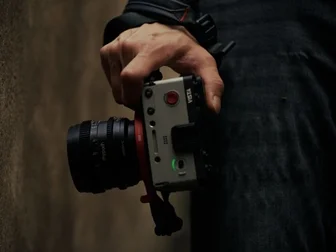
Kinefinity finally shipped the camera they have been teasing since NAB.
I remember standing in front of the Kinefinity booth at NAB 2026, looking at a small box under glass with a "Vista" sticker. The rep told me it would ship before summer. I was skeptical — Kinefinity has a history of announcing things early and delivering late. So when I saw the Weibo post this morning saying the 维塔 was on sale in China, I had to check twice.
What you actually get for the money
Let me put the specs in plain terms, because the marketing copy is dense. The Vista is a 610-gram box — about the weight of a 70-200mm f/2.8 lens with the hood on. Inside is a full-frame 6K sensor shooting 6016 × 3984 in open-gate 3:2. That aspect ratio is the headline feature: you can reframe for vertical, for anamorphic, for 2.39:1 cinema, all from the same take, with no crop.
It does 6K at 50fps, drops to 4K Super 35 at 100fps for slow motion. Dual base ISO at 800 and 5120, which means you can shoot daylight with the 800 and dim interiors with the 5120 without your footage falling apart. Fourteen stops of dynamic range, which is in the same neighborhood as a Sony FX3 or a Canon C70 — not a Venice, but for the price it should not be.
The things that actually matter for solo work
Most "cinema cameras" in this size bracket skimp on I/O. Kinefinity did the opposite. Two full-size HDMI ports, two USB-C ports that both run at full speed (so you can power an external monitor while offloading footage to the same port), built-in Wi-Fi and Bluetooth, a CFexpress Type B slot, and a built-in 220GB SSD that records on power-up.
The built-in SSD is the bit that got me. You can hand the camera to a client, they shoot a wedding, they hand you back the camera, and you already have the footage. No media to lose, no cards to format, no "I forgot to bring a spare." For solo event shooters and documentary work, that is a real workflow change.
Storage can also dual-record simultaneously to SSD + CFexpress. On-camera backup. Kinefinity has been quietly building redundancy into their cameras for a while, and the Vista is the first time it shows up at this price.
The monitor situation is finally solved
The 4-inch 700-nit flip-out OLED is bright enough to see outdoors. Most built-in monitors on small cameras are 400 nits, which is fine indoors and useless in daylight. 700 is not flagship-monitor bright, but it is "I can frame this without a hood" bright. The 3:2 aspect ratio of the screen means you can see the full open-gate frame with status info above and below — no overlay eating into your image.
Pricing, and what the early-bird math looks like
In China, the early bird is ¥12,900 (roughly $1,799 at current rates), MSRP ¥16,900 (around $2,360). Globally, Kinefinity is listing the early bird at $1,999 with MSRP at $2,499. Shipping starts June 20 in China; international is "3–8 weeks" according to the US site.
For comparison: a Sony FX30 body is about $1,800, a FX3 is $3,900, a Canon C70 is $3,500. The Vista is not the cheapest full-frame camera you can buy, but it is the cheapest one that shoots open-gate 6K with a built-in monitoring system and a professional codec path. At $1,999 early bird, it undercuts the closest competitors by $500 to $1,000.
Who this is for — and who should pass
Buy this if you are a solo filmmaker or a small-crew event shooter who wants a true cinema sensor and codec pipeline in a body you can handhold all day, mount on a small gimbal, or throw in a bag without thinking about it. The dual USB-C + built-in SSD alone is a productivity win for documentary and event work.
Skip this if you already own an FX3 or a C70 and are happy. Both have better autofocus and stronger lens ecosystems. Skip it if you need internal ND filters — the Vista does not have them, and that is the one spec that surprised me. For variable light, you are back to screw-on NDs or electronic shutter tricks.
Skip it if you are a studio or narrative filmmaker who needs raw output, dual XLR audio, or a global shutter. The Vista is built for run-and-gun, not for soundstage work.
My take after one hour with the press materials
I have not held one yet — international shipping is "3–8 weeks" and I have not pre-ordered. But I have shot with Kinefinity cameras for years (the MAVO Edge is my B-cam), and the build quality and UI tend to be honest. If the Vista delivers on the dynamic range and the dual-record workflow at the price Kinefinity is asking, this is going to be the most disruptive sub-$2,500 cinema camera since the original Blackmagic Pocket 4K.
If you have been waiting for a full-frame open-gate cinema camera that does not require a separate monitor, a separate media reader, or a separate budget line for batteries, the wait is over.