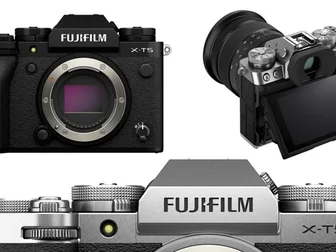
Six months. That's how long the Fujifilm X-T5 has been riding in my bag next to my Lumix GH7, and I keep flipping between them like a guy who can't decide which kid he likes more. This isn't a spec dump — I've done those, you don't need another one. This is what it's actually like to drag the X-T5 through six months of Hong Kong streets, rainy alleys in Mong Kok, a wedding in Sai Kung, two commercial shoots, and way too many late-night walks with my dog.
The honest answer up front: I didn't expect to like the X-T5 as much as I do. I came into it kind of skeptical because Fuji's been hyping their film simulations for years and I assumed it was marketing fluff. Spoiler — it's not. But the camera also has some quirks that legit pissed me off, especially coming from my GH7 + OM 12-40mm f/2.8 PRO II setup. Let me walk you through the real stuff.
Why I even picked up an X-T5
I shoot hybrid. Mostly photo, sometimes video. The GH7 has been my workhorse since it launched, and the OM 12-40mm stays glued to it for about 90% of what I do. It's small, it's tough, the IBIS is bonkers, and the files grade beautifully in DaVinci Resolve. I'm not switching systems. But I wanted a dedicated stills body for street work — something with a real viewfinder, proper dials instead of touch menus, and a color science I could trust for out-of-camera JPEGs.
Every Fujifilm photographer on the internet kept saying "the X-T5 changed everything" so I grabbed one used from a buddy. Six months later, here we are.
The first thing that surprised me: size and weight
I knew it was small. I didn't realize how small. With the XF 23mm f/2 WR lens on it (my usual street combo), the whole rig fits in my jacket pocket. Not literally, but it feels like nothing in a sling bag. My GH7 + 12-40mm combo is already pretty compact, but the X-T5 is in a different league. On a humid day in Wan Chai when I'm sweating through my shirt, every gram matters.
That said — the grip is a little shallow for my hands. I wear large gloves sometimes (I shoot in light rain a lot, those thin surgical gloves don't cut it), and my pinky hangs off the bottom. Not a deal-breaker, but I noticed it within ten minutes.
Dials. Real, actual, physical dials.
This is the part Fuji fans won't shut up about, and yeah, they're right. ISO dial on top. Shutter speed dial on top. Exposure comp dial on top. Aperture on the lens. Drive dial on the left. I haven't touched a menu in weeks except to format a card.
Coming from the GH7 — which is amazing but heavily menu-driven, especially for stuff like AF modes — this is genuinely refreshing. When someone walks past me doing something interesting in Kowloon at 8pm, I can change three settings in the time it takes my GH7 to even wake up.
But here's the catch: the dials click firmly, which is good. They also lock sometimes, which is annoying. The exposure comp dial in particular has a habit of getting bumped in the bag, and I've come back with a bunch of shots at -2/3 EV that I didn't ask for.
Image quality: this is where it wins
40 megapixels on an APS-C sensor. That's a lot. My GH7 is around 25MP on M4/3, so the file is genuinely bigger. Cropping is a superpower. I shot a candlelit dinner scene last month, framed wide, then cropped 50% in post for an alternate tighter composition. The detail held up. I couldn't have done that with my M4/3 files at the same crop.
Dynamic range is also noticeably better than my GH7, especially in the shadows. I was shooting into a sunset on a beach in Clearwater Bay and I could pull back the foreground exposure by almost two stops without the noise getting ugly. With my GH7 in the same scenario, I'd start seeing banding around one stop pulled.
But — and this matters — the files are noisier than full-frame at high ISO. By ISO 6400 on the X-T5 you're definitely seeing grain. My friend's Sony A7 IV at the same ISO looks cleaner. But Fuji grain has character. It looks like Tri-X pushed to 1600, not like ugly digital mush. I actually like it.
Autofocus: the biggest gap from my GH7
Okay, this is where I have to be honest. The X-T5's AF is good. It's not great. Coming from the GH7's phase-detect system which is honestly class-leading for the price, the Fuji feels a step behind in three specific situations:
Eye AF for fast-moving subjects — kids running around at a friend's birthday party, my dog chasing a ball, that kind of thing. The X-T5 finds the eye maybe 80% of the time. The GH7 finds it 95%+ of the time.
Low contrast scenes — foggy mornings, shade under awnings. The Fuji hunts more than the GH7 does. Not painfully, but noticeably.
Video AF — I tried using the X-T5 for a 20-minute interview and it drifted twice in 20 minutes. The GH7 would have nailed it.
For street photography specifically — which is mostly static or slow-moving subjects — this isn't a problem. The X-T5 is more than capable. But if your main thing is sports, wildlife, or anything fast, test before you commit.
Film simulations: the secret weapon
This is the part I was skeptical about and now I'm a convert. Fuji's film simulations — Provia, Velvia, Classic Chrome, Acros — are baked into the JPEGs. Out of camera. No Lightroom needed. No Capture One. No fussing.
For street work, I shoot almost exclusively in Classic Chrome or Acros (the black and white one). The colors look like they came out of a real darkroom print, not like a "filtered" Instagram image. I sent a batch of street shots to a magazine last month — they picked three without asking for RAWs. The JPEGs were good enough to publish as-is.
This is genuinely useful when I'm traveling and don't want to spend hours editing. Pull the SD card, dump it, post. With my GH7 I always shoot RAW + JPEG because the out-of-camera colors are kinda flat and need work. With the X-T5 I just shoot JPEG.
The things that genuinely annoyed me
Battery life. The NP-W235 is fine, but not great. I get about 350-400 shots per charge. My GH7 does 500-600. If I'm out all day shooting street, I bring three batteries for the Fuji and two for the GH7. Not a deal-breaker but worth knowing.
The Q menu is slow. Buried three button presses deep sometimes. I customize the heck out of every camera I own and I still hit the menu way more often on the X-T5 than I'd like.
No flip screen for vertical shooting. It tilts, which is great for waist-level street work. It does NOT fully articulate. If you shoot a lot of vertical video or want to vlog, look elsewhere.
The shutter is loud-ish. Not Leica loud, but louder than the GH7's silent electronic shutter. For discreet street work this matters.
How I actually use it now
After six months, here's my real workflow. The X-T5 lives in a small Billingham bag with the XF 23mm f/2 and the XF 35mm f/1.4. It comes out when I'm doing street, when I'm doing travel, when I want to be discrete. The GH7 stays home for commercial gigs, video, and anything that needs fast AF.
I won't lie — there are days I grab the X-T5 over the GH7 even for stuff that doesn't need its specific strengths. The dials, the colors, the size — it just makes me want to shoot more. And that's worth something. A camera that makes you shoot more is better than a camera with better specs that lives in your bag.
My final take
If you're a street photographer, a travel photographer, or someone who just wants beautiful JPEGs without spending hours in post, the X-T5 is one of the best values in mirrorless right now. Get the XF 23mm f/2 or the XF 35mm f/1.4 and you've got a kit that fits in a jacket pocket and shoots photos you'd be proud to print large.
If you shoot a lot of video, sports, or anything fast-moving, look at the GH7 or a Sony body instead. The X-T5's AF isn't bad, it's just not best-in-class.
Six months in. Still grabbing it. Probably will for another six. That's the highest compliment I can give a camera.
If you want to nerd out on the dynamic range numbers, Gerald Undone did a great video on it —
One more thing: the lens ecosystem
I should mention this because it's where Fuji actually wins versus the alternatives. The XF lens lineup is mature. There's a focal length and price point for basically everyone, and the used market is healthy. I picked up the XF 35mm f/1.4 R (the older version, not the WR) for like $400 used and it's one of my favorite lenses I've ever owned. The character is gorgeous, the focus throw is just right for zone focusing on the street, and it's built like a small tank.
Compare that to my OM 12-40mm f/2.8 PRO II — also a fantastic lens, but it's a $900 zoom. The Fuji prime lens lineup lets you build a small, fast, character-rich kit for way less money. If I lost everything tomorrow and had to rebuild on a budget, Fuji would be high on the list specifically because of the lens ecosystem.
Real talk: who this camera is NOT for
I want to be fair to anyone reading this who's trying to make a decision. The X-T5 is not for you if:
You shoot a lot of action or wildlife. The AF buffer and tracking are okay, not great. A used Sony A9 II or a Canon R6 II will serve you better.
You need the best video specs in a stills body. The X-T5 shoots 6.2K open gate which is genuinely useful, but it has the same 30-minute record limit and the AF is meh in video. A GH7, a Fuji X-H2S, or a Sony A7S III is the right tool.
You want a fully articulating screen. The X-T5's three-way tilt is brilliant for stills. It does not flip forward. If you vlog or shoot vertical video for social, this isn't your camera.
You're coming from full-frame and won't accept the high-ISO noise. The X-T5 is clean through ISO 3200 and totally usable at 6400. By 12800 it's noisy. A full-frame body will be cleaner at equivalent exposures.
If none of those apply to you, read on.
Compared to my GH7 + 12-40mm combo, specifically
Since this is what I actually carry, let me put them head to head for a real street photographer's day:
Weight (body+lens): X-T5 + 23mm f/2 is about 720g, GH7 + 12-40mm f/2.8 PRO II is about 890g.
Out-of-camera JPEG quality: X-T5 is excellent, GH7 is mediocre (needs post).
AF speed for street: X-T5 is very good, GH7 is excellent.
IBIS effectiveness: X-T5 gives ~7 stops, GH7 gives ~8 stops.
Battery life: X-T5 gets ~350 shots, GH7 gets ~550 shots.
Dials vs menus: X-T5 is all dials, GH7 is mostly menus.
Video capability: X-T5 does 6.2K (decent), GH7 does 4K 60p (excellent).
Weather sealing: both good.
Color science out of camera: X-T5 is stunning, GH7 needs work.
Both are real tools. Both get used. They just get used for different jobs.
What I'd want in a successor
If Fuji ever makes an X-T6, here's my wishlist:
Better subject-detect AF (the X-T5 got better with firmware but still trails Sony/Canon)
A fully articulating screen option (or a separate X-T5 variant)
Slightly deeper grip
USB-C charging that actually works well while shooting
A joystick that doesn't feel like it's made of recycled bottle caps
None of these are deal-breakers. The X-T5 as it stands today is genuinely excellent. I just want to see Fuji keep pushing.
Final word
I've owned a lot of cameras in fifteen years of shooting. Some I used for a few months and sold. Some I held onto forever. The X-T5 is in the second category. It made me slow down, look around, and shoot more deliberately — which is exactly what a street camera should do.
If you grab one, shoot it for at least a month before deciding. The Fuji color science and the dial-based operation feel weird for the first week, then they feel like home. That's when you'll know if this camera is for you.
— Leo