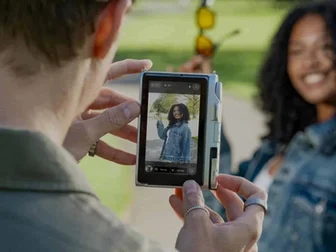
The original instax mini Evo was the rare gadget that made printing feel like part of the shooting instead of a chore at the end. Late on October 26, Fujifilm announced its successor: the instax mini Evo 2, a hybrid instant camera that keeps the retro dials and the print-only-the-good-ones logic, and adds the one thing the original was missing — a screen you can actually compose on.
What changed
The headline hardware upgrade is the display. The Evo 2 carries a 4.5-inch LCD touchscreen that dominates the back of the camera, replacing the original's much smaller panel. Composition, the 100-effect menu system, and playback all run through it now, while the lens dial, film dial, and print lever keep the tactile ritual intact.
Underneath, the sensor grows from the original's 1/5-inch to a 1/2.77-inch unit, according to Digital Camera World, which tested the camera ahead of launch. In standard mode images come out around 6.13 megapixels (2860 x 2144); a new wide-angle lens effect uses more of that sensor and, with a microSD card installed, outputs up to 12.8 megapixels. DCW's verdict after shooting with it: quality is improved over the original, but this still sits squarely in the low-fi compact category. Nobody is buying an instax for the sensor, and Fujifilm knows it.

The creative system is the point. Ten lens effects and ten film effects combine into 100 looks, including double exposure, light leak, lens blur, and half-frame diptych modes, plus a new after-image mode that fires a second shot right after the first and overlays the two. A new instax Expanded View feature shows a wider field of view than the actual frame, with an on-screen white box marking what will be captured — peripheral vision for a camera that otherwise crops the world to a credit-card-sized print.
The four-second catch
The other new trick is instax Immersive Movie. With a microSD card installed, the Evo 2 automatically records the four seconds leading up to every shutter press and wraps the clip in an instax frame animation. It's clearly aimed at behind-the-scenes social posts, and it comes with a real tradeoff: in that mode, the still photo drops from 2860 x 2144 down to 616 x 464 pixels, per DCW's hands-on. Four seconds of motion for a quarter of the resolution. That's a party trick, not a feature you'll leave on.
Printing is unchanged in the ways that matter: 600 dpi output on instax mini film, a choice between the vivid instax-Rich mode and the more muted instax-Natural mode, and the analog print lever that made the original satisfying to use. The companion app still turns the camera into a phone printer and a remote shutter, and now organizes printed frames into a digital gallery you can annotate.

The tension Fujifilm is betting on
I've never owned an instax — my film budget goes elsewhere — but the mini Evo has always struck me as the smartest product in the line, because the hybrid design solves the actual problem with instant film: every wasted frame costs real money. Shooting digital first and printing selectively isn't a compromise; it's the whole argument.
What interests me about the Evo 2 is the tension it's carrying. The brand identity is analog dials and physical prints, and the headline upgrade is a smartphone-sized touchscreen. Fujifilm is betting those two things reinforce each other rather than cancel out — that the screen makes the 100-effect system usable enough that people actually explore it instead of leaving the camera on one setting forever. If you assume most owners never explore past one or two effects — a fair assumption for a camera that gets passed around at parties — that bet makes sense. Whether a 4.5-inch display makes the camera feel more like a toy and less like an object is the thing I genuinely can't call without holding one.
The context worth noting: the mini Evo Cinema was named to TIME's Best Inventions of 2026 list just days ago, on October 23 — the second straight year an instax hybrid has made that list. Instant film is not a nostalgia side-business for Fujifilm anymore, and the Evo 2 is priced like a product the company expects to sell in volume.
Price and availability
The instax mini Evo 2 launches in black only, at $289.95 USD, £229.99, or CA$379.99 — a little higher than the original Evo's launch price, per DCW, and still well under the $349 WIDE Evo. Shipping starts at the end of November 2026. In the box: a shoulder strap, a USB-C charging cable, and a one-year warranty. The microSD card you'll want for Immersive Movie and the wide-angle mode is, of course, sold separately.