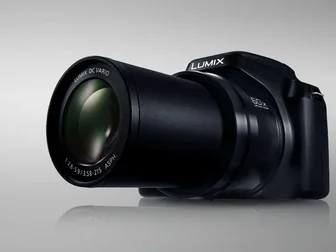
Quick Verdict & 2026 Value Proposition
Announced in mid-2024 as the modern refresh of the best-selling FZ80 (2017), the **Panasonic Lumix DC-FZ80D** occupies a rare and valuable niche in modern digital photography. In an era where smartphone cameras have eliminated basic compact cameras, the FZ80D offers something no phone can physically replicate: a staggering **60x optical zoom lens covering 20mm ultra-wide to an astronomical 1200mm super-telephoto equivalent**.
Panasonic updated the camera with critical modern essentials: **universal USB-C charging**, a dramatically upgraded **2.36M-dot OLED electronic viewfinder**, and a sharper **3.0-inch 1.84M-dot touch LCD monitor**.
At an MSRP of **$479 USD new ($340–$390 USD used)**, is the FZ80D the right camera for you? If you need low-light indoor capability, no—its 1/2.3-inch sensor degrades quickly above ISO 800. But if you want a lightweight, all-in-one daylight travel, safari, and backyard birdwatching tool that pulls distant wildlife right into your lap without changing lenses, the FZ80D is unmatched in its price class.
Buying Decision | Summary
**Buy if...** | You want genuine 1200mm optical zoom reach for daylight wildlife, birding, moon photography, and travel landscapes without carrying a heavy telephoto camera bag.
**Skip if...** | You primarily shoot in dim indoor lighting, night scenes, or require shallow portrait background blur (get an interchangeable-lens MFT camera instead).
**2026 Value Rating** | **8.9 / 10** for budget superzoom reach & daylight safari; **4.5 / 10** for low-light versatility.
Price & Market Availability (November 2026)
Key Hardware Upgrades: FZ80D vs Original FZ80 (2017)
Feature | **Original Lumix FZ80 (2017)** | **New Lumix FZ80D (2024/2026)** | Practical Advantage
**Charging Interface** | Proprietary Micro-USB 2.0 | **Universal USB Type-C** | Charge with any modern smartphone cable or portable power bank.
**Electronic Viewfinder** | 1.17M-dot LCD EVF (0.46x) | **2.36M-dot OLED EVF (0.74x)** | **2x sharper view**; bright OLED contrast makes framing 1200mm subjects easy.
**Rear Touchscreen LCD** | 3.0" 1.04M-dot LCD | **3.0" 1.84M-dot Touch LCD** | Crisp image playback and touch-to-focus operation.
**Optical Zoom Range** | 20-1200mm equivalent (60x) | **20-1200mm equivalent (60x)** | Identical proven 14-element Leica-designed optical formula.
Key Technical Specifications
Parameter | Official Specification | Practical Impact
**Sensor** | 18.1MP 1/2.3-inch High Sensitivity MOS | Delivers sharp daylight detail; ISO noise becomes visible above ISO 800.
**Lens Range** | **20mm Ultra-Wide to 1200mm Super-Telephoto (60x)** | 20mm is wider than most bridge cameras (typically 24mm); 1200mm reaches distant birds.
**Maximum Aperture** | **f/2.8 (wide) – f/5.9 (telephoto)** | Relatively bright at 20mm; drops to f/5.9 at 1200mm, requiring good daylight.
**Optical Stabilization** | **Power O.I.S. (Optical Image Stabilizer)** | Essential for keeping handheld framing stable at extreme 1200mm magnification.
**Video Capabilities** | 4K UHD (3840 x 2160) at 30p; FHD 1080p at 60p | Crisp 4K video recording; 4K Photo modes extract 8MP stills at 30 fps.
**Continuous Burst** | 10 fps (AF-S) / 6 fps (AF-C) mechanical | Capable of tracking moving wildlife across open fields.
**Macro Capability** | 1 cm (0.4 inch) minimum focus distance | Allows extreme close-up macro shots of insects and flowers at 20mm.
**File Formats** | **RAW (.RW2)**, JPEG, RAW+JPEG | RAW support allows recovering shadow details and applying modern AI denoising in post.
**Battery & Charging** | DMW-BMB9 battery; **In-camera USB-C charging** | Convenient charging on the go; ~330 shots per charge using the LCD.
**Weight & Dimensions** | 130.2 x 94.3 x 119.2 mm; **640g (with battery & SD)** | Comfortable ergonomic DSLR-style handgrip that provides two-handed stability.
The Optical Reality: FZ80D vs Smartphone Telephoto
Many photographers ask: *“Why carry a bridge camera when modern smartphones have 5x or 10x telephoto lenses?”*
Here is the engineering reality: 1. **True Optical Glass vs Digital Cropping:** A flagship smartphone typically features a 5x optical telephoto lens (~120mm equivalent). When a phone zooms to "30x" or "100x", it is not zooming optically—it is digitally cropping a tiny portion of the sensor and using generative AI algorithms to "paint" guessed details. The results often look smudged, waxy, and synthetic. 2. **Real 1200mm Light Gathering:** The FZ80D physically shifts 14 glass elements inside a motorized optical barrel to deliver a genuine 1200mm optical field of view. The feathers on a hawk's wing or the craters on the moon are real optical photons gathered by glass, not AI hallucination. 3. **Ergonomic Stability:** Holding a flat glass phone steady at 1200mm is nearly impossible. The deep rubberized grip of the FZ80D and eye-level OLED viewfinder allow you to brace your elbows against your chest, providing rock-solid triangulation.
Tips for Getting the Sharpest Images at 1200mm
Target Audience & Final Recommendation
- Safari and national park travelers who want an all-in-one camera that covers sweeping landscapes (20mm) and distant mountain goats (1200mm) without swapping lenses in dusty conditions. - Backyard birders and moon photography enthusiasts on a strict sub-$500 budget. - Photography beginners wanting to learn manual exposure controls with modern USB-C charging convenience. - **Who Should Look Elsewhere:** Photographers needing indoor low-light party/event photos, or creators wanting professional shallow depth of field.