Quick Verdict & 2026 Buyer's Snapshot
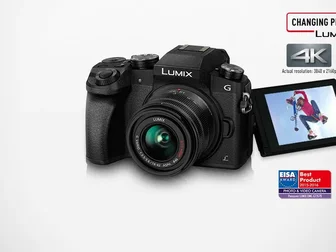
Originally released in 2015, the **Panasonic Lumix DMC-G7** made history by bringing internal 4K video recording to a consumer price point. In 2026, it remains one of the absolute cheapest ways to get clean, uncropped 4K UHD video, a fully articulating touchscreen display, a dedicated 3.5mm external microphone input, and physical manual controls for around **$200 to $260** on the used market.
Buying Decision | Summary
**Buy if...** | You need a dedicated budget 4K YouTube/talking-head studio camera on a tripod, an affordable webcam streaming setup via HDMI, or an inexpensive body to learn manual camera exposure controls for under $250.
**Skip if...** | You shoot handheld run-and-gun video without a gimbal (the G7 has **no In-Body Image Stabilization**), require fast continuous autofocus for moving subjects, or need in-camera USB battery charging.
**2026 Value Rating** | **8.8 / 10** for ultra-budget stationary video & learning; **5.2 / 10** for handheld run-and-gun work.
Price & Market Availability (November 2026)
Because the Lumix G7 was mass-produced for many years and sold extensively in beginner kits, supply on the used market is abundant and prices are exceptionally attractive.
*Important Buying Note:* The Lumix G7 **cannot charge its battery via USB**. Always ensure your used purchase includes an original Panasonic DE-A99 AC wall cradle charger, or budget $15–$20 for a compatible dual-slot wall charger and two spare DMW-BLC12 batteries.
Key Technical Specifications
All parameters below are cross-referenced directly against official Panasonic technical service manuals and CIPA compliance documentation.
Parameter | Official Specification | Practical Impact
**Sensor** | 16.0MP Digital Live MOS (17.3 x 13.0 mm) | With Optical Low-Pass Filter (OLPF). Standard 4/3 aspect ratio with 2.0x crop.
**Lens Mount** | Micro Four Thirds (MFT) | 19.25mm flange distance; compatible with hundreds of native and adapted manual lenses.
**Stabilization** | **NONE (No IBIS)** | **Critical Limitation:** Handheld stability relies 100% on lens O.I.S. or external gimbals.
**Shutter System** | Mechanical focal plane shutter | Mechanical: 1/4000s – 60s, Bulb (up to 2 min). Electronic: up to 1/16000s.
**Viewfinder (EVF)** | 2.36M-dot OLED Live View Finder | 100% field of view, 0.70x magnification (35mm equiv). Crisp OLED panel with high contrast.
**Rear Monitor** | 3.0" 1.04M-dot Free-Angle Touchscreen | Swivels out to the side, rotates 270°, and flips forward 180° for self-monitoring/vlogging.
**Autofocus** | Contrast-Detect with DFD (49 areas) | Snappy single-AF; tends to hunt/pulse during continuous AF tracking in 4K video.
**Video Modes** | 4K UHD (3840x2160) at 30p/25p/24p | 100Mbps MP4. Features a slight **~1.18x crop** (effective 2.36x full-frame multiplier).
**Audio I/O** | **3.5mm external mic jack**; stereo mic | Direct microphone input enables high-quality audio recording. **No headphone jack.**
**Battery Life** | DMW-BLC12 (7.2V, 1200mAh) | CIPA: approx. 350 shots (rear monitor), 360 shots (EVF). Good battery stamina.
**Charging Port** | **No in-camera USB charging** | Requires external AC wall cradle charger. USB port is micro-B for data only.
**Dimensions & Weight** | 124.9 x 86.2 x 77.4 mm; 410g (with battery) | Lightweight polycarbonate body with deep ergonomic SLR-style grip.
How the G7 Compares to Alternatives
Metric | **Panasonic Lumix G7** | **Panasonic Lumix G85 (G80)** | **Canon EOS M50 / M50 II**
**Sensor** | 16.0MP M4/3 (with OLPF) | 16.0MP M4/3 (no OLPF) | 24.1MP APS-C CMOS
**In-Body Stabilization** | **None** | **5-axis Dual I.S. 2 (~5 stops)** | None (Electronic Digital IS only)
**Body Construction** | Polycarbonate; Not sealed | Magnesium-alloy front; **Weather-sealed** | Polycarbonate; Not sealed
**Shutter Type** | Mechanical spring shutter | Electromagnetic drive (no shock) | Mechanical focal plane
**Screen Type** | 3.0" Free-Angle Touchscreen | 3.0" Free-Angle Touchscreen | 3.0" Vari-Angle Touchscreen
**4K Video Crop** | **~1.18x crop** | **~1.18x crop** | **Heavy ~1.56x crop** (total 2.5x)
**Autofocus in 4K** | Contrast DFD (pulses) | Contrast DFD (pulses) | Contrast only (Dual Pixel disabled in 4K)
**Microphone Jack** | **Yes (3.5mm)** | **Yes (3.5mm)** | **Yes (3.5mm)**
**Typical 2026 Used Price** | **$200 – $260** | **$320 – $400** | **$380 – $460**
**The Verdict** | Best sub-$250 budget studio camera | The superior all-rounder if budget permits | Good 1080p vlogging, but discontinued mount
How We Evaluated This Camera
*Transparency Statement:* This article is an independent **Research-based buyer’s guide**. Our evaluation synthesizes official Panasonic technical documentation, circuit schematics, verified optical crop calculations, and thousands of aggregated user and repair reports from the photography community. LensClear does not claim current hands-on laboratory testing for this legacy camera, and no fabricated sample photographs or synthetic AI images are used in this guide. All imagery displayed represents official manufacturer product photography.
Why the Lumix G7 Still Dominates the Sub-$250 Video Market
In 2026, most sub-$300 used cameras are limited to 1080p recording, lack external microphone inputs, or crop their video sensors heavily. The Lumix G7 breaks that mold by delivering:
1. Sharp 100Mbps 4K UHD Video
The G7 captures 4K UHD (3840x2160) at 30p, 25p, and 24p using a full-pixel readout from an 8-megapixel region of the sensor. With a mild crop of only ~1.18x, it produces crisp, detailed 4K footage that looks substantially sharper than the soft 4K found on older budget cameras. It also includes the **Cinelike D** and **Cinelike V** picture profiles, giving videographers a neutral color profile for grading in DaVinci Resolve or Premiere Pro.
2. Fully Articulating Display
The 3.0-inch 1.04-million-dot touchscreen LCD is mounted on a side hinge, allowing it to swivel out to the side and rotate forward a full 180 degrees. For solo video creators, YouTubers, and educators recording tutorials, this allows effortless framing verification without an expensive external monitor.
3. Dedicated 3.5mm Microphone Input
Poor audio ruins video faster than poor image resolution. The G7 includes a standard 3.5mm TRS stereo microphone jack positioned cleanly on the left side of the body, allowing you to mount a Rode VideoMic, wireless lavalier receiver, or podcast microphone directly to the hot shoe.
Crucial Hardware Caveats You Must Understand
While the G7 offers extraordinary value, buyers must account for three significant hardware compromises before purchasing:
1. No In-Body Image Stabilization (IBIS)
Unlike the Lumix G85, GX85, or GX9, the G7 has **no sensor-shift stabilization**. If you shoot handheld video with an unstabilized lens (such as the Panasonic 20mm f/1.7 or an adapted vintage lens), your footage will exhibit noticeable micro-shakes and jitter. For video work, you must either: - Keep the camera on a sturdy tripod or desk mount. - Use lenses equipped with **Mega O.I.S.** or **Power O.I.S.** (such as the 14-42mm f/3.5-5.6 II or 12-60mm f/3.5-5.6). - Mount the camera to a motorized 3-axis gimbal.
2. Video Autofocus Hunting (Contrast DFD)
Panasonic's Depth From Defocus (DFD) autofocus is very fast for single stills (AF-S). However, during continuous video autofocus (AF-C), the system constantly nudges the focus slightly back and forth to measure contrast changes, causing visible background "pulsing" or "breathing." For professional results, experienced G7 creators set the camera to manual focus (MF) with focus peaking enabled, or use single-tap autofocus before hitting record.
3. No In-Camera USB Charging
The G7 does not support USB charging. You must remove the DMW-BLC12 battery and insert it into an AC wall cradle charger. For studio desk setups, many creators purchase an inexpensive AC dummy battery (DC coupler) that plugs directly into a wall outlet for unlimited recording time.
Best Lens Pairings for the Lumix G7
1. **Lumix G Vario 14-42mm f/3.5-5.6 II ASPH Mega O.I.S.:** The ideal budget starter zoom (28–84mm equiv.). Compact, optically stabilized, and usually adds only $50–$60 to the cost of a used G7 body. 2. **Panasonic Lumix 25mm f/1.7 ASPH:** A 50mm equivalent "nifty fifty" prime lens. Costing around $100–$130 used, its bright f/1.7 aperture delivers beautiful background blur (bokeh) for seated talking-head video and low-light portraiture. 3. **Lumix G Vario 12-60mm f/3.5-5.6 ASPH Power O.I.S.:** A superior all-in-one zoom (24–120mm equiv.) with faster autofocus, robust optical stabilization, and wider wide-angle coverage for desk setups.
Frequently Asked Questions (FAQ)
Does the Lumix G7 have a 30-minute recording limit?
Yes. Like most cameras of its era, European and North American consumer models have a continuous clip recording limit of 29 minutes and 59 seconds per file in 4K and Full HD. For longer continuous live streaming, the G7 provides clean HDMI output to a capture card (like an Elgato Cam Link) without any time limit.
Can the Lumix G7 be used as a webcam for streaming?
Yes. The Lumix G7 features a micro-HDMI port that can output clean 1080p video with on-screen display icons disabled. Connected to an HDMI-to-USB capture card, it serves as a high-end webcam for Zoom, Twitch, and YouTube broadcasting.
Is the Lumix G85 worth the extra $120 over the G7?
If you shoot handheld video or shoot outdoors in bad weather, **yes**. The G85 adds 5-axis In-Body Image Stabilization (Dual I.S. 2), a weather-sealed magnesium-alloy body, and an electromagnetic shutter. If you shoot exclusively on a tripod in a home studio, the G7 provides identical 4K video quality for significantly less money.