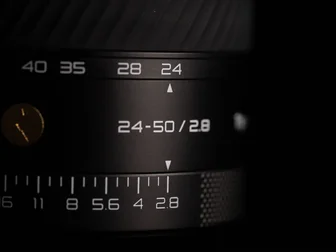
Thypoch's 24-50mm f/2.8 Voyager Lands on Nikon Z: The First AF Thypoch on the Mount, With No Native Equivalent
Thypoch is bringing the Voyager 24-50mm f/2.8 to Nikon Z, Nikon Rumors reports, after a test page appeared on the Chinese optical brand's own store. The lens already ships in Sony E — the same 16-element, 13-group, 432-gram constant-aperture zoom — and the Z version is described as "coming soon," with no firm Z price yet.
For Nikon shooters, the gap this fills is the headline. The Z system does not have a native 24-50mm f/2.8. Nikon's own 24-50mm f/4-6.3 sits at $450 and stops down past f/4 on the wide end. The closest third-party constant f/2.8 zoom has been the Tamron 24-70mm f/2.8 — bigger, heavier, twice the price. A 24-50mm f/2.8 is the focal range most of us live inside anyway: 24 for street, 35 for documentary, 50 for portraits.
What Thypoch built
The Voyager is the first full-frame autofocus zoom made by a Chinese optical brand, and Thypoch's first AF lens at all. The company built its name on manual-focus Simera cinema primes, so going straight to AF — and skipping AF primes entirely — is a deliberate bet on the zoom form factor.
The optical formula is 16 elements in 13 groups: two ASPH, three ED, three HRI. Aperture is 10 rounded blades. The barrel is internal-zoom, so physical length stays fixed across the focal range — a real-world advantage for video shooters who need to keep hood-mounted filters or matte boxes in the same plane.
It weighs 432 grams, measures 92.88mm long, takes 67mm filters, and has a USB-C port on the mount for firmware updates. Weather sealing is light-rain rated, not submersion rated.
The Z angle
Three things make this Z version a story beyond the lens itself. First, it's Thypoch's first AF lens on any Nikon-mount lineup, which had been manual-focus only up to now. Second, it's the first full-frame constant f/2.8 zoom on Z under 600 grams — the Tamron 24-70mm f/2.8 Di III VXD G2 is 1,085g; Nikon's own Z 24-70mm f/2.8 S is 805g. Third, the E-mount MSRP of $649 undercuts Sony's own FE 24-50mm f/2.8 G — which PetaPixel pegs at $1,198 after a recent $100 discount — by almost half.
The Z price is the open question. Thypoch's E-mount MSRP is $649, with a launch-period price of $619 from May 14 to May 31, 2026. The Z version hasn't published a price yet, but the 67mm filter, 432g weight, and 16/13 optical formula are spec-sheet identical, so a Z MSRP in the same neighborhood is the reasonable bet.
What's not yet confirmed
Three things to watch. The Z-mount MSRP — Thypoch has not posted it on its store or newsroom, only the test-page signal Nikon Rumors spotted. The autofocus drive and stepping-motor architecture — Thypoch has not named it, and the E-mount version's AF behavior on Sony bodies is the only public reference. And firmware — the USB-C port exists, but Thypoch has not said whether the Z launch ships on the latest firmware or whether Z users will need an early update.
Why it matters for Z shooters
If the Z MSRP lands at $649, it undercuts Tamron's 20-40mm f/2.8 — which Nikon Rumors listed at $729 for Z — by $80 and matches Sony E pricing directly. A 24-50mm f/2.8 at 432g with internal zoom is also a category the Z system did not have, and third-party Chinese lens makers keep being the ones filling those gaps before the camera brands do.
I haven't handled the Voyager on Z yet, but on Sony E, Phillip Reeve's review and OpticalLimits' lab data both confirm the internal-zoom spec and the 432g weight match Thypoch's official numbers. The question for the next few weeks is whether Z autofocus performance matches what Sony E users are already reporting — and that requires a Z body in hand.
— Leo