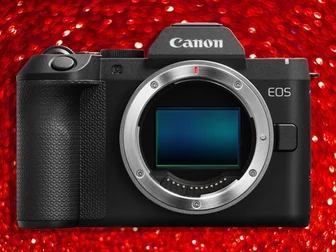
Yodobashi Camera's sales chart for the second half of October put a camera on the podium that had been on sale for three days. Canon's EOS R8 Mark II body finished second in the retailer's interchangeable-lens ranking for 16–31 October, as CAPA Camera Web reported on 21 November. PetaPixel picked the table up on 23 November and read it as a hit.
The window is the story. The R8 II reached Japanese stores on 29 October, which leaves three days of sales inside a fortnight-long chart. It still beat every camera except the Sony a7 V, which returned to first place for the first time in a month after the a7C II zoom kit had taken the previous ranking. Those two Sonys have traded the top spot in every chart since the second half of August, and the a7 V has led seven of the first eight months of 2026 on PetaPixel's count.
The three days that produced a second place
A launch week is not a normal week. Stock lands, pre-orders clear, and the early buyers are the ones who were already waiting. Three days of that can outrank a camera selling steadily for fourteen, which is roughly what happened: the a7 V held first, the R8 II took second, and no other new body came close. CAPA describes the camera as a full redesign, with a squarer body built on straight lines, in-body stabilisation and pre-continuous shooting added, and autofocus pitched at the level of Canon's higher-end models.
None of that is a sales figure. Yodobashi publishes ranks, not units, so the distance between first and second stays invisible, and a table built on three days of pent-up demand says more about launch supply than about the quarters ahead.
Body, kit, kit: one camera in three places
Yodobashi counts body-only sales and lens-kit sales as separate entries, and Canon spread the R8 II across the top ten three times: second for the body, fourth for the RF 24-105mm f/4-7.1 IS STM kit, ninth for the kit with the RF 45mm f/1.2 STM. PetaPixel's reading is that the three entries added together might have taken first from the a7 V. It might have, but the retailer does not publish a combined table, so the claim rests on an assumption about how one camera's three listings would merge.
What the split does show is breadth. Canon put three models and five SKUs into the top ten, Sony two models and three SKUs, Fujifilm two models. The X-M5 with the XC 15-45mm kit climbed from fourth to third, its first top-three finish in two months, and the X-T30 III with the XC 13-33mm kit held sixth.
What a Yodobashi chart can and cannot say
This is one retail chain in one country, and Yodobashi's customers skew enthusiast and professional, so the table is a read on what serious Japanese buyers picked over a fortnight rather than on the global market. The figures are also older than the coverage suggests: the window closed on 31 October, CAPA published on 21 November, and by the time the story travelled it was working from three-week-old data. November's ranking, covering 1–15, will be the first honest test of whether the debut holds.
I have handled the a7 V and the a7C II in a shop, briefly, and what stayed with me is how close those two bodies sit in size while being different cameras in the hand. I have not touched an R8 II, so I have nothing to say about how it feels or how it shoots. The ranking is the only evidence in front of me.
There is a second table worth a glance for the opposite reason. Yodobashi tracks compacts separately, and the Canon PowerShot G7 X Mark III topped it again, seven years after launch, while being routinely out of stock. A camera that keeps selling on scarcity is a different phenomenon from a new body selling on novelty, and both sit in the same retailer's November data.
The R8 II's three entries are the test. A debut can ride a launch weekend into second place; holding three positions in the top ten through November is harder to fake.