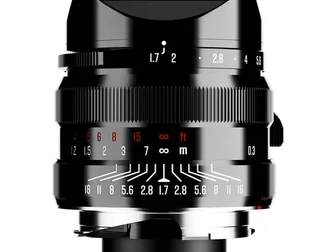
Brightin Star's MF 35mm f/1.7 APO ASPH turns 307 degrees from infinity to its closest focus, and 207 of those degrees sit between 0.7 and 0.3 meters. That is roughly the throw of a cine prime on a stills lens. The product page for the 35mm f/1.7 APO ASPH lists it at $1,099, marked down from $1,199 during a Black Friday promotion the site dates from November 19.
Brightin Star showed the lens at CP+ in February and funded it on Kickstarter in August, according to PetaPixel's report on the launch. It is manual focus only, which puts it in a narrow category: fast M-mount glass from a Chinese maker that is not a rehoused cinema lens.
- Price: $1,099 for Leica M; $1,129 with an adapter
- Mount: Leica M, with adapters for Sony E, Nikon Z, Canon RF, Fujifilm X, Fujifilm GFX and L-Mount

- Optics: 11 elements in 7 groups, including three double-sided aspherical elements, three high-refractive elements and one ED element
- Minimum focus: 0.3m, rangefinder-coupled to 0.7m
- Size: 43mm long, about 260g, 39mm filters
A focus scale built for 0.3 meters
Brightin Star splits the focus throw in two. From infinity to 0.7m, the ring turns 100 degrees. From 0.7m to the 0.3m close-focus limit, it turns another 207 degrees, for 307 in total. The company calls that arrangement cinema style, and the description is accurate: no stills lens needs a third of a turn to cross seven tenths of a meter.
The catch is the rangefinder. Leica's optical rangefinder stops coupling at 0.7m, so the long second half of the throw only functions in live view or on an adapted body. On a film M, the extra travel does nothing. On an M11 or a mirrorless camera through an adapter, it makes close focus something you can set by feel rather than by rocking back and forth, which is the usual method with a short-throw lens at 0.3m.
The first thing I would want to test is whether the long throw holds up in practice, because a 307-degree scale is only useful if the helicoid stays smooth through the transition at 0.7m, where the two ranges meet.
APO without a standard
Brightin Star uses an apochromatic label, and there is no industry definition that governs it. What the company does describe is an eleven-element design in seven groups with three double-sided aspherical elements, six aspherical surfaces, three high-refractive elements and one ED element, plus two floating groups that move independently as the lens focuses. PetaPixel reports the company claims the arrangement minimises focus breathing.
The floating groups matter more than the APO badge for anyone adapting this lens. A 35mm that focuses to 0.3m spends much of its travel near the sensor, and field curvature at close range is the usual failure point for wide-to-normal primes. Independent groups are the standard engineering answer, though whether they correct the problem here needs a test chart and a flat subject.
Brightin Star also says the lens covers the 44×33mm sensor in Fujifilm's GFX bodies. The company does not publish an image circle figure, and coverage of a larger format is a claim that the adapters alone cannot prove. A 35mm on GFX is a 27mm-equivalent wide, so any corner softness or mechanical vignetting would show up immediately.
Brightin Star frames the lens as the first entry in an Apex series, and the quote the company gave PetaPixel leans on the word heritage: "We believe a truly exceptional M-mount lens should never have to choose between heritage and innovation." That is marketing copy, and it points at a specific design choice. The barrel is all metal, the focus and aperture rings are geared for fingers rather than motors, and the dimensions sit close to a classic 35mm rangefinder optic. The internals are not heritage at all: modern high-refractive glass, aspherical surfaces on both sides of three elements, and a floating-group helicoid.
Brightin Star is charging $30 for each adapter, which keeps the adapted price at $1,129 against a native Leica M purchase. A 39mm AERO UV filter is offered as an option on the same page.